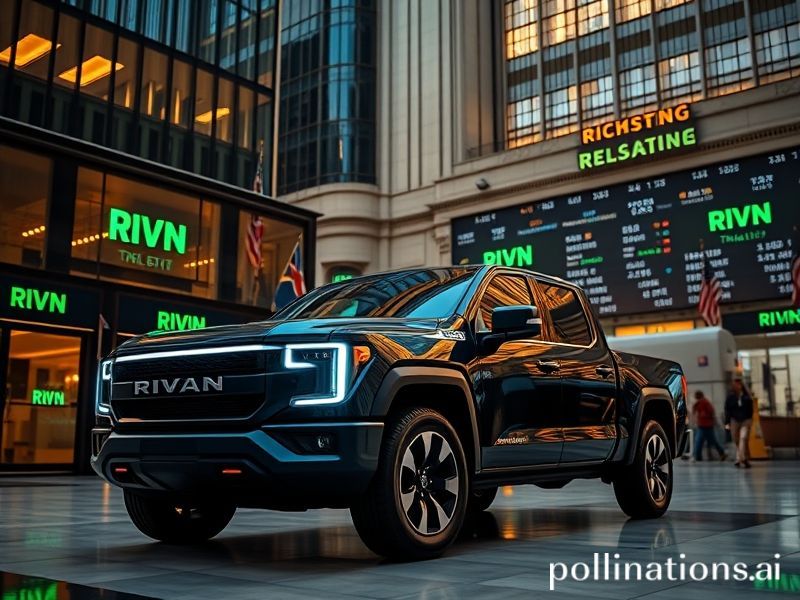
Rivian Stock: A Global Vanity Mirror on Four Wheels
By Dave’s Locker International Desk
Somewhere between the Arctic Circle and the Singapore Strait, investors are staring at the same flickering green-red ticker that spells RIVN and wondering what it says about their own national neuroses. The electric-truck startup, born in a converted Illinois Mitsubishi plant, has become the world’s most expensive mood ring: green when the planet pretends it will meet climate targets, red whenever someone remembers we still dig cobalt with bare hands.
To the European Union, which just spent the summer politely begging citizens to stop buying SUVs the size of Liechtenstein, Rivian is either salvation or sacrilege. Brussels bureaucrats clutch their soy lattes and whisper that a 7,000-pound American pickup running on electrons instead of unleaded might—might—justify the 40 % import tariff they slapped on it last quarter. Meanwhile, German auto unions, whose grandparents once built Panzer transmissions, now march for “battery sovereignty.” The irony is not lost on anyone who owns history books, but those are currently out of stock on Amazon.de.
Across the Pacific, the Chinese read Rivian’s quarterly burn rate ($1.57 billion last quarter, or roughly the GDP of Fiji) the way Renaissance bankers studied indulgence prices: as a signal of how much guilt the wealthy will pay to feel clean. BYD, the Shenzhen giant that can stamp out an electric bus between lunch and tea, quietly calculates how many steering yokes it must sell to offset one American’s weekend camping trip. State media calls Rivian “a lovely proof of concept.” Translation: we’ll mass-produce the concept for half the price before Detroit figures out the software update.
The Gulf states watch from climate-controlled penthouses, bemused. Abu Dhabi’s sovereign fund reportedly owns a slice of Rivian—small change next to their stakes in everything from English football to French museums dedicated to sustainability. They understand better than most that salvation is a tradable commodity, like Brent crude or Swiss boarding-school places. Every spike in RIVN is a silent thank-you note from Silicon Valley for keeping oil above $80 long enough to make batteries look cheap.
South American lithium brine pools, meanwhile, have become the new Persian Gulf, only with more flamingos and fewer press junkets. Chilean activists tweet aerial photos of turquoise evaporation ponds labeled “RIVIAN’S REAL CHARGING NETWORK,” then brace for tear-gas scented with the same lithium that powers your conscience. Bolivian officials, whose country sits on the Salar de Uyuni’s white gold, threaten to nationalize supply every time the stock dips below $12. The threat lasts exactly as long as it takes a Morgan Stanley analyst to remind them their GDP is still smaller than Etsy’s quarterly revenue.
Back in North America, the retail-investor subreddits oscillate between messianic zeal and end-times panic, a bipolar disorder now recognized by the WHO under “Post-Market Traumatic Stress.” They post drone footage of the Normal, Illinois plant and debate whether the 2026 delivery target for the R2 compact is “aspirational” or “fraud.” No one mentions that the parking lot still holds more Teslas than Rivians; cognitive dissonance is the only truly renewable resource.
And then there are the actual trucks—capable, earnest, and about as common on global roads as polite comment sections. A handful have reached Norway, where they are photographed next to fjords like guilty mastiffs. One owner in suburban Oslo told our correspondent he bought it “to support American innovation,” then asked if anyone knew a reliable diesel generator for winter camping. The fjord, for the record, did not laugh. Nature has better comedic timing than we do.
Conclusion
Rivian’s stock price is less a valuation of an automaker than a referendum on the entire post-national experiment: can a planet that can’t agree on a time zone build a supply chain pure enough to absolve our sins? The answer, priced daily in dollars, yuan, riyals, and euros, is a polite maybe—followed by the sort of nervous cough usually heard in the last act of a Chekhov play. Until then, the world will keep refreshing the ticker the way medieval peasants once counted rosary beads: not because it works, but because the alternative is admitting we have no idea where we’re driving.