Dodgers vs. Orioles: When Two Coastal Elites Remind the World That Baseball Still Exists
by Dave’s Locker Foreign Desk
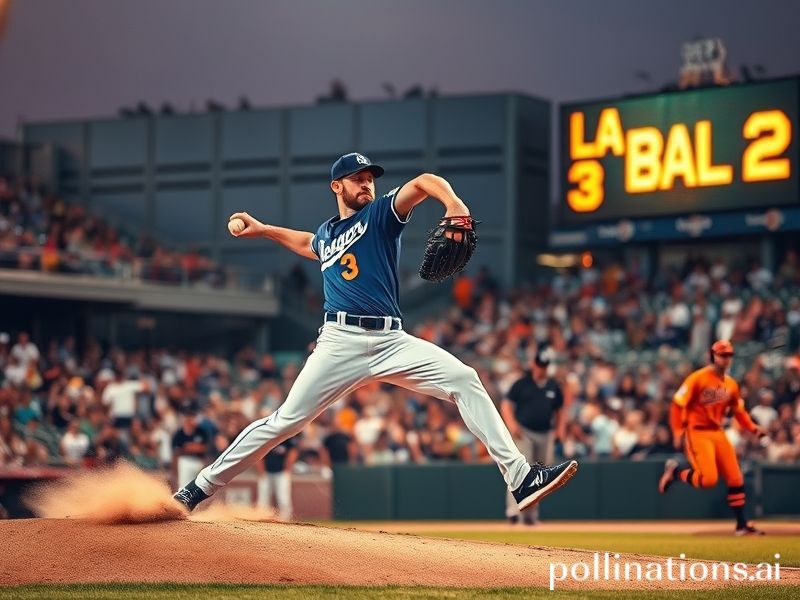
LOS ANGELES—Last night, under the same smog-filtered moon that once watched the Soviet Union collapse, the Los Angeles Dodgers politely thrashed the Baltimore Orioles 7-3. From a purely terrestrial standpoint it was an ordinary interleague matchup. From a planetary one, it was a tidy parable about late-stage capitalism wearing stirrups.
Consider the principals. The Dodgers, a franchise whose annual payroll could refinance the Greek debt, rolled out a lineup featuring three MVPs and a utility infielder who owns more real estate than Luxembourg. Across the diamond stood the Orioles, baseball’s charming underfunded NGO, whose most expensive player still takes the light rail to work and whose analytics department shares a printer with the grounds crew. If the game felt lopsided, so does most of the modern world: one dugout sponsored by crypto exchanges, the other by a local crab shack that also sells bail bonds.
An international audience tuning in via MLB.TV—an app whose blackout restrictions make the Berlin Wall look porous—might have wondered why anyone still cares. Baseball, after all, ranks somewhere between kabaddi and competitive tax evasion in global popularity. Yet 52,312 souls paid triple-digit prices to sit in Chavez Ravine, a pilgrimage site now ringed by wildfire smoke and influencer drones. They chanted “M-V-P” at Shohei Ohtani, a Japanese unicorn who pitches like Sandy Koufax and hits like Godzilla, thereby single-handedly keeping U.S.–Japan trade relations amicable. When Ohtani doubled, the Tokyo stock market twitched; when he later struck out, three hedge funds in Connecticut shorted Nintendo.
Meanwhile, the Orioles’ contingent—roughly 200 fans in orange who flew Southwest for the free peanuts—watched their club cling to relevance like a remora on a shark. Their best hope, rookie shortstop Jackson Holliday, is 20 years old, i.e., young enough to be nostalgic for TikTok. Facing Dodgers closer Evan Phillips, Holliday struck out on three pitches that registered as hate crimes in Baltimore. Somewhere in Havana, a scout for Industriales wept into his government-issued rum.
The geopolitical subplot thickened when the stadium PA blasted “God Bless America” during the seventh-inning stretch, a ritual invented in 2001 and now as compulsory as airport shoe removal. The crowd stood, ballcaps over hearts, while a drone camera zoomed in on a vendor selling $18 micheladas to a man wearing a Vladimir Putin T-shirt. No one seemed to notice the contradiction; nationalism, like beer, is best served cold and foamy.
For Europe, still mourning the end of the soccer season and the beginning of existential dread, the game offered a safe outlet: no hooligans, no VAR, just gentle pastoral failure punctuated by $12 nachos. For Latin America, the contest was a reminder that 30% of MLB rosters are Dominican or Venezuelan, yet neither team started a single player from either country—a statistical improbability akin to Swiss neutrality. One assumes the players were resting for tomorrow’s flight to Toronto, where they will be detained by customs agents who think “bullpen” is a cartel.
By the ninth inning, the Orioles had turned to a relief pitcher with an ERA higher than Sri Lanka’s inflation rate. The Dodgers countered with a pinch-hitter whose watch cost more than the Baltimore bullpen combined. Final score: 7-3, same as the global wealth gap if you squint. Fireworks erupted over the pavilion, chemically identical to the ones used last week in Gaza, though here they merely signaled that rich people had won again.
As fans filed out, Uber surge pricing reached IMF-loan levels. Outside the stadium, a man in a Manny Machado shirsey—still angry about 2018—tried to sell knockoff jerseys to tourists who only spoke Mandarin. Capitalism, like baseball, is a game of adjustments.
Conclusion
In the end, the Dodgers improved to 42-25, the Orioles slipped to 38-27, and the rest of Earth spun indifferently on. The game proved nothing except that spectacle remains the last truly bipartisan language. Somewhere in Kyiv, a soldier streamed the highlight of Freddie Freeman’s RBI double between mortar rounds. Somewhere in Lagos, a teenager updated his fantasy roster while the power flickered. And somewhere in Baltimore, a father told his son, “We’ll get ’em tomorrow,” which is what all empires say the night before the fall.