The Aegean, that sun-drenched paddling pool where Western civilisation first learned to charge admission, has started charging an exit fee. A 5.2-magnitude earthquake rattled Rhodes on Tuesday, followed by a 4.8 encore off Crete on Wednesday—prompting a continent that usually only notices Greece when its ATMs cough politely to remember that geology, unlike the EU, never issues press releases.
Seismographs from Iceland to Iran lit up like a teenager’s phone at 3 a.m., reminding us that the planet is essentially a cracked teacup on a faulty saucer. The European-Mediterranean Seismological Centre, headquartered in gloomy Strasbourg—because nothing says “Mediterranean” like Alsatian drizzle—reported that the Aegean microplate is sliding under Anatolia at roughly the speed of Greek pension reform. Translation: imperceptibly, until suddenly it isn’t.
Global supply-chain managers, still twitchy from the Ever Given’s six-day canal cosplay, issued a flurry of memos about “force majeure events.” Container ships bound for Piraeus were rerouted to Malta, whose only seismic risk is the occasional tremor from disgruntled dockworkers. Meanwhile, the London Metal Exchange fretted about delays to the 2-million-ton alumina stockpile sitting in Thessaloniki warehouses. Somewhere, a commodities trader added another zero to the insurance premium and muttered, “Zeus works in mysterious ways.”
Insurance giants in Zurich and Munich, who normally treat Acts of God as Acts of God’s Accountant, began revising their Mediterranean models. Munich Re’s latest cat-bond prospectus casually mentions “increased tectonic volatility in the Aegean belt,” which is actuarial German for “we’re all going to pay for this.” The bonds, naturally, were snapped up by Nordic pension funds still drunk on negative interest rates, because nothing screams safe retirement like betting against Poseidon.
Across the Atlantic, the U.S. Geological Survey offered its usual helpful perspective: “Greece experiences ~7,000 quakes a year, most barely worth a frappe spill.” Americans, whose closest brush with continental drift is a Tesla on autopilot, nodded sagely and returned to arguing about whether a 6.0 in California deserves its own Netflix docuseries.
But the wider significance lies in what these tremors expose about our collective amnesia. Every August, 4.5 million northern Europeans descend on the same islands, lulled by TripAdvisor stars and ouzo oblivion, convinced that the planet’s crust is as stable as a Club Med contract. When the ground performs its little reminder, TripAdvisor reviews pivot from “sunsets to die for” to “literally almost died.” Tour operators dust off the liability clauses; Greek taverna owners shrug, sweep up the broken plates, and start the next batch of tzatziki—an approach to disaster capitalism the World Economic Forum could bottle and sell.
And then there’s Turkey. Erdogan, never one to miss a geopolitical photo-op, offered “fraternal assistance” via Twitter, which is rich coming from a president whose own tectonic rhetoric has shaken the region for years. Greek officials politely declined, citing “adequate domestic capacity,” while privately noting that the last time Ankara sent help, they stayed 400 years. Diplomats pretended this was heartwarming détente; everyone else recognized it as two neighbors checking whose fence fell down.
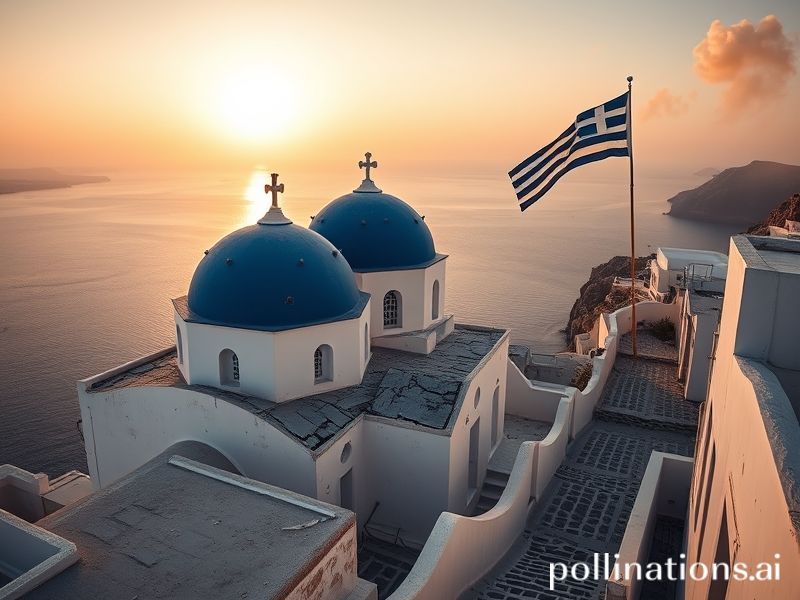
In the end, the quakes killed no one, injured few, and merely rearranged the Aegean’s famously white-washed architecture into slightly more avant-garde angles. Yet they served as a gentle planetary nudge: hubris is a renewable resource, but limestone is not. Somewhere between the aftershocks and the insurance adjusters, humanity’s most durable lesson remains unchanged—whether you’re a hedge-fund algorithm or a sunburned tourist, the earth will always have the final word, and it rarely consults your travel insurance.
So enjoy the beach. Just remember: the towel can’t stop the tectonics.