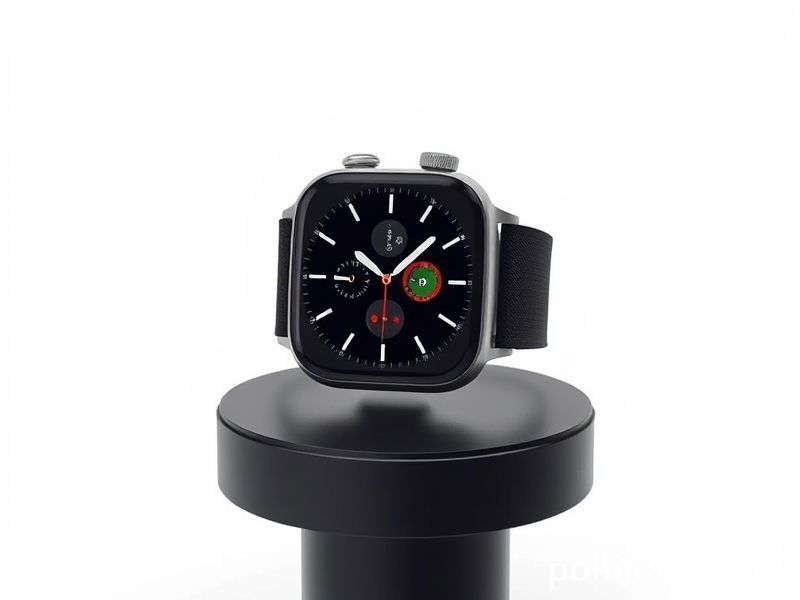
GENEVA—The Apple Watch Series 11 debuted this week, and humanity’s response was as choreographed as a North Korean military parade: half the planet gasped in rapture, the other half Googled how to pawn a kidney in Jakarta. From Berlin’s glass-walled co-working chapels to Lagos traffic jams where the watch costs more than the average annual salary, the same thought flickered: “Do I need this, or has late capitalism simply perfected need-creation?” The Series 11 does not answer that question; it merely tracks how fast your pulse races while you pretend not to care.
Cupertino’s keynote—streamed live to 195 countries plus whatever micronation Elon Musk is eyeing this quarter—was a masterclass in geopolitical modesty. Executives took the stage in recyclable sneakers to tout the watch’s new “Global Vitals” dashboard, which promises to detect Dengue in Delhi, burnout in Stockholm, and existential dread in Paris. The irony, of course, is that the same algorithm that allegedly saves lives in the DRC is also busy reminding a hedge-fund analyst in Zurich to stand up every hour lest his AppleCare premiums spike. Equality, Silicon Valley-style: everyone’s wrist gets the same vibrating nudge toward immortality, interest rates permitting.
Over in Shenzhen, supply-chain soothsayers report the Series 11’s blood-oxygen sensor is now 18% smaller, freeing up space for a second microphone so Siri can better hear you cry into your congee at 3 a.m. Meanwhile, the Democratic Republic of Congo mines another 3,000 metric tonnes of cobalt to keep those LEDs blinking a soothing, democratic teal. Apple offsets this by purchasing carbon credits from a reforestation project in the Brazilian Amazon, which satellite imagery suggests is currently growing a lovely monoculture of eucalyptus and denial.
Europe greeted the launch with typical performative outrage. The European Commission immediately threatened an antitrust probe into the watch’s new “Wellness Walled Garden,” arguing that only allowing ECG data to sync with Apple-branded pacemakers violates the Digital Markets Act, or at least the continent’s sense of existential superiority. Brussels insiders privately admit the Commission’s real fear is that citizens might choose convenience over continentally curated suffering. France, ever the contrarian, announced subsidies for domestically produced smartwatches that smell faintly of Gauloises and surrender when submerged.
Across the Pacific, Japan’s elderly population embraced the Series 11’s fall-detection upgrade with the resigned enthusiasm of a society that has already priced solitude into GDP. In Tokyo’s Shibuya Crossing, billboards depict a silver-haired model whose watch auto-dials an ambulance as she keels over—artfully, in 4K—while commuters scroll past, earbuds muting the sound of demographic collapse. The government lauds the watch as “a cost-effective alternative to building more nursing homes,” which is the sort of fiscal ingenuity that once launched kamikazes.
Not to be outdone, India’s Ministry of Health proposed distributing subsidized Series 11 units to rural clinics, arguing that the watch’s new malaria alert feature will compensate for the 1.3 doctors per 10,000 citizens. Critics note the plan’s pilot phase ended when villagers discovered the watch’s battery lasts longer than the clinic’s generator fuel. Still, the optics play well on Instagram, and that, after all, is half the battle in emerging markets.
From a macro perspective, the Series 11 is less a gadget than a geostrategic thermometer. Its success will be measured not merely in unit sales but in the velocity with which supply chains reconfigure, currencies wobble, and governments scramble to regulate—or monetize—your heartbeat. Analysts at Credit Suisse (RIP) estimate the watch will add 0.03% to global GDP, a figure roughly equivalent to Malta’s entire economy, minus the fireworks.
Back on the human wrist, the watch quietly logs another metric: the moment you realize your life has been gamified by a trillion-dollar corporation that grades your sleep like a sadistic gym teacher. Somewhere, a server farm in Nevada hums with the aggregate heartbeat of eight billion anxious primates, all praying the next software update doesn’t brick eternity. The Series 11 can’t promise salvation, but it will vibrate reassuringly while you wait.