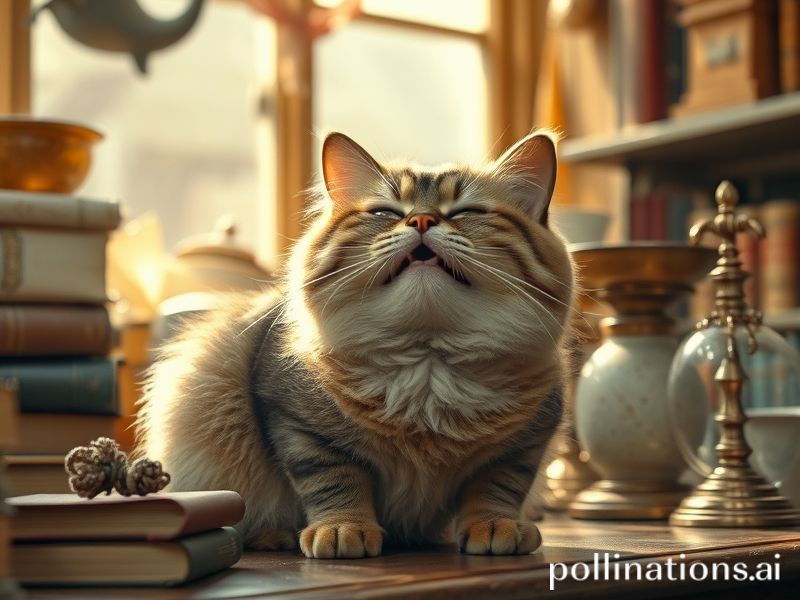
Bagpuss, the saggy cloth cat from 1974, is currently enjoying a second life on four continents—streaming in 17 languages, trending on Brazilian fan-art forums, and inspiring a boutique line of ethically sourced felt mice in Kyoto. All this for a programme that was originally cobbled together in a converted cowshed outside Leeds with a budget that wouldn’t cover today’s BBC coffee allowance. The global resurrection of the world’s most narcoleptic feline says less about nostalgia than it does about a planet so chronically sleep-deprived it will binge-watch anything that yawns first.
Internationally, Bagpuss has become a Rorschach test for whatever neurosis happens to be local. In the United States he is “that British mindfulness hack,” marketed by wellness apps promising to reduce cortisol in seven episodes or fewer. German philosophy undergraduates screen him in dim seminar rooms as an example of “post-reunification objet-trouvé entropy.” Meanwhile, South Korean students have remixed the opening lullaby into lo-fi study beats titled “Sewing Machine Dreams,” which apparently help you cram for civil-service exams while contemplating the inevitability of planetary decay—an emotional combination only Gen Z could survive.
The economic footprint is not trivial. Official merchandise—mostly knitted in the same low-wage regions that produce the devices we watch him on—moved £28 million last year, enough to buy every child in Yemen a school bag or, more realistically, one additional missile for somebody’s “defensive” arsenal. Disney+ reportedly floated a gritty reboot: “Bagpuss: Woken,” in which the cat is reimagined as a trauma therapist patching up displaced woodland creatures after an unspecified forest war. The pitch deck leaked; Netflix counter-bid; both were beaten by a Chinese streaming giant that simply deep-faked the original footage, colorised it, and added product placement for melatonin gummies. Viewers from Lagos to Lagos-on-the-Thames now drift off to the same patched-up Victorian toy shop, dreaming of simpler times that never existed.
Diplomatically, the show has achieved what the UN never could: a shared reference point that offends no one except, perhaps, actual cats. When British and Iranian negotiators met in Vienna last winter to discuss tanker insurance, the only ice-breaker that worked was discovering both delegations grew up on illegal VHS dubs narrated by the same unseen Olivier Postgate. The talks still collapsed, but for one brief moment the room smelled of rose-tinted childhood rather than impending sanctions. Analysts call it “soft power”; the rest of us call it “desperate.”
Yet the darker resonance is hard to ignore. Bagpuss wakes, surveys a broken world, fixes a wooden lion or two, then immediately goes back to sleep—an accurate summary of every COP climate summit. The mice chant their shrill chorus, the toad sings in resigned baritone, nothing fundamentally changes, and the credits roll before anyone has to deliver bad news. It is the perfect metaphor for liberal democracy circa 2024: patch the visible holes, hum a consoling tune, congratulate ourselves on artisanal craftsmanship, repeat. No wonder the show streams so nicely in countries where actual protest is either criminalised or monetised into NFTs.
Still, the planet keeps spinning—slightly wobblier each year—and Bagpuss keeps snoring, a dusty comfort blanket for adults who once believed stories could save them and now settle for buffering speeds above 5 Mbps. Tomorrow the algorithm will nudge us toward something newer, louder, more high-definition. But tonight, from Vladivostok to Valparaiso, millions will queue up the same 15 minutes of hand-stitched 1970s Britain, watching a cloth cat yawn itself back into hibernation while the world outside does precisely the same.