The Empire Strikes Back—With a Mic: How BBC Sports Became the World’s Genteel Referee While Rome Burns
By the time the vuvuzelas had mercifully fallen silent in Johannesburg, the BBC’s World Cup coverage had already been translated into forty-three languages, pirated across three continents, and memed into oblivion on whatever corner of Weibo wasn’t behind bars that week. That was 2010. Since then, Auntie’s sports division has quietly become the closest thing planet Earth has to a neutral narrator—an accidental superpower in a world where everyone else is busy arguing about tariffs, vaccines, or whether that dress was blue or gold.
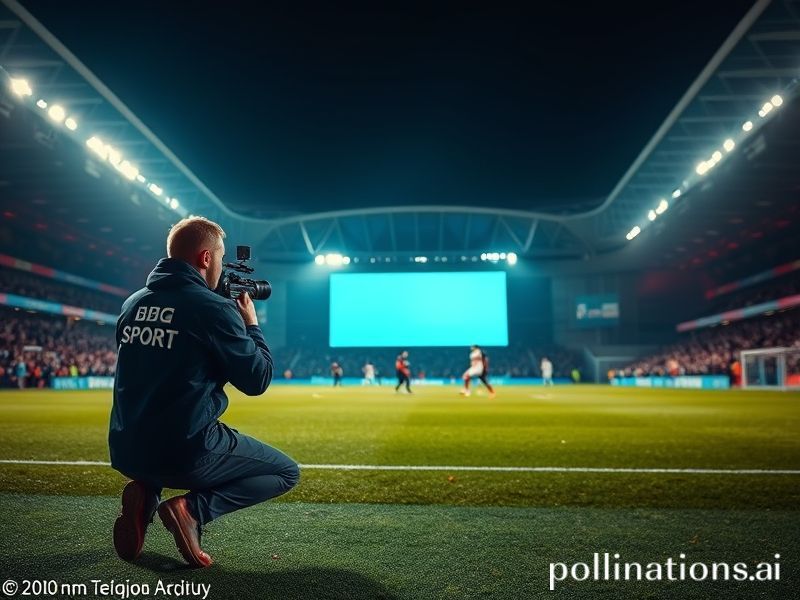
It’s a neat trick for an outfit still funded, at least in part, by every British household stubborn enough to keep paying the licence fee. While Netflix hemorrhages subscribers like a medieval surgeon, the BBC’s sports app somehow sits at the top of download charts from Lagos to Laos, dispensing polite commentary, granular statistics, and—if you listen closely—the faintest whiff of imperial nostalgia. The commentary box is the last corner of Britannia where the sun never sets, powered by satellite uplinks and the unspoken agreement that, yes, we all still speak football.
This soft-power flex carries geopolitical weight in inverse proportion to its actual budget. When the BBC calls a handball in the Asian Champions League, Singaporean betting syndicates flinch; when Gabby Logan raises an eyebrow at VAR, Balkan sports bars collectively hold their rakija. Even the Americans—who insist on calling a 0-0 draw “nil-nil” with the same linguistic confidence they bring to ordering “croissants” at Starbucks—treat the BBC’s website as a kind of sporting Rosetta Stone. ESPN may own the broadcast rights, but it’s the Beeb’s phlegmatic match reports that settle bar bets from Brooklyn to Bogotá.
Of course, neutrality is a relative concept. The BBC’s commentators still pronounce “Qatar” as if it were a minor character in a Jane Austen novel, and every African side is inevitably “athletic” or “spirited,” which is commentator code for “we’ve never actually been to Kinshasa.” Yet compared with the state-run hysterics at Russia’s Match TV or China’s CCTV—where every under-23 defeat is spun as a glorious moral victory—the BBC’s measured tones feel like diplomatic immunity in 4K.
The real genius lies in the metadata: the heat maps, the xG (expected goals) algorithms, the rolling graphics that break down pressing intensity with the same solemnity once reserved for NATO briefings. In an age when truth itself is paywalled, the BBC gives away granular match data for free, effectively open-sourcing the lingua franca of global tribalism. Dictators can censor the news, but try stopping teenagers in Tehran from streaming the xG of a Champions League quarter-final. Football, unlike democracy, has offside lines you can’t redraw.
And let’s not underestimate the quiet mercenary work. When the Saudi Public Investment Fund bought Newcastle United, BBC Sport’s forensic dissection of the deal—complete with animated infographics of beheading statistics—was clipped, subtitled, and weaponised by human-rights groups from Geneva to Riyadh. Soft power, meet hard truths, wrapped in a chyron and sponsored by nothing more sinister than a 94-year-old Scottish presenter who still calls it “the wireless.”
Yet the greatest irony is that the BBC’s global sports dominance persists precisely because it doesn’t try too hard to dominate. While tech giants chase the next dopamine-drip highlight reel, Auntie still insists on showing the full ninety minutes plus stoppage time, including that tedious spell around the 67th minute when everyone suddenly remembers they left the kettle on. In an attention economy built on methamphetamine pacing, the BBC offers the radical proposition that some things are worth watching sober—even if the world, increasingly, is not.
So when the next World Cup kicks off in the smoggy dystopia of 2026—spread across three countries, five time zones, and whatever remains of the polar ice caps—rest assured the BBC will be there, calmly explaining why the fourth substitute is now allowed in extra time while the rest of us argue about carbon footprints and concussion protocols. Someone has to narrate the apocalypse with clipped vowels and a camera angle wide enough to catch the slow-motion collapse of civilization just off the far post.
Conclusion: In the end, BBC Sports isn’t just covering the game; it’s providing the last universally accepted scoreboard for a planet that can’t agree on anything else. And if that isn’t worth the licence fee, well—there’s always pirate radio.