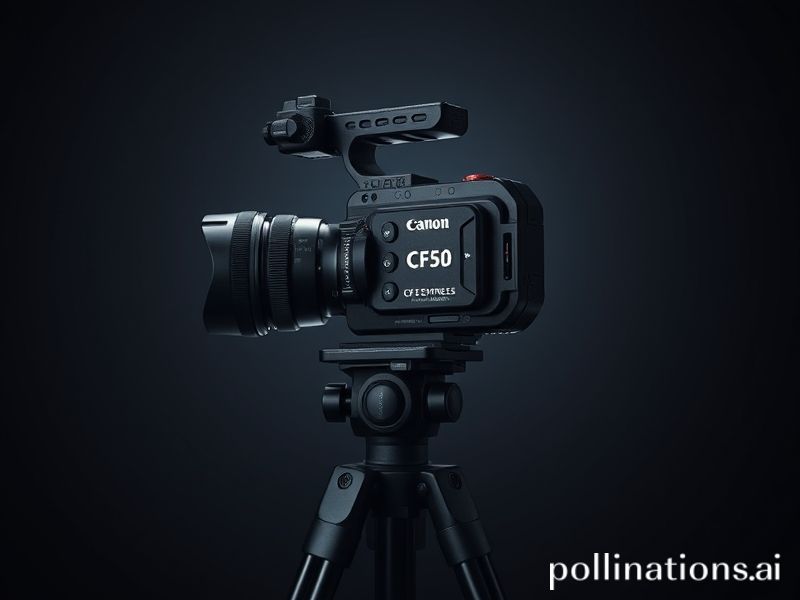
Canon C50: The Camera That Will Film the End of the World in 6K—And Make It Look Cinematic
PARIS—Every few years Canon releases a new box of circuits and glass that promises to democratize cinema-grade image-making. The freshly minted EOS C50 is no exception, except now the democrats have drones, and the cinema is TikTok. Unveiled last week at a trade show where the air smelled faintly of desperation and complimentary espresso, the C50 arrives just in time to document whatever fresh geopolitical horror 2025 coughs up next—at 6K 30p, 12-bit, with Canon Log 2 so you can really dial in the shadows on societal collapse.
Built like a stealth bomber mated with a lunchbox, the body weighs 1.3 kg—perfect for the lone stringer sprinting through tear gas in Istanbul or the wedding videographer in Akron who insists on gimbal shots of the cake cutting. The RF mount accepts everything from a nifty-fifty to a $70,000 cine servo zoom, which means your revolutionary footage and your cousin’s gender-reveal video will share the same color science. Progress.
Global supply chains being what they are (a polite term for organized looting), the C50’s magnesium chassis begins life in a Japanese factory, shuttles to Vietnam for final assembly, and lands in your local reseller priced at €4,899, $4,999, or roughly one Bitcoin on a volatile Tuesday. Canon swears the parts are “conflict-free,” a phrase that translates to “we think the minerals stopped bleeding somewhere over the Pacific.”
Europeans, ever the moral referees, have already drafted a rider requiring all footage to include a carbon-offset watermark. Meanwhile, the Indian subcontinent—already the planet’s biggest content farm—has pre-ordered so many units that FedEx had to charter extra 747s. Rumor has it Mumbai studios will use the C50 to reboot Bollywood classics in vertical 9:16, because nothing says epic romance like two lovers separated by a push notification.
In Africa, where electricity is negotiable but storytelling is not, NGOs are pairing the C50 with portable solar rigs to train local journalists. Expect heart-rending dispatches delivered via Starlink, color-graded on an iPad Mini, and uploaded before the next coup d’état hits deadline. The camera’s dual-base ISO—800 and 3200—proves handy when the generator sputters out mid-interview and the only light source is a burning tire.
Canadians, ever polite, are using it to film apology videos in RAW. South Koreans are strapping it to subway ceilings for 24-hour live streams of commuters who refuse to look one another in the eye. Australians have already lost two units to crocodiles. Somewhere in the Arctic, a climate scientist is capturing the last sunset over an ice shelf; the footage will look gorgeous in the eventual museum exhibit titled “We Told You So.”
Canon’s marketing department insists the C50 is “empowering creators worldwide,” which is corporate speak for “we’ve armed every auteur with a credit card and a grievance.” The camera ships without an EVF, because nothing builds character like ruining a take by trusting the rear LCD under Saharan sun. The optional XLR module costs extra, so your audio will either be pristine or sound like it was recorded inside a kettle—there is no middle ground.
And yet, for all the snark, the C50 is a mirror. Point it at a refugee camp and you get Citizen Kane in real time. Point it at a birthday party and you get Citizen Kane with balloons. The difference is not the tech; it’s the human holding it, trembling slightly, wondering if anyone will still be around to watch.
So here’s to the Canon C50, the newest apostle of our global attention economy. May it capture every protest, every puppy, every last drifting iceberg. And when the servers finally go dark, at least the footage will be crisp enough for the aliens to reconstruct what the hell we thought we were doing.