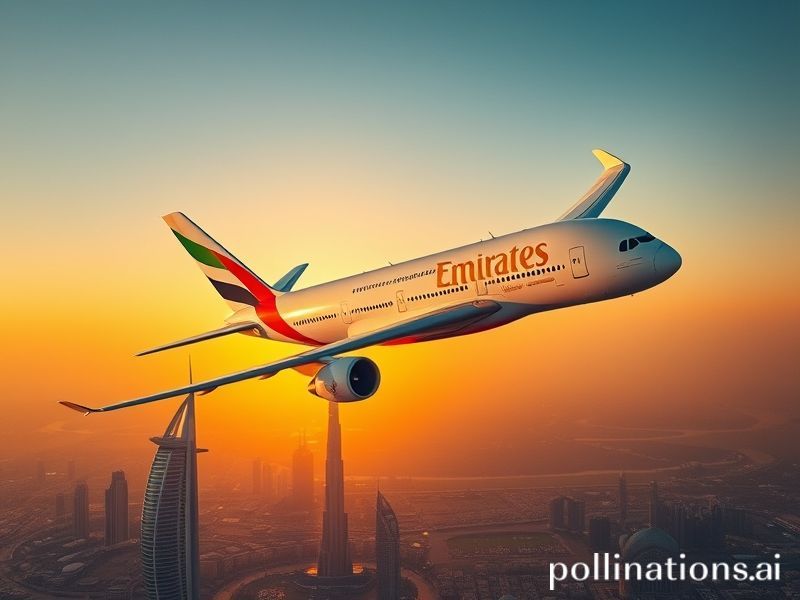
Call them what you will—emirates, sheikhdoms, pocket kingdoms with a flag and a runway—the seven siblings stitched together by the late Sheikh Zayed into what we now politely call the United Arab Emirates have improbably become the world’s most efficient laboratory for the question: “Just how far can you stretch the adage ‘fake it till you make it’ before the desert notices?”
From the 35th floor of a glass syringe in Dubai, the view is pure sci-fi: an indoor ski slope where expats pay $12 a minute to fall down artificial snow while the mercury outside tests the boiling point of human ambition. Abu Dhabi, meanwhile, plays the more sober older brother—same father, different PR firm—bankrolling art museums designed by Gehry and flying falcons in business class to Saudi Arabia, just to remind everyone that national symbols still travel better than diplomatic cables.
Globally, the UAE has become the Switzerland of sand: neutral enough to host talks between enemies who refuse to sit in the same hemisphere, yet rich enough to make neutrality look like a luxury product. When the U.S. wants to bomb somewhere discreetly, Emirati airfields pop open like well-oiled jewelry boxes. When Russia needs a sanctions-proof middleman, Dubai’s free zones sprout a thousand shell companies overnight, each with a brass plate and the lifespan of a fruit fly.
Europe, drowning in its own energy guilt, now ships LNG through the Strait of Hormuz with the same moral flexibility it once reserved for tax loopholes. Meanwhile, China’s Belt and Road rolls into Khalifa Port on schedule, unloading container after container labeled “Made in Everywhere,” while Beijing quietly buys up 5G contracts like Pokémon cards. The emirates, ever gracious hosts, take a cut from each side and still find time to tweet about tolerance.
Of course, tolerance has its limits. The same cities that court Instagram influencers with golden visas also deport laborers whose biggest crime was believing the brochure. A South Asian construction worker who helped pour the foundation for the world’s tallest building can, in a pinch, be repatriated for the cost of a single night in its penthouse. One suspects the Burj Khalifa keeps growing precisely to ensure there’s always a higher floor from which to ignore the view below.
Yet the world keeps flying in. Hedge funds, crypto fugitives, aging pop stars seeking tax absolution—they all land at DXB, where the immigration queue is longer than most nation-states and twice as existential. There is something almost touching in the way humanity still believes a new skyline can erase an old reputation, as if concrete and chrome were witness-protection programs for countries.
And perhaps they are. The emirates have rebranded geography itself: turning oil into airports, sand into sovereign wealth funds, and summer into a season best experienced indoors. Climate scientists warn that parts of the Gulf may become uninhabitable by 2070; the UAE responds by commissioning architects to design air-conditioned cities under glass domes, because nothing says “long-term planning” like building a greenhouse inside a greenhouse.
Still, credit where due. In a region historically allergic to federalism, seven royal families have managed to share a currency without sharing a single Netflix password. They have turned existential resource anxiety into a global consulting model: want to diversify your economy? Build an airline, host a World Expo, and—if the neighbors start quarreling—offer them a neutral golf tournament. Just remember to schedule it for winter; even diplomacy wilts at 45°C.
As COP28 looms in Dubai, the emirates will once again position themselves as mediators between Planet Earth and the species currently terraforming it. Delegates will sip chilled water harvested from the humidity of their own breath, nodding politely at pledges printed on recycled promises. Outside, the fountains dance in choreographed ecstasy, recycling the same million gallons like a liquid mantra: growth, growth, growth.
In the end, the emirates matter because they are the mirror we asked for—distorted, airbrushed, and back-lit with LED. They sell us the future we claim to want: frictionless, climate-controlled, and utterly unaffordable to the people who built it. And when the sand finally reclaims what was always its own, at least the satellite images will be stunning.