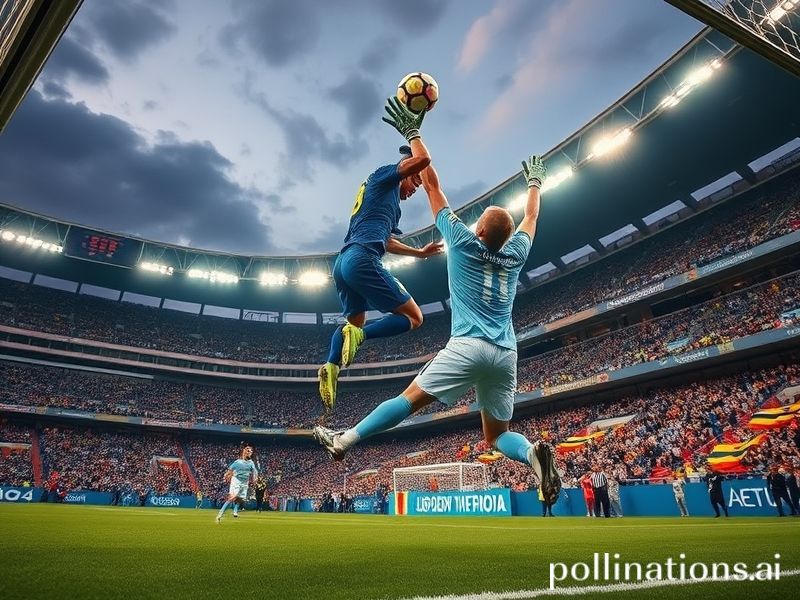
Quito, Ecuador – Somewhere between the Andes and a nervous hedge fund, Ecuador and Argentina are playing a game that looks suspiciously like football but smells unmistakably like geopolitics. The fixture itself—tonight at Estadio Rodrigo Paz Delgado—will decide little in the cosmic ledger: three points, a few million collective heartbeats, maybe a shattered TV or two. Yet the ripples travel farther than the Andean condor’s glide path, carrying whispers about the global economy, the climate apocalypse, and humanity’s stubborn insistence on turning everything into content.
Let’s begin with the obvious: Argentina arrives as reigning world champions, fresh from reminding France that even the best-laid plans can be unraveled by a diminutive deity in size-five boots. Lionel Messi, now plying his sunset trade in Miami, has become an export more reliable than Argentine soybeans, which is saying something in a country where inflation laughs at mere triple digits. Ecuador, meanwhile, fields a squad assembled with the fiscal prudence of a student who’s just discovered buy-now-pay-later apps. Their star, Chelsea’s Moisés Caicedo, cost more than the national budget line for school lunches, a fact the education minister prefers not to discuss over dinner.
But the match is merely the decorative froth on a much darker latte. Ecuador’s government has dollarized faster than a TikTok trend; Argentines, conversely, have so many exchange rates they could start a trading-card series. Each devaluation, each IMF bailout letter, pings the Bloomberg terminal of a bond trader in London who still thinks Quito is a kind of herbal tea. The game therefore doubles as a living stress test: can two economies held together with bailing wire and WhatsApp rumors still produce elite athletes? Spoiler: yes, because poverty remains the planet’s most underrated talent incubator.
Globally, the broadcast rights feed an ecosystem that stretches from illegal streams in Lagos internet cafés to betting apps in Manila that somehow accept avocados as collateral. FIFA, ever the benevolent octopus, pockets the cash while lecturing fans about carbon footprints—this from an organization that ships entire stadiums across continents like a toddler scattering Lego. The irony thickens when you remember both nations are on the front line of climate collapse: Argentina’s soy belt is turning to dust, while Ecuador’s glaciers retreat faster than a finance minister asked about debt restructuring. Tonight’s ninety minutes will consume more diesel-powered floodlights than a midsize village uses in a year, but relax, they bought offsets—probably from a start-up run by a sophomore at Wharton.
There is, of course, the geopolitical subplot. China has refinanced both countries at interest rates polite society would call predatory but diplomats term “South-South cooperation.” Every crunching tackle is therefore underwritten, indirectly, by a state bank in Beijing that lists human rights as an optional clause. Meanwhile, the United States watches via Telemundo, comforted that at least this Latin American drama doesn’t involve another congressional subpoena. Somewhere in Brussels, an EU official drafts a stern memo about fair play, then books a flight to Doha—business class, naturally.
The fans themselves are the final, combustible variable. Argentines have traveled in such numbers that Quito’s airport briefly looked like the last helicopter out of Saigon, only with more replica shirts and less dignity. Ecuadorian supporters, sensing destiny and a possible upset, have been practicing Schadenfreude in the mirror. Should the home side win, the resulting street party will be visible from the ISS; should they lose, economists predict a brief dip in national serotonin that could shave 0.3 percent off GDP. Either outcome will be distilled into memes, those luminous plankton of the attention economy, and forgotten before the next crypto crash.
When the whistle blows, the planet will keep spinning—though slightly wobblier thanks to polar melt and collective sighs. One nation’s anthem will blare, another’s will crackle, and twenty-two millionaires will chase a ball stitched in a sweatshop whose coordinates are classified. The final score will be archived next to yesterday’s Wordle, another tiny datum in the ledger of human striving. And somewhere, a hedge fund algorithm will update its Latin America risk model, blissfully unaware it just watched the same game as a goat herder in the Puna plateau—proof, if any were needed, that absurdity remains the only truly universal currency.