The Tractor Also Rises: How a Middle-Aged British Blowhard Became the World’s Accidental Agricultural Prophet
By Our Man in the Manure
PARIS — In a week when the UN warns that soil degradation could shave 10 % off global GDP by 2050, the hottest export out of the United Kingdom is neither whisky nor royal scandals but a 64-year-old ex-car bore in ill-fitting Wellington boots. “Clarkson’s Farm,” Amazon’s surprise hit about Jeremy Clarkson’s attempt to run 1,000 acres of Cotswold mud, has now been subtitled into 35 languages, spawned memes in Jakarta, and convinced at least three hedge-fund managers in Greenwich to buy hobby vineyards they will almost certainly bankrupt. The show is ostensibly a lark—Top Gear meets Old MacDonald—but, like so many British comedies, it hides a suicide note for the planet inside the punch-lines.
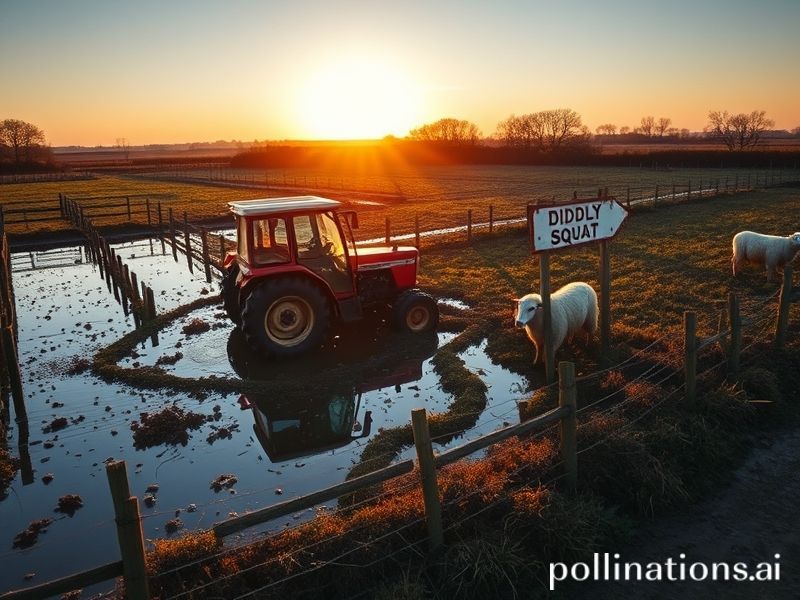
Consider the global context. While COP delegates trade carbon credits in air-conditioned tents, Clarkson is on his knees praying to a £250,000 Lamborghini tractor that refuses to start because its onboard computer objects to English rain. The gag writes itself, yet the audience from Iowa to Uttar Pradesh recognizes the same technological overkill that has turned agriculture into a balance-sheet blood sport. When Clarkson’s wheat crop earns £68 a tonne but costs £71 to plant, the joke lands harder in Punjab, where 300,000 farmers have committed suicide since 1995 after identical spreadsheets. Dark humor travels well when the darkness is shared.
There is, of course, the matter of scale. Clarkson loses £11,000 on sheep; Fonterra sneezes and loses NZ$600 million. Still, the micro mirrors the macro. The European Union’s new “Farm to Fork” strategy aims to cut pesticide use by 50 % by 2030, a noble idea unless you happen to be a Spanish almond grower watching Clarkson’s pesticide-free cabbages get devoured by caterpillars the size of Cuban cigars. Meanwhile, Brazil’s soy barons chuckle over subtitles as they torch another chunk of the Amazon, comforted by the knowledge that sustainability looks adorable when practiced by a man who once punched a producer over a steak.
The show’s real export is anxiety, gift-wrapped in sheepdogs named after Nazi generals. Urban viewers in Seoul or São Paulo recognize the creeping dread that their food arrives via systems too complex to survive ordinary incompetence, let alone climate shock. When Clarkson’s farm shop sells out of honey at £14 a jar, the queue of Range Rovers stretches longer than the bread lines in Khartoum, a juxtaposition that Twitter wits have already labeled “apartheid, but artisanal.” The meme misses the point: the global North is discovering, via television, what the global South has always known—food insecurity is not a supply problem; it’s a distribution problem wearing a Savile Row suit.
And yet, the man is accidentally useful. British farming ministers, previously about as popular as wet cardboard, now cite “the Clarkson effect” to justify subsidies for regenerative agriculture. New Zealand’s new agricultural emissions tax is being rebranded “a bit like Diddly Squat but with spreadsheets,” proving that satire can sometimes do what white papers cannot. Even the World Economic Forum has noticed: next January, a Davos panel titled “Can Petrolheads Feed the Planet?” will feature Clarkson via Zoom, presumably muted after his opening joke about organic kale.
None of this will save us, naturally. The planet will still warm, the topsoil will still blow away, and the next season will probably end with Clarkson accidentally sinking the entire farm into a slurry lagoon. But for eight binge-worthy hours, millions of humans are reminded that the distance between Amazon’s streaming servers and Amazon’s burning rainforest is smaller than we think. That’s a victory of sorts, albeit the kind celebrated with artisanal gin while the house burns down.
Conclusion: In the end, “Clarkson’s Farm” is less a farming show than a global Rorschach test. Viewers in wealthy countries see a charming midlife crisis; viewers elsewhere see a slow-motion documentary of how the colonial experiment ends—surrounded by sheep, up to our necks in debt, and arguing about the price of eggs. The joke’s on all of us, but at least it’s a well-produced joke. Pass the locally sourced popcorn before the power cuts begin.