The General Who Invented Traffic Jams and Détente: Dwight D. Eisenhower’s Accidental World Tour
By Our Man in Geneva, still waiting for the diplomatic pouch to arrive on time
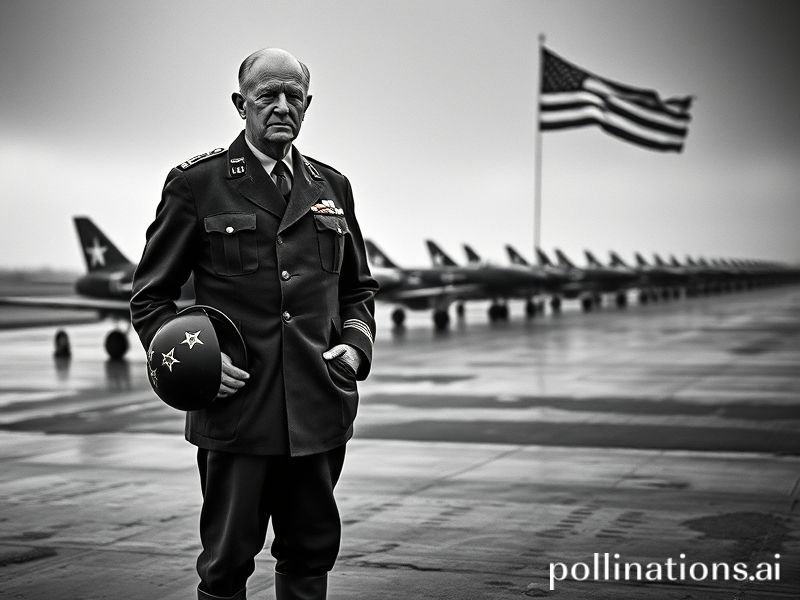
The first thing you notice about Dwight David Eisenhower—if you’re unfortunate enough to be stuck behind a column of Belgian tourists on the A7 outside Lyon—is that his ghost is everywhere. Not in the misty-eyed, flag-draped sense favored by American cable news, but in the existential, why-is-this-roundabout-here sense familiar to anyone who has ever tried to parallel-park in Naples. The man who commanded the liberation of Europe ended up liberating it a second time, this time from the tyranny of decent rail service, by exporting the U.S. Interstate System to every corner of the planet that could pour concrete and ignore urban planning.
Internationally, Eisenhower is remembered less as a warrior than as an overworked travel agent. NATO’s European members still recite his name the way Catholics mutter saints when the Wi-Fi drops: “Eisenhower built the roads we now use to flee climate change.” The same autobahns he admired in defeated Germany became the model for highways from Sicily to Sapporo, ensuring that future generations could sit in identical bumper-to-bumper contemplation of mortality and diesel prices. Sic transit gloria mundi—on four lanes, with optional toll plazas.
Yet the general-turned-president saved his finest sleight of hand for geopolitics. While Americans recall the 1950s as a golden age of backyard bomb shelters and racial harmony (only one of which existed), the rest of the planet remembers Ike as the first U.S. leader to treat thermonuclear annihilation as a scheduling conflict. The “New Look” policy—cut conventional troops, bulk up on nukes, and let the world know you’re just crazy enough to use them—was marketed globally as fiscal prudence. Europeans, who had recently hosted the last conventional war, applauded the savings on barbed wire. Asians, still redecorating cities flattened by older models of American ordnance, noted the convenience of skipping straight to the afterlife.
The doctrine’s apex came during the 1956 Suez Crisis, when Eisenhower threatened to bankrupt Britain and France by selling sterling bonds like unwanted baseball cards. Paris and London discovered, to their horror, that empire now required Washington’s co-signature. It was the first recorded instance of a superpower repo man, and it taught post-colonial capitals a lasting lesson: if you want to misbehave, do it in someone else’s reserve currency. (Beijing was taking notes; everyone else merely took the bus.)
Not that Eisenhower neglected subtler tools. The Atoms for Peace program wrapped reactors in gift paper and mailed them to any non-communist postal address, thereby seeding the future Iranian nuclear crisis with the same benign enthusiasm a dentist shows for lollipops. Meanwhile, the CIA—an organization he once described as “a legacy of ashes and plausible deniability”—toppled governments from Tehran to Guatemala City, proving that democracy, like cholesterol, came in good and bad varieties depending on who was taking the measurement.
Still, the old Kansan retained a soldier’s distaste for permanent war. His farewell warning about the “military-industrial complex” was delivered in the tone of a man who’d spent years watching generals and arms salesmen swap Christmas cards. Abroad, the speech was greeted with polite astonishment: an American president admitting that the war machine might have its own mailing address? The novelty was so great that European editorialists briefly stopped writing about cheese subsidies.
In death, Eisenhower has become the patron saint of unintended consequences. Every drone strike launched from an airfield he approved, every container ship idling in a port he helped finance, every climate summit held in a city designed for Buicks—all bear his fingerprints, smudged though they may be. The interstate exits of his imagination now lead to megachurches, Amazon warehouses, and refugee camps in roughly equal proportion, a testament to the American knack for turning logistical triumphs into spiritual cul-de-sacs.
So the next time you find yourself inhaling exhaust on a twelve-lane ring road outside Bangkok, spare a thought for the Supreme Allied Commander who merely wanted to move tanks faster. Somewhere in Valhalla, Eisenhower is probably shaking his head, muttering that the shortest route between two points is still a straight line—but mortals will insist on adding tollbooths.