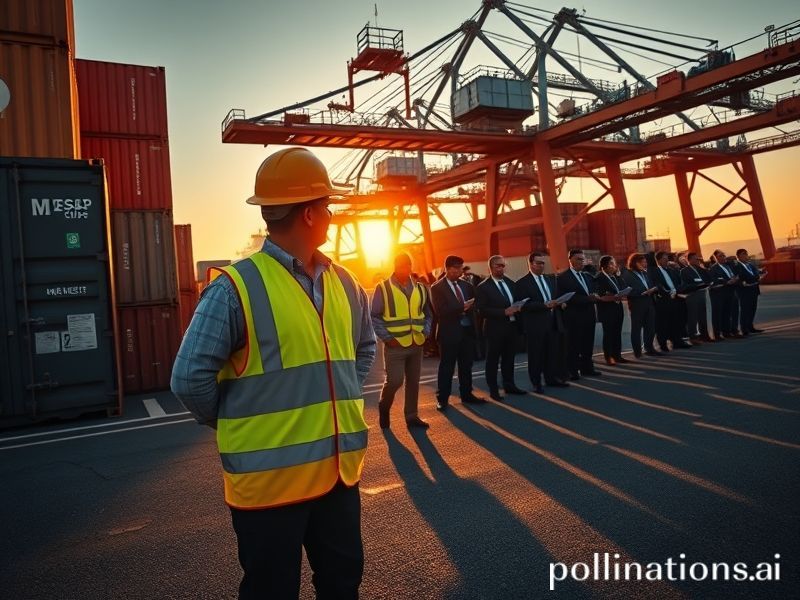
“Economy jobs” is the polite euphemism we now use for the sort of work that keeps the planet spinning while the rest of us refresh our portfolios. From the sweat-beaded brow of a Bangladeshi fast-fashion machinist to the algorithm-tethered soul of a Berlin “gig-economy” cyclist, these are the positions that exist precisely because someone, somewhere, decided that dignity was a non-essential line item.
Global supply chains have become the world’s most efficient misery-distribution networks. In Vietnam, workers stitch sneakers that retail in Stockholm for the equivalent of six months’ rent in Ho Chi Minh City. Meanwhile, in Sweden, a marketing intern—technically employed, technically housed—earns too little to buy the shoes she advertises. The circle of life, Disney forgot to mention, is largely powered by Excel spreadsheets and a faint smell of despair.
Take the Philippines, where the call-center industry has rebranded night as day, selling Western customer-service fantasies back to their originators. Agents adopt names like “Brad” and “Ashley,” practice Midwestern vowels, and absorb the existential residue of someone else’s broken Keurig. The pay is triple the local minimum wage, which sounds generous until you realize the minimum wage was calibrated to keep people hungry enough to answer the phone.
Across the Atlantic, Portugal touts itself as Europe’s sunny tech hub—translation: a place where software engineers accept 40 % less than their German counterparts in exchange for beach-adjacent burnout. Lisbon cafés brim with “digital nomads” sipping €5 flat-whites while writing code that will eventually delete someone’s job in Lyon. Everyone agrees the arrangement is “win-win,” especially the landlord who just quintupled the rent.
China’s answer to precarious labor is the “lying-flat” generation: young professionals who refuse overtime and instead perfect the art of looking busy without actually being so. Their rebellion is less Marx than MacGyver—crafted from VPNs, naps, and a finely tuned sense of cosmic futility. The government has responded with moralistic editorials and a few arrests, because nothing terrifies a growth-obsessed state like a demographic that discovers the off switch.
Latin America offers its own innovation: the “rappitendero” (Colombia) or “motochorro con propina” (Argentina), motorcycle couriers who gamble their lives for tips that barely cover brake pads. In Mexico City, entire families operate as Amazon last-mile subcontractors, turning living rooms into micro-warehouses where toddlers learn to bubble-wrap destiny. The World Bank applauds such entrepreneurship; the toddlers would prefer Legos.
Even the Gulf States—famous for importing entire economies—have discovered the beauty of disposable labor. Dubai’s Expo 2020 (held in 2021, because calendars are also on zero-hours contracts) showcased pavilions built by Nepalese workers whose passports were politely confiscated for safekeeping. The theme was “Connecting Minds, Creating the Future,” apparently with reinforced concrete and unpaid overtime.
All of this is overseen by a managerial caste armed with Slack, mindfulness apps, and the delusion that empathy can be scheduled bi-weekly between 2:00 and 2:15 p.m. They hold “all-hands” Zooms to celebrate quarterly earnings while the hands in question are somewhere in Sri Lanka, cramping over trackpads for $1.50 an hour. The stock photo accompanying the slide deck shows an ethnically diverse group high-fiving in a co-working space that exists only in the uncanny valley.
What binds these disparate toilers is the quiet understanding that their roles are engineered to be replaceable. The moment a robot can fold a T-shirt faster or a drone can deliver pad-thai without unionizing, the human component will be thanked for its service and escorted to the nearest exit. Until then, the global economy keeps humming—a choir of exhausted voices singing in 17 languages about free shipping.
So the next time you click “add to cart,” remember: somewhere, a person you will never meet is stapling their eyelids open so your serotonin can arrive by Tuesday. And if that doesn’t make you feel connected to the human family, well, there’s always next-day delivery.