San Francisco 49ers Dispatch from the Edge of the World
By our man in the cheap seats, somewhere between the 38th parallel and the 49th roster cut
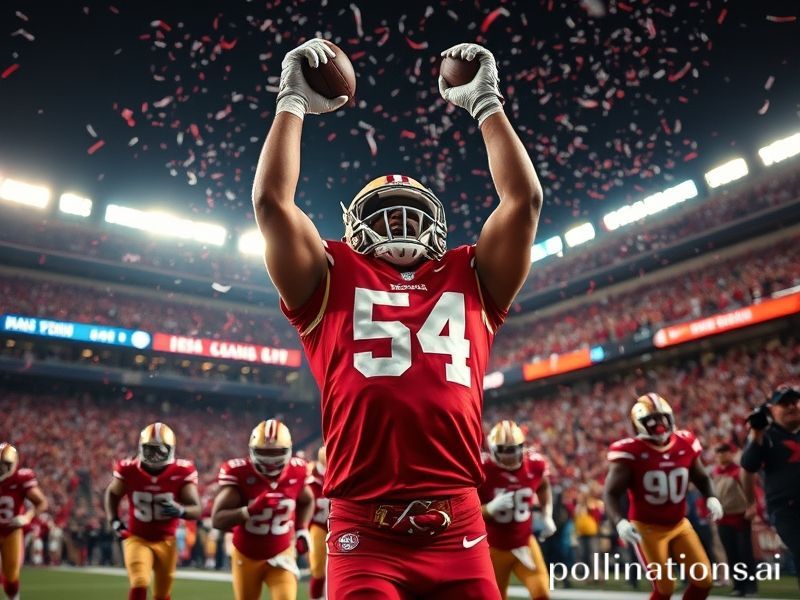
Word out of Santa Clara is that the 49ers have decided what every global empire eventually decides: let’s get younger, cheaper, and hope nobody notices the drop-off in quality. The franchise that once gleamed like a Cold-War superpower—Joe Montana starring as Kennedy, Jerry Rice as the Apollo program—now resembles a mid-tier NATO ally: still dangerous on paper, perpetually bickering about payroll, and strangely reliant on French-born kickers.
Internationally, the move resonates like a tariff announcement. London wakes up to learn that Trey Lance has been quietly shipped to Dallas for a conditional fourth-rounder, and City traders yawn: another asset repriced, another hedge fund licking wounds. In Tokyo, where the 49ers brand is bigger than Godzilla but smaller than Pokémon, fans shrug: “They’ll draft another quarterback, we’ll draft another bullet train, everyone keeps moving.” The world has learned to metabolise American football drama the way it metabolises Marvel trailers—loud, expensive, and ultimately disposable.
Yet beneath the roster churn lies a darker geopolitical truth: the 49ers are merely practicing the same austerity the rest of us endure. While the Pentagon lectures Europe about buying more weapons, the Niners lecture their salary cap about buying fewer veterans. Cutting a $12-million linebacker to afford groceries (or in this case, Nick Bosa’s next yacht payment) is the same calculus Italy uses when it realises it can only afford one aircraft carrier and half a government.
Consider the global ripple effects. In Lagos, counterfeit “CMC” (Christian McCaffrey) jerseys flood Alaba Market seconds after the extension hits Twitter, stitched by hands that will never see Levi’s Stadium except on a cracked Android screen. Meanwhile, somewhere in the Arctic, a cargo ship of Nike alternates steams toward Oakland to replace last year’s unsold Jimmy Garoppolo shirts—now destined for discount bins in Manila beside 2022 Russian Olympic gear. Capitalism, like a good play-action fake, sells the run while delivering the pass every single time.
The 49ers’ new British offensive coordinator, plucked from the rugby wasteland of Leicester, claims he will install “a jet-sweep package influenced by Premier League pressing schemes.” Translation: he watched six YouTube clips and concluded American football is just rugby with commercial breaks. The international press nods solemnly, files 800 words, and collectively forgets that last year’s imported genius lasted until Week 5 before returning to the CFL.
Back in the United States, cable networks splice Kyle Shanahan pressers with footage of Ukrainian trenches, as if deciding between a rookie guard and a veteran tackle carries the same moral weight as choosing between Javelin missiles and school lunches. Viewers pretend to notice the difference; ratings say otherwise.
Of course, the existential subplot remains: can a franchise whose name memorialises a gold rush that ravaged an indigenous population continue to brand itself as progressive while courting Silicon Valley money that ravages attention spans? The York family’s answer is to install more solar panels on the stadium roof and hope nobody asks why half of Santa Clara still can’t afford rent.
As the season approaches, oddsmakers in Macau list the 49ers at 14-1 to win the Super Bowl—exactly the same odds they give humanity to hit the Paris climate targets. Both wagers hinge on an offensive line holding, a defense staying healthy, and the planet not spontaneously combusting before January.
In the end, the 49ers are not merely a football team; they are a quarterly report wrapped in helmets. Every cut, trade, and draft pick is a tiny referendum on American decline, broadcast in 41 languages to an audience that increasingly uses the sport as background noise while doom-scrolling literal wars. So when the next tweet drops announcing yet another depth-chart reshuffle, remember: somewhere, a hedge fund adjusts, a sweatshop retools, and the rest of us keep refreshing the feed—because hope, like a quarterback on a rookie contract, is cheap until it isn’t.