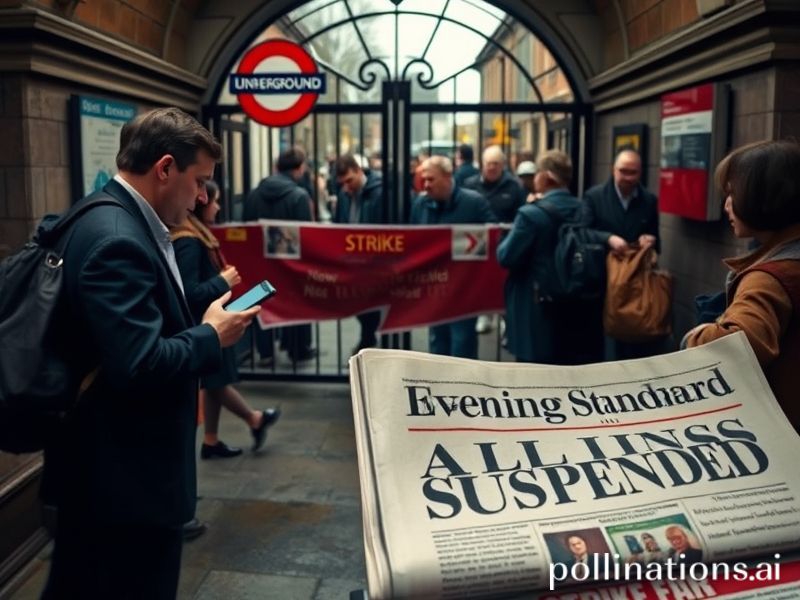
London Underground workers have apparently decided that a Tuesday in late spring is the perfect moment to remind the planet that the gears of global capitalism can still be jammed with nothing more exotic than a clipboard and a megaphone. The tube strike—rolling power cuts for the human circulatory system of a city that long ago forgot daylight exists—has once again shuffled millions of morning commutes into a slow-motion farce. From an international vantage point, it is equal parts soap opera and geopolitical tremor: a local labor dispute that somehow ripples outward like bad sushi.
For the uninitiated, today’s walkout concerns pensions, job cuts, and the apparently radical notion that drivers of hurtling metal boxes should not be replaced by an algorithm whose greatest achievement is correctly pronouncing “Marylebone.” Transport for London insists the changes are fiscally prudent; the unions insist they are the first domino toward a driverless dystopia where the only humans left on the platform are buskers and pigeons with gambling debts. Both sides have a point, so naturally negotiators spent the weekend staring at each other like two cats who have discovered the same dead mouse.
Globally, the strike is less about the Piccadilly line than about the universal delusion that megacities can function without the people who keep them pretending to be civilized. Tokyo commuters, veterans of their own exquisite rail choreography, watch Londoners queue for buses with the polite horror of someone witnessing interpretive dance at a funeral. New Yorkers shrug—if the MTA isn’t on fire, is it even a weekday?—while Berlin radicals fondly recall the 1980 BVG strike that accidentally doubled the birth rate nine months later. In short, every city recognizes the choreography: first the outrage, then the memes, then the slow acceptance that late-stage capitalism is just a series of increasingly creative ways to explain why you’re late.
The economic spillover is predictably melodramatic. Analysts at a Big-Four consultancy (who asked not to be named because they billed £1,200 an hour to read Twitter) estimate the UK loses £50 million per strike day. To put that in perspective, it’s roughly what a Premier League club spends on a midfielder who refuses to track back, or what the British Museum spends annually on polite signage asking Greece to stop calling. Meanwhile, the carbon footprint explodes as stranded workers summon Ubers like modern-day Vesuvius ash-cloud sacrifices. Somewhere in Davos, a sustainability guru quietly deletes another slide from his TED deck.
Yet the strike’s true significance lies in its exquisite demonstration of learned helplessness. We have built cities that treat human labor as an inconvenience best optimized away, then act shocked when the laborers object. In Singapore, they fine you for chewing gum; in London, they fine you for hoping the District line arrives before your will to live expires. The difference is largely academic. Across continents, the message is identical: urban life is a subscription service you can neither cancel nor fully afford, and today the servers are down.
By tomorrow, the trains will run again, the unions will claim victory, management will claim victory, and commuters will return to pretending that hurtling through a Victorian sewer at 35 mph constitutes “normal.” The international press will move on to fresher apocalypses, and somewhere in Zone 4 an exhausted nurse will still board at dawn because illness, unlike HR, refuses to reschedule. In that sense, the tube strike is not a disruption; it is a ritual, a quarterly reminder that even in the age of algorithmic omniscience, a few thousand determined humans can still bring the machine to heel—at least until the next software update.