The Weeknd Tickets: How a Scarborough Kid’s Tour Became the New Global Reserve Currency
By Dave’s Locker Foreign Desk
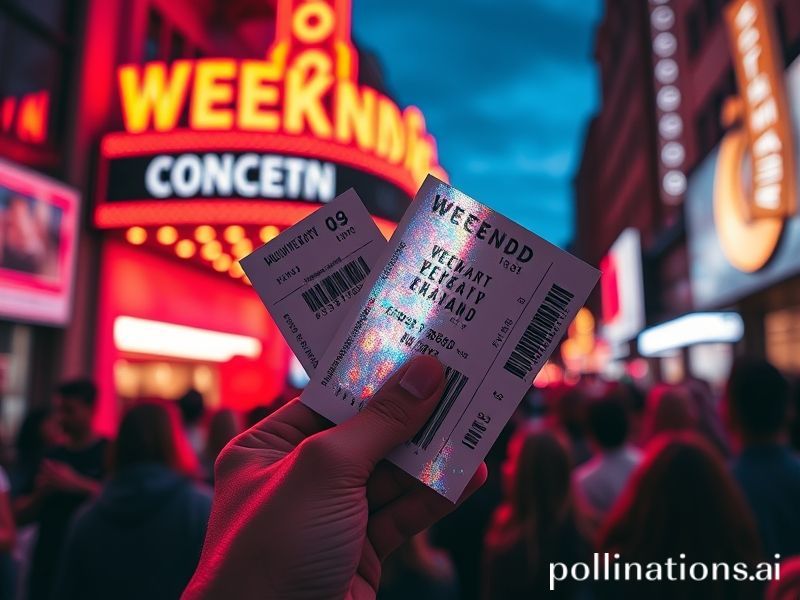
Somewhere between a Shanghai scalper’s WeChat group and a Berlin club kid’s burner phone, The Weeknd’s 2024 “After Hours Til Dawn” tickets are trading hands like miniature bearer bonds—only with more glitter and a higher failure rate than the Argentine peso. What began as a polite Canadian R&B project has metastasized into an international liquidity event: governments shrug at inflation, but fans from Lagos to Lima treat the phrase “face value” the way central bankers treat “transitory.”
In Seoul, office drones run three phones simultaneously—one for Ticketmaster, one for Yes24, one for the corporate VPN that pretends they’re still in California—while their bosses pretend not to notice, because the CFO needs a pair for his daughter’s gap-year redemption arc. The South Korean won may wobble, but a verified barcode on the floor of the KSPO Dome is harder currency than most family reputations.
Meanwhile, in Dubai, the resale market has gone full futures contract. A Lebanese fixer recently sold “options” on two VIP packages—strike price: one gold-plated iPhone and an undisclosed favor—before the public on-sale even began. The buyer was a Saudi prince who collects pop-star sightings the way his father collects British football clubs. The deal closed on a yacht that technically doesn’t exist on any registry. Somewhere, an IMF economist just felt a disturbance in the force and can’t explain why.
Europe, never one to miss a bureaucratic opportunity, is drafting new consumer-protection language aimed at “parasitic secondary ticketing platforms.” Translation: Belgian lawmakers want a cut. Until the statute passes, enterprising Dutch students are laundering allocations through NFTs, because nothing screams “anti-scalping” like blockchain receipts minted at 3 a.m. on a Tuesday. The carbon footprint is appalling, but so is missing the synth drop in “Blinding Lights,” so here we are.
Down in São Paulo, the queue for the Morumbi Stadium sale was less a line than a live-action sociology experiment. Street vendors hawked counterfeit wristbands next to evangelical preachers promising salvation to anyone who could score Section A. Both groups accepted Pix. By sundown, the only thing more abundant than tears was the smell of acarajé and broken dreams. A local economist noted that the unofficial ticket economy now rivals the state’s annual book-publishing revenue; the culture minister responded by suggesting books are also fungible.
Of course, the United States remains the spiritual home of predatory pricing. American Express presales, Citi cardmember windows, and the mysterious “artist presale” (password: “Starboy1989”) have turned the average Swiftie—sorry, Weekndette—into an algorithmic day trader. Congressional aides quietly admit that if Ticketmaster’s dynamic pricing engine were applied to student loans, the national debt would clear itself in a fiscal quarter. Instead, we get senators tweeting outrage while their interns refresh the queue on the boss’s platinum card.
The human collateral is global. A Kenyan software engineer missed his own engagement party because he was debugging a proxy server in a Nairobi cybercafé. In Manila, a call-center agent sold her K-drama merch to finance a flight to Singapore—only to discover the ticket she bought on Viagogo was a screenshot of a barcode from 2022. She now streams the concert from a pirated Twitch feed, sobbing gently into instant noodles. The feed buffers every time a drone flies overhead; poetic justice tastes like chicken flavor.
And yet, for all the dystopian pageantry, the phenomenon confirms something almost heartwarming: in an age of fractured everything, a falsetto about heartbreak still unites the planet’s anxious strivers. Oil sheikhs, Ukrainian coders, Chilean baristas—they all want the same two hours of artificial fog and expertly curated regret. We may not agree on vaccines, trade routes, or whether Twitter is real life, but we can synchronize our doomscrolling to a four-four beat at 120 BPM.
So when the lights finally dim in Melbourne, Mexico City, or Milan, take a moment to savor the miracle: humanity has engineered a planetary black market just to watch one man feel sorry for himself in real time. If that isn’t globalization’s twisted love letter, I don’t know what is. Just remember to enable two-factor authentication; love may be universal, but the resale bots are faster.