Troy Aikman: How a Helmeted Cowboy Became the World’s Most Unlikely Soft-Power Export
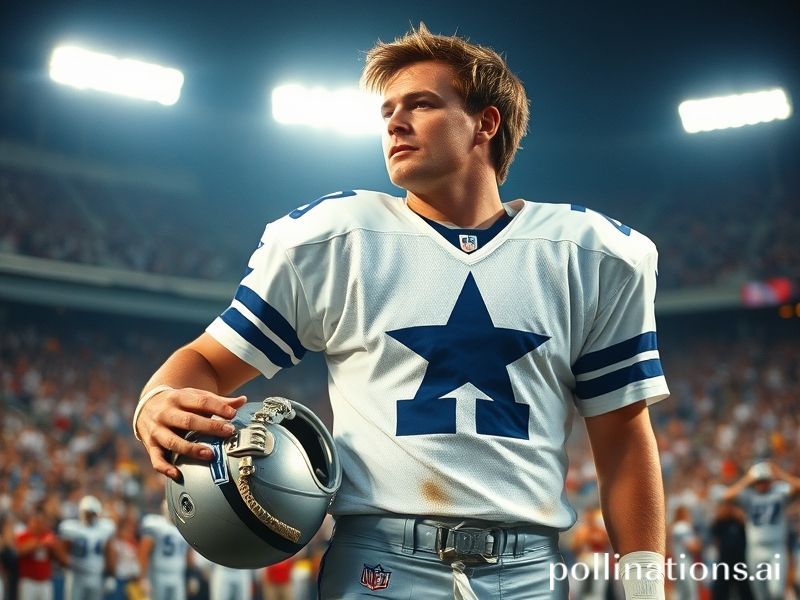
By the time Troy Aikman finished carving up NFL secondaries in the mid-90s, the Berlin Wall had already been rubble for half a decade and CNN was beaming grainy footage of American excess into living rooms from Lagos to Novosibirsk. What those distant viewers saw—beyond the shoulder pads, the Pepsi ads, and the ever-present star on the helmet—was a walking Rorschach test for late-century American mythology: tall, blond, surgically accurate, and faintly bored by his own greatness. In other words, a perfect Trojan horse for exporting Pax Americana in high-definition.
The rest of the planet didn’t tune in for the Cowboys per se; they tuned in for the soap opera. Aikman was the unflappable protagonist in a weekly telenovela that featured oil-baron owners, narcoleptic referees, and the faint whiff of collusion that makes any global audience feel right at home. While European soccer hooligans were busy repurposing stadiums as civil-war training grounds, Aikman stood in a pristine pocket, untouched, as if protected by a NATO no-fly zone. The symbolism wasn’t lost on anyone. If you wanted to understand why American empire looked so annoyingly frictionless, the answer was 60 yards of perfectly mowed Bermuda grass and a quarterback who never seemed to sweat.
Fast-forward past three concussions, a Hall of Fame induction, and the inevitable Fox Sports makeover, and Aikman has become something even more potent: a post-national commentator. On any given Sunday, his voice is piped into Bundesliga-adjacent sports bars in Bangkok, where expats argue over whether the Bills’ latest choke job proves the existence of original sin. Aikman’s commentary—equal parts Kansas plainsaw and Silicon Valley gloss—functions as a sort of Rosetta Stone for global capitalism. He translates the brutality of American football into the universal language of brand synergy, seamlessly pivoting from a replay breakdown to a Subway ad without ever dropping his aw-shucks cadence. Somewhere in Davos, a junior analyst is taking notes.
Meanwhile, the Chinese Super League is busy luring geriatric stars with suitcases full of yuan, and Saudi Arabia is staging exhibition games in air-conditioned mega-domes that look like Bond-villain lairs. But Aikman, relic of a simpler age when the only existential threat was the 49ers’ secondary, remains the reference point. Ask a random Atlético Madrid fan what “quarterback poise” looks like and he’ll mime Aikman’s languid drop-back, subconsciously accepting a cultural export that once arrived via shortwave radio and VHS tapes labeled “NFL Films.”
Of course, every empire eventually faces blowback. In France, philosophers who’ve read too much Baudrillard now claim Aikman’s stoicism was merely a simulation of stoicism, performed for a society that had already replaced reality with spectacle. In Argentina, where Maradona’s corpse is practically a national shrine, pundits sneer that Aikman never played through a broken ankle while dodging death threats from the local cartel. Fair enough—yet even the skeptics stream Monday Night Football on illegal fire sticks, proving that resentment and consumption can coexist like two hostile roommates splitting the rent.
The darker joke is that Aikman’s global afterlife mirrors our own collective denial. We watch him narrate modern gladiators smashing their cerebellums in real time, and we pretend the popcorn butter isn’t laced with complicity. Somewhere in a Zurich boardroom, an insurance actuary has already priced out the long-term cognitive damage, converting future dementia into present-day dividends. Aikman himself flogs concussion-awareness PSAs between beer commercials, because irony died long before Harambe did.
Still, the arc bends toward merchandising. You can now buy a limited-edition Aikman jersey stitched in a Vietnamese factory, shipped through Rotterdam, and sold to a teenager in Lagos who’s never seen a football game but recognizes the iconic star as shorthand for “aspirational Americana.” The jersey costs more than the local monthly minimum wage, which feels grotesque until you remember that the same calculus applies to every European soccer kit, K-pop album, and Tesla key fob. Troy Aikman, accidental prophet of late capitalism, simply happened to wear a helmet while preaching.
In the final analysis, the man who once read defenses like bedtime stories has become a bedtime story himself—an allegory of power so soft it could sell you a memory foam mattress. The planet keeps spinning, quarterbacks keep fracturing, and Aikman keeps narrating it all with the mild bemusement of someone who’s already cashed the check. History may not end with a whimper or a bang, but with a color commentator noting, “That’s gotta hurt,” right before we cut to commercial.