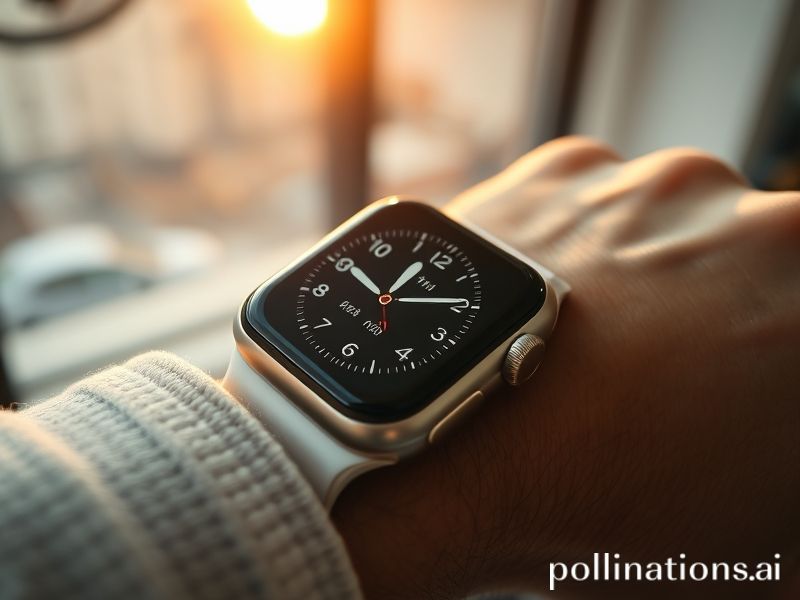
Somewhere between the Geneva motor show and a Lagos traffic jam, the Apple Watch completed its quiet conquest of the human wrist. Ten years ago it was a curiosity for Californian yoga instructors; today it is the de-facto visa stamp of the global middle class—more recognizable than most passports and twice as judgmental when you miss your stand goal.
The numbers are almost indecent. Apple now ships roughly 50 million watches a year, enough to circle the equator three times if you laid them end-to-end—an experiment certain Shenzhen factory managers have probably already costed out. In India, where the average monthly wage still struggles to buy the stainless-steel model, sales jumped 60 % last quarter. In Saudi Arabia, the Hermès edition is the new gold Rolex for twenty-something princelings who wish to appear both pious and athleisure-compatible. Even in Caracas, where inflation can erase a bolívar’s value during a single heartbeat, enterprising bachaqueros flip smuggled Series 9s for triple list price. Nothing says “hedge against collapse” like a gadget that reminds you to breathe while the economy hyperventilates.
Of course, the watch was never just a watch. It is a polite ankle monitor for the self-employed, a tamagotchi for adults who forgot to have children, and a tiny confession booth where you whisper your sins (12,847 steps, but only 27 minutes of exercise—Father Tim Cook is disappointed). In Seoul subway cars, junior Samsung engineers secretly tap-clack on their Apple watches under the table, the corporate equivalent of attending mass in the enemy cathedral. In Brussels, EU commissioners wear them to morning jogs while drafting antitrust suits against the very company that now knows their resting heart rate (58 bpm, suspiciously calm for someone regulating Big Tech).
The geopolitics of the wrist grow darker by the micron. Each watch contains rare earths wrestled from Congolese mud, lithium brine bled out of Chilean deserts, and micro-coils wound by hands whose own pulse is measured by productivity software. The supply chain is so intricate that a sneeze in a Malaysian clean room can cause a three-week delay in Berlin Christmas stockings. When Taiwan’s TSMC hiccups, the global bourgeoisie collectively develops heart palpitations—data the watch dutifully uploads to iCloud, where it is anonymized, aggregated, and monetized to sell you melatonin gummies.
Meanwhile, the watch’s health features have turned every wearer into an unwitting epidemiologist. During Delhi’s last pollution crisis, Apple’s servers registered a 14 % spike in blood-oxygen requests from Connaught Place alone—an accidental census of who could afford both N95 masks and titanium cases. In Kyiv, doctors use the ECG app to triage patients when Russian missiles knock out hospital power; the same waveform is simultaneously beamed to Cupertino and parsed for product improvements. The marketing copy writes itself: “Saving lives, one shareholder at a time.”
Yet the real revolution is sociological. The watch has become the smallest sovereign state on Earth, issuing its own border controls. Strap one on and you enter a timezone where meetings are never missed, calories are never unlogged, and the tyranny of the quantified self is enforced by gentle taps on the wrist—like a courtier whispering “Sire, your mortality is trending on Twitter.” In Lagos, young fintech employees brag about closing rings the way their fathers bragged about closing deals. In Paris, philosophers write essays about how the watch’s hourly stand reminders are late-capitalist parables of original sin. Both groups are correct, and both still buy the next edition.
We end, as all global stories must, on a container ship plowing through the South China Sea. In its steel belly, shrink-wrapped pallets of Series 10 watches sway gently, each box promising a longer life and a shorter attention span. The vessel is bound for Rotterdam, then by rail to Prague boutiques where they will gleam beneath vaulted ceilings older than the concept of minutes. Centuries ago, those arches housed prayers for salvation. Now they host queues for notifications. Same wrist, different religion.