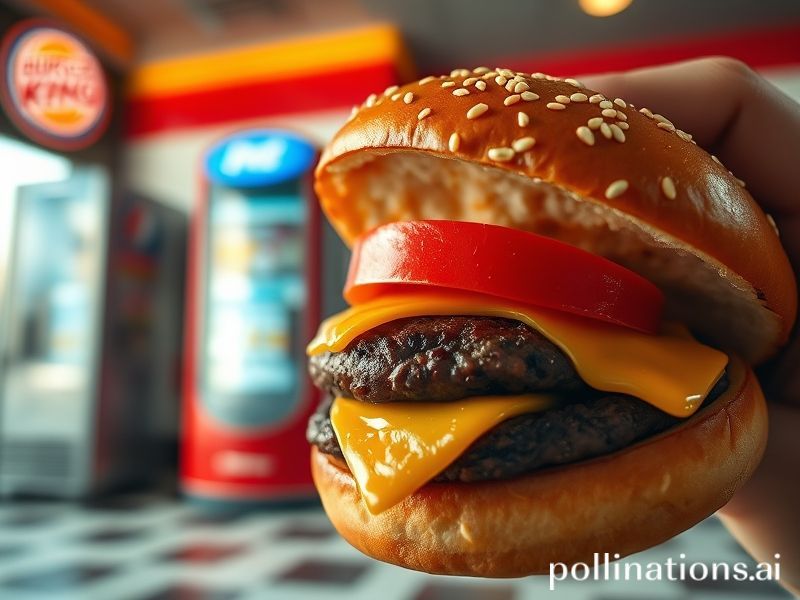
Burger King Japan’s announcement that it will serve a ¥2,000 (US $15) “Wagyu King” burger landed in my inbox while I was watching grainy footage of Sudanese refugees queueing for sorghum. The juxtaposition was almost too perfect: one civilization reduced to boiled grain, another racing to stuff the planet’s most pampered cow between two sesame-seed buns and call it “fast” food. Somewhere, the ghost of Ferdinand Marcos is wondering why he didn’t think of marketing Kobe sliders during the ’85 famine.
The burger itself is engineered theater. Frozen, not fresh, Wagyu patties—because nothing says “melt-in-the-mouth luxury” like a supply chain that begins in a Nebraska blast-chiller—are flown to Tokyo, flame-broiled by a teenager earning ¥1,100 an hour, then photographed under studio lights strong enough to tan a lizard. The result is a product that costs less than a Tokyo taxi ride yet promises the epicurean ecstasy once reserved for emperors and hedge-fund divorce celebrations. Globalization’s final gift: democratic access to aristocratic fat, served in paper.
From São Paulo to Dubai, franchises are watching like vultures at an all-you-can-eat carrion buffet. If the Wagyu King moves units, expect copycats: McDonald’s “McKobe” in Riyadh (with halal certification, naturally), KFC’s “Wagyu Zinger” in Lagos, perhaps even a vegetarian “Wagyu-lite” in Portland grown from cultured fat cells and existential dread. The supply chain, already stretched thinner than a oligarch’s tax returns, will scramble to rebrand any cow that once stood still long enough to be photographed next to a beer bottle. By 2026, “Wagyu” will be a synonym for “beef that once saw a passport,” and the word “Kobe” will appear on menus the way “Tuscan” now adorns canned minestrone.
Environmentalists are, predictably, having a conniption. A single Wagyu patty requires roughly 1,500 liters of water and enough grain to bribe three mid-level warlords. Multiply that by the 16 million burgers Burger King moves daily worldwide, and you’re basically turning the Amazon into a feedlot one sesame seed at a time. But let’s not moralize too loudly; the same activists posted their outrage from iPhones charged by Mongolian coal plants while wearing lithium-mined sneakers. Hypocrisy, like cholesterol, is only dangerous when other people have it.
The geopolitical angle is tastier than the burger itself. Japan’s decision to monetize its culinary heritage comes as the yen limbo-dances to 34-year lows and China slaps restrictions on Japanese seafood because Fukushima water allegedly glows in the dark. Tokyo needs export wins that don’t require US fighter jets; selling symbolic beef to mall rats is cheaper than rearmament and plays better on Instagram. Meanwhile, Washington smiles: every patty shipped is one more Japanese mouth reliant on American frozen beef futures, a rare victory in a trade relationship that lately resembles a divorced couple arguing over who keeps the Peloton.
Consumers, those reliable punchlines in the planetary sitcom, will queue for the privilege of photographing their lunch, bite once, remember they actually prefer chicken, and toss the rest—thus completing the sacred cycle of late-capitalist liturgy. The discarded wrapper will migrate to a Manila river where children who’ve never heard of Wagyu will fish it out for recycling money, proving that everything really does come full circle, especially garbage.
In the end, the Wagyu King is not about beef; it’s about storytelling—an edible fairy tale we tell ourselves while the world burns politely in the background. The moral? If you can’t stand the heat, put a $15 burger in it and call it premium. Just chew quickly; history is served rare, and it’s getting colder by the minute.