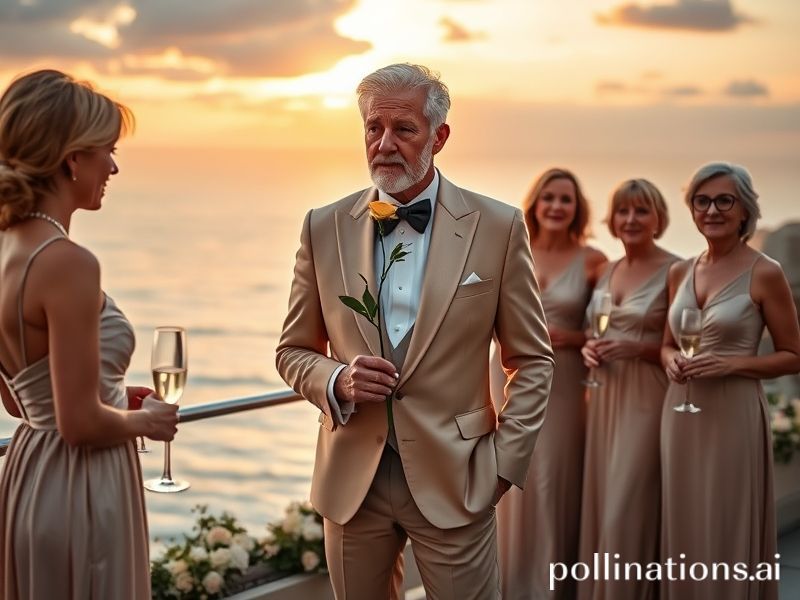
The Golden Bachelor 2025: When Geriatric Love Becomes Global Geopolitics
In a world where nuclear powers play chicken over shipping lanes and artificial intelligence is busy writing love letters to itself, humanity has found its latest distraction: watching a 72-year-old pharmaceutical magnate from Pasadena navigate the treacherous waters of televised romance. The Golden Bachelor 2025—now broadcasting to 147 countries with subtitles in 23 languages—has somehow become our species’ most successful diplomatic initiative since the invention of the Happy Meal.
While BRICS nations plot their escape from dollar dominance and Europe discovers the hard way that Russian gas wasn’t just a lifestyle choice, global audiences have tuned into what critics are calling “the geriatric Hunger Games with better lighting.” The show’s protagonist, Gerry Turner—because apparently Americans can’t spell “Jerry”—has unwittingly become a symbol of something much larger than his collection of sensible cardigans and stories about his 1967 Mustang.
From the cafes of Buenos Aires to the living rooms of Lagos, humanity watches with bated breath as septuagenarians navigate rose ceremonies and helicopter dates, proving that the human capacity for delusion remains the only truly renewable resource. The show’s international success has spawned local versions faster than you can say “demographic time bomb”—Japan’s “Silver Samurai of Love” features contestants who remember the original samurai, while Italy’s “L’Amore D’Oro” has become must-view television in a country where the average age now exceeds the life expectancy of medieval peasants.
The economic implications are staggering. China’s state television has reportedly paid record sums for broadcasting rights, seeing the show as perfect propaganda for their “lying flat” generation—why overthrow capitalism when you can watch your parents’ generation find love in a hot tub? Meanwhile, Russian oligarchs have been spotted buying American retirement communities, apparently betting that the future of entertainment lies in watching wealthy widows compete for companionship between pickleball tournaments.
International relations experts—when they’re not busy updating their LinkedIn profiles—note that the show’s global appeal coincides perfectly with the world’s pension crisis. “It’s genius, really,” explains Dr. Henrietta Voss from the Institute for Studying Obvious Things in Geneva. “Why address the systematic abandonment of the elderly when you can convince them that their golden years should be spent in televised wife auditions?”
The cultural export has proven particularly potent in nations grappling with aging populations. South Korea, a country so youth-obsessed that 60-year-olds filter their faces into oblivion, has embraced the show as proof that romance doesn’t die—it just gets more pharmaceutical sponsorships. France, naturally, has created a more philosophical version where contestants discuss Sartre between wine tastings, though ratings suggest global audiences prefer their senior citizens less existential and more prone to hot tub confessionals.
What makes this international phenomenon particularly delicious is how perfectly it captures our collective denial. While climate change accelerates and democracy performs its death rattle across multiple continents, we’ve decided that the most pressing question facing humanity is whether Gerry will choose the retired nurse from Arizona or the former flight attendant who definitely isn’t here for his money.
The show’s producers, ever attuned to the pulse of global anxiety, have announced plans for “Golden Bachelor: World Tour,” where contestants will navigate romance across different cultures, presumably while learning that heartbreak sounds remarkably similar in every language. Rumors suggest special episodes filmed in countries with particularly bleak demographic futures—because nothing says “romantic getaway” quite like visiting nations where the birth rate has dropped below replacement level.
As the world watches wealthy seniors navigate manufactured romance against backdrops of international luxury, one thing becomes clear: we’ve collectively decided that facing our actual problems is less appealing than watching septuagenarians play musical chairs with engagement rings. In the words of one particularly candid contestant: “At our age, we don’t have time for games—unless they’re televised and come with a potential book deal.”
The roses are red, the violets are blue, and somewhere in a retirement community near you, love is blooming in high definition while civilization quietly expires.