Harrison Smith and the Curious Global Cult of the American Safety
Dateline: Somewhere over the Atlantic, where Wi-Fi costs more than a decent bottle of Moldovan wine and still drops every time the plane hits a cloud. From this altitude, the spectacle of modern fandom looks remarkably uniform: whether you’re in Lagos, Lyon, or Lahore, the same blue-and-white jerseys flicker across airport bar televisions, all bearing the surname of a man who tackles strangers for a living—Harrison Smith.
For the uninitiated, Smith is the Minnesota Vikings’ free safety, a position whose very name sounds like a tax shelter for Swiss bankers. Yet in 2024 his reputation has vaulted beyond the parochial swamps of U.S. sports talk radio and into the broader global consciousness, the way a BTS single or a new strain of avian flu might. Why? Because the world is currently starved for uncomplicated heroes, and Smith—31, taciturn, fond of fly-fishing—fits the bill like a pair of well-worn Birkenstocks. He hits hard, speaks softly, and has never (to public knowledge) purchased a cryptocurrency. In an age when national leaders can’t be trusted with their own social-media passwords, that passes for moral clarity.
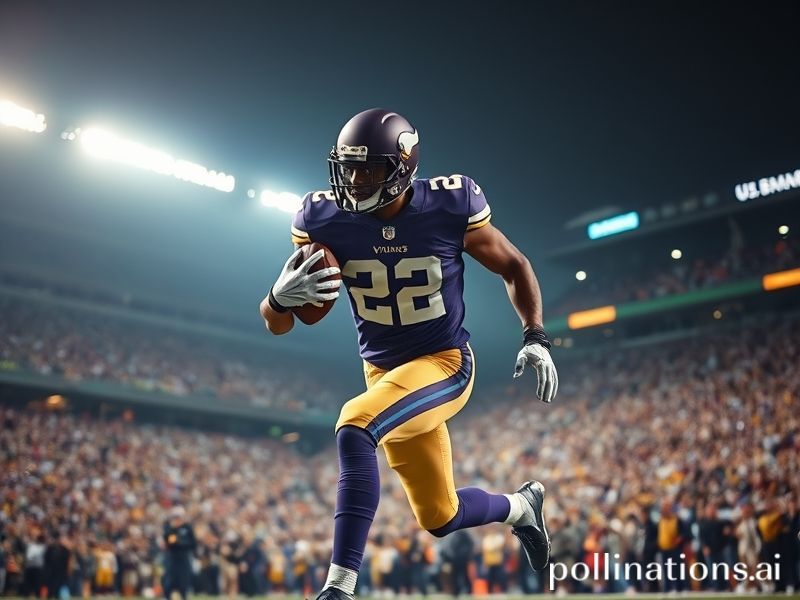
The international ripple effects are subtle but measurable. Scandinavian defensive coordinators now binge All-22 film the way teenagers doom-scroll TikTok. Japanese sports networks splice his interceptions into highlight packages between segments on bowing etiquette. Even the French—who traditionally treat American football the way they treat American coffee—have begun muttering “Formidable, ce Smith” into their morning croissants. Global streaming rights for NFL games have spiked 18% year-over-year in markets where Smith’s name recognition now outranks that of several mid-tier EU trade ministers. Somewhere in Brussels, a bureaucrat drafting regulations on turnip curvature is wondering why his teenage son suddenly wants a purple #22 jersey instead of a subsidized Erasmus year.
Of course, the machinery that propels Smith across borders is the same one that brings you algorithmic pop songs, Marvel spin-offs, and oat-milk shortages: late-stage capitalism in cleats. Nike ships his signature sneakers from Vietnamese factories to sneaker boutiques in Dubai, where they retail for the equivalent of a Bangladeshi garment worker’s monthly wage. EA Sports renders his digital doppelgänger with the loving care once reserved for Renaissance Madonnas, ensuring that a kid in São Paulo can virtually pancake a kid in Saskatchewan while both complain about server lag. The whole spectacle is so seamlessly globalized that you half expect Smith to celebrate tackles by unveiling a QR code linking to a discount on Icelandic thermal socks.
And yet, beneath the merchandising gloss lies a darker, almost comforting truth: the planet still craves narratives of controlled violence. With Ukraine smoldering, Sudan imploding, and the Amazon approaching medium-rare, watching a 210-pound man legally upend a 220-pound man offers a rare moral clarity. The boundary between good and evil is literally painted in chalk. The clock counts backward to zero, mercifully ending every dispute. No wonder United Nations cafeteria screens now default to NFL RedZone during lunch breaks; peacekeepers need palate cleansers between genocide reports.
Smith himself remains endearingly oblivious to his role as geopolitical pacifier. Interviewed after a recent win, he attributed his two interceptions to “just reading my keys” and “trusting the scheme”—phrases that, if uttered at Davos, would be immediately dissected for hidden metaphors on supply-chain resilience. Asked about his global fan base, he shrugged, said “That’s pretty neat,” and promptly returned to discussing walleye fishing on Mille Lacs Lake. Somewhere, a think-tank fellow just updated a white paper on “Performative Authenticity in Post-Hegemonic Soft Power.”
The takeaway, dear reader, is not that Harrison Smith will solve climate change or broker Middle East peace. He will, however, continue to sprint, collide, and occasionally cartwheel into our collective consciousness at 4K resolution, reminding us that for all our sophisticated despair, we remain simple mammals who enjoy watching other mammals run really fast in predictable patterns. In a fractured world, that may be the safest form of unity available—at least until the Wi-Fi cuts out again somewhere over the Atlantic.