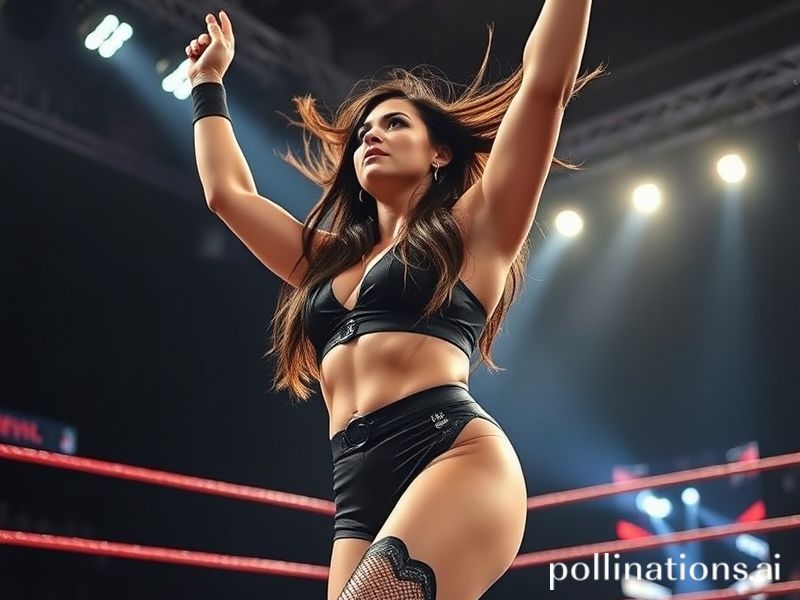
The Bella Epoch: How a WWE Diva Became the Perfect Metaphor for Our Global Identity Crisis
In the grand theater of international affairs—where nuclear powers play chicken in the Taiwan Strait and central banks perform interpretive dance with inflation rates—it’s oddly fitting that Nikki Bella, a professional wrestler from Scottsdale, Arizona, has emerged as our most honest diplomat. While the UN Security Council debates the semantics of “concern” versus “grave concern,” Bella has been quietly demonstrating what soft power actually looks like in the age of OnlyFans and OnlyFams (families, that is, for those still clinging to traditional social structures).
The global implications are, in a word, spectacular. From Mumbai to Manchester, young women aren’t just emulating Bella’s signature move set—they’re adopting her particular brand of entrepreneurial feminism, where bodily autonomy meets brand autonomy in a perfect suplex of late-stage capitalism. In Brazil, fitness influencers now speak fluent “Bella”—a dialect mixing Spanish-English code-switching with the universal language of sponsored content. Meanwhile, Japanese wrestling promotions report that their biggest export isn’t athletic prowess anymore, but the very concept of the “influencer-athlete,” a hybrid species that Nikki perfected somewhere between her first reality show and her wine label launch.
What makes this particularly delicious from an international perspective is how Bella represents America’s most successful export: the monetization of personal narrative. While China exports rare earth minerals and Germany peddles precision machinery, the United States has cornered the market on turning human experience into content. Nikki Bella isn’t just a wrestler; she’s a one-woman special economic zone, operating in that liminal space where athletic achievement, relationship drama, and entrepreneurial grit become indistinguishable from each other.
The broader significance becomes apparent when you consider how Bella’s brand transcends traditional geopolitical boundaries. In Russia, where the state has weaponized traditional gender roles, her empowerment narrative finds surprising traction among women who see in her a blueprint for financial independence that doesn’t require oligarch patronage. Across the Middle East, her journey from athlete to entrepreneur resonates in countries where female athletic participation remains controversial but female economic participation is increasingly vital.
Perhaps most tellingly, Bella’s twin careers—in-ring performer and lifestyle guru—mirror the global economy’s own identity crisis. Just as she’s both athlete and entrepreneur, countries now find themselves both manufacturers of goods and manufacturers of influence. Switzerland doesn’t just make watches anymore; it makes the concept of Swiss precision. South Korea doesn’t just export electronics; it exports the very idea of Korean cool. Nikki Bella, in her infinite wisdom, understood this before the World Economic Forum did: in the attention economy, you’re always selling two products—the thing you make and the story of how you made it.
The dark joke here is that while we debate trade wars and currency manipulation, the real economic battleground is being fought over who controls the narrative of female empowerment. Bella’s particular genius was recognizing that authenticity itself could be branded, packaged, and sold back to the very people seeking it—a capitalist ouroboros that would make even the most cynical Davos delegate blush.
As we hurtle toward whatever fresh hell the 2020s have planned for us, Nikki Bella stands as both prophet and product of our times: a woman who turned the very performance of womanhood into a multinational corporation. In a world where traditional institutions are losing credibility faster than a wrestling promoter at a Senate hearing, perhaps we shouldn’t be surprised that our new global ambassadors come with finishing moves and reality TV contracts. After all, in the squared circle of international relations, we’re all just working an angle.