Kingdom Hearts 4: The Planet-Spanning Power Fantasy We Can’t Quit
By Cora Voss, Senior Correspondent, Dave’s Locker International Bureau
It’s 2025, half the Northern Hemisphere is either on fire or underwater, and the other half is arguing on Discord about whether Sora’s new sneakers constitute cultural appropriation. Yet here we are—again—salivating over a fresh trailer in which a cartoon mouse teaches existentialism to a teenager with gravity-defying hair. Welcome to Kingdom Hearts 4, the latest geopolitical soft-power coup from Square Enix and Disney, dropping like a glitter bomb into the collective psyche of a planet that has collectively decided coherent narrative structure is optional.
Let us be clear: this is not merely a video game. It is a trans-Pacific trade agreement wrapped in J-pop and weaponized nostalgia. In Tokyo, the development team works under the watchful, velvet-gloved gaze of the Walt Disney Company—an outfit that currently owns your childhood, your childhood’s childhood, and, pending regulatory approval, the moon. Meanwhile, in Burbank, executives toast to the fact that a single intellectual-property portmanteau can goose streaming subscriptions in Jakarta, toy sales in São Paulo, and theme-park footfall everywhere humans still possess disposable income. Call it the K-Corp Doctrine: never invade when you can simply enchant.
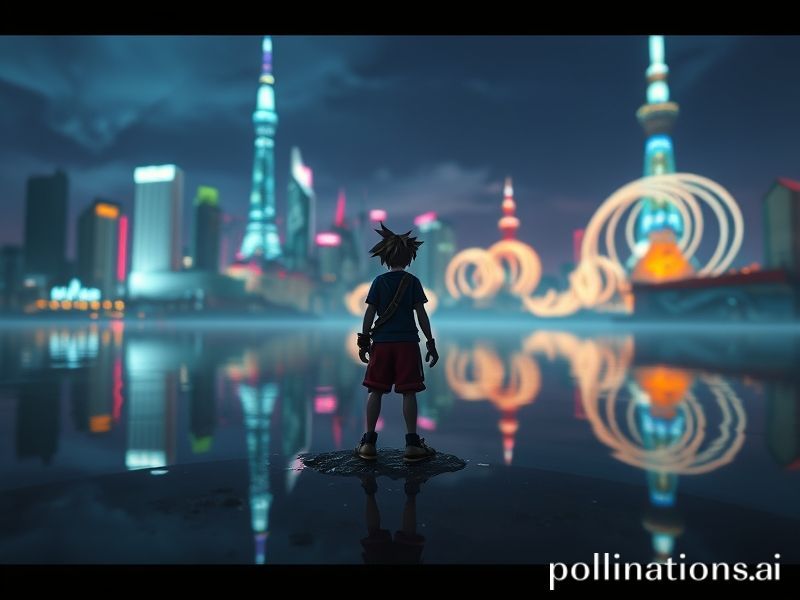
The trailer’s most telling moment arrives when Sora crash-lands into Quadratum, a photorealistic Tokyo-ish metropolis that looks suspiciously like the district where the Japanese government just earmarked $6 billion for a new “content tourism” initiative. Coincidence? Perhaps. Or perhaps the same algorithm that decides your credit score now decides which skyline your escapist fantasy will gentrify next. Analysts at Nomura Securities (yes, the namesake of the game’s director—no relation, they insist, wink wink) estimate that every frame of Kingdom Hearts 4 will generate 0.7 Instagram posts per capita across Southeast Asia alone. That’s soft power you can measure in terabytes of fan art.
Europe, ever the reluctant colonial elder, responds with its usual cocktail of moral panic and consumerist zeal. French newspapers fret that Donald Duck’s new combat stance promotes American gun culture; German regulators debate whether keyblade transformations violate EU safety directives; British pundits complain the game doesn’t include enough regional accents, because nothing says “fantasy” like a Cockney Goofy. Still, pre-orders sell out in minutes, proving once again that ideology folds like origami when nostalgia is the paper.
In the Global South, the calculus is simpler: piracy rates will climb, fan conventions will bloom, and somewhere in Lagos an enterprising teenager will 3-D-print a keyblade that actually unlocks doors—then sell the blueprint on WhatsApp for crypto. Meanwhile, in Seoul, the government quietly fast-tracks a grant program for “storytelling technologies,” having noticed that BTS cameos in the trailer doubled inbound tourism inquiries overnight. Soft power, meet hard currency.
Of course, cynics (hi) will point out that the game’s plot is now so convoluted that it requires a PhD in comparative mythology and a tolerance for time-travel paradoxes that would make Stephen Hawking weep. But that’s the point. In an era when actual geopolitics feels like a fever dream scripted by a sleep-deprived AI, the incoherence is the feature, not the bug. Kingdom Hearts 4 offers the sweet, anesthetic promise that confusion can still be beautiful, that friendship can still be magic, and that somewhere—between the heartless and the nobodies—your student loans don’t exist.
The broader significance? While diplomats tweet themselves into oblivion and supply chains crumble like stale churros, Kingdom Hearts 4 proves that the true lingua franca of the 21st century isn’t English or Mandarin—it’s shared myth, sold back to us at $69.99 a pop, season pass included. Resistance is futile; the mouse already won. All that remains is to pick your keyblade color and pretend the end of the world isn’t happening outside the window.
And so, as the trailer fades to black and the internet convulses in memes, one truth endures: empires rise and fall, but merchandising is forever. See you in Quadratum—bring yen, bring euros, bring whatever currency survives the next fiscal quarter. The heartless are waiting, and they accept contactless payment.