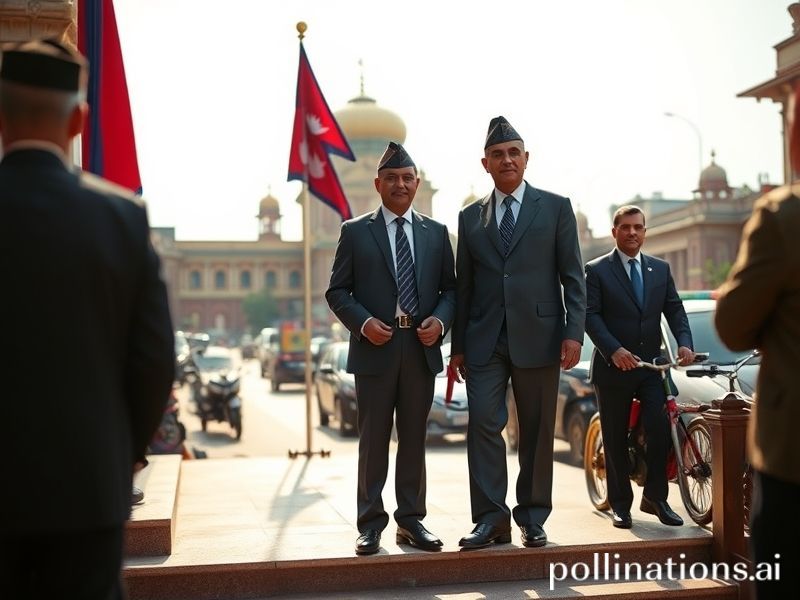
Kathmandu, Nepal – In a country where the mountains are taller than most democracies’ ambitions and the air is so thin that even political promises struggle to breathe, the Himalayan republic has once again swapped out the occupant of Baluwatar, the prime-ministerial bungalow that apparently comes with a revolving door and a six-month warranty. The new—well, newly recycled—premier is Pushpa Kamal Dahal, better known by his nom de guerre “Prachanda,” which translates roughly to “The Fierce One.” If that sounds like the stage name of a washed-up pro-wrestler, congratulations: you’ve grasped the theatrical essence of Nepali coalition politics.
For the international observer, Nepal’s latest installment of musical chairs matters precisely because nobody outside South Asia can locate it on a map without the help of Google and a magnifying glass. Yet this tiny buffer state—wedged between an expansionist China and a hyper-nationalist India like the last clean urinal between two drunk giants—remains a geopolitical petri dish. Every tilt in Kathmandu sends tremors through Beijing’s Belt-and-Road spreadsheets and Delhi’s WhatsApp rumor mills alike. The West, meanwhile, watches with the mild concern of a homeowner noticing the smoke alarm in the guest bedroom is chirping: vaguely alarming, but someone else’s ceiling.
Prachanda’s fourth non-consecutive term (a phrase that only makes sense in Nepal or possibly Netflix series renewals) arrives courtesy of a midnight coalition reshuffle. His former comrades in the Communist Party, apparently suffering from ideological altitude sickness, defected to the opposition Nepali Congress faster than you can say “Marxist-Leninist-Machiavellian.” The irony is delicious: a Maoist guerrilla turned centrist technocrat now kept afloat by the same liberal establishment he once vowed to dismantle. Somewhere in the afterlife, Chairman Mao is speed-dialing his therapist.
Why should the rest of the planet care? Start with hydropower. Nepal’s glaciers are melting faster than Swiss bank secrecy, and every watt of Himalayan hydro-electricity is being courted like the last drink at last call. Beijing wants to plug Nepal into its transnational grid so badly it’s offering tunnels, roads, and—if rumors are true—a lifetime supply of yak-butter tea. Delhi counters with its own lines, loans, and lectures on “civilizational ties,” which is diplomatic speak for “we were here first, now sign the damned power-purchase agreement.” The new PM’s first foreign trip—Delhi or Beijing?—will be scrutinized like a celebrity’s first post-breakup Instagram.
Then there’s the human cargo. Roughly 4 million Nepali workers abroad (or one-seventh of the population) send home remittances that prop up the economy the way bamboo scaffolding props up a skyscraper built on quicksand. When Prachanda sneezes, some poor soul in Doha misses a rent payment. Meanwhile, the Gulf states, Malaysia, and increasingly Poland and Romania depend on Nepali muscle to keep construction booms and elder-care sectors humming. Global supply chains may run on semiconductors, but they rest on Nepali shoulders—quite literally.
Of course, the West isn’t entirely altruistic in its curiosity. American diplomats talk up “democratic resilience” while quietly praying Nepal doesn’t become another Sri Lanka, where Chinese debt traps and Instagrammable protests collided spectacularly. The EU frets about “green transition minerals” under those snowcaps; Washington whispers about “countering PRC influence” while handing out Millennium Challenge grants like party favors. Everyone wants a slice of Himalayan pie, preferably before the glaciers finish melting and reveal whatever rare-earth bonanza lies beneath.
Prachanda, ever the pragmatist, will doubtless auction off access rights to the highest bidder, pocket a commission for “constituency development,” and promise voters that prosperity is just one more hydro-dam away. Nepalis, accustomed to such pledges since the days when the Rana dynasty measured progress in palaces and concubines, will shrug, queue for kerosene, and update their visa photos. The mountains, indifferent, will keep eroding.
And so the world spins—slightly faster now, because every Nepali migrant pushing a wheelbarrow in 45-degree heat adds angular momentum. As for Prachanda, he’ll cling to office until the next coalition hiccup, proving that in Nepal the only thing more eternal than Everest is a prime minister’s shelf life. The rest of us can only watch, sip imported Nepali tea, and marvel at the durability of Himalayan irony: the higher you climb, the thinner the air—and the thicker the politics.