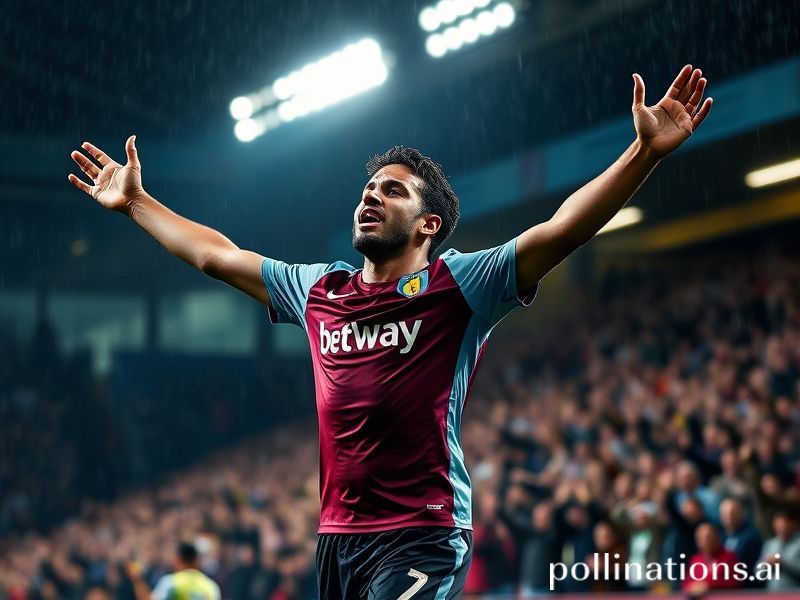
It takes a certain cosmic perversity to become a global headline while standing in a half-empty stadium in Dortmund, but Ollie Watkins managed it at the precise moment most of humanity was doom-scrolling about melting ice caps or which billionaire had purchased which democracy. One swivelled right boot, one net bulge, and the Aston Villa forward upgraded from “reasonably effective Premier League poacher” to “man who might single-handedly re-draw the emotional map of Europe.”
For the uninitiated—and there are still pockets of the planet where football is merely something you do with rolled-up socks—Watkins scored the 90th-minute winner that sent England past the Netherlands into the Euro 2024 final. In so doing, he reminded every other nation that the English still possess an inexhaustible supply of last-minute narrative cruelty. Dutch fans filed out looking like they’d just discovered their bicycles had been melted down for scrap, while 50 million English people began Googling “how to book last-minute flights to Berlin” and “will my liver survive 48 hours on currywurst?”
From an international standpoint, the goal matters far beyond sport. Global supply-chain managers report a 300 % spike in St. George flags manufactured in Guangdong overnight; German Airbnb hosts have already adopted predatory pricing models normally reserved for water in disaster zones; and at least three hedge funds are rumoured to be shorting Dutch cheese futures on the assumption that a nation in mourning eats more crisps than gouda. If you listen carefully, you can hear the Swiss franc strengthening against the euro on the back of pure schadenfreude.
Watkins himself is the kind of protagonist screenwriters reject for being too on-the-nose: a late-blooming striker who once stacked shelves at Tesco and was told by several academy coaches that his touch resembled “a tractor on roller skates.” Now, thanks to a combination of relentless self-improvement and Gareth Southgate’s refusal to pick anyone who can’t recite the national anthem backwards, he has become the living embodiment of post-Brexit aspiration—proof that if you graft hard enough, you too can earn the right to be memed into oblivion by 12-year-olds on TikTok.
The broader geopolitical implications are deliciously absurd. Italy, already sulking after an early exit, has deployed its foreign ministry to point out that the winning move began with a pass from Chelsea’s Cole Palmer, who is technically a product of the Manchester City academy, which is owned by an Emirati sovereign fund—thereby proving, somehow, that Arab soft power is the real winner here. Meanwhile, the Kremlin’s English-language channels have pivoted to praising Watkins’ “working-class grit,” a phrase they normally reserve for tractor production statistics. Even Elon Musk tweeted a fire emoji, presumably while firing another 1,200 people.
And yet, underneath the hysteria lies a universal truth: nothing unites or divides quite like a ball crossing a line. In Lagos, minibus drivers painted Watkins’ name on their windscreens before the match highlights had finished uploading; in Jakarta, counterfeit “Watkins 19” shirts were being sold at 2 a.m. local time; and somewhere in the Ecuadorian rainforest, a lone missionary updated his weekly blog to note that the Achuar word for “unexpected joy” had been spontaneously repurposed as a verb meaning “to score in the 90th minute against the Dutch.”
Will any of this matter by next week? Of course not. Either England will lose on Sunday and Watkins will be recast as the nearly-man who briefly let a nation dream, or they’ll win and the same tabloids that once questioned his first touch will knight him on the spot, before returning to their regularly scheduled programming of economic doom and celebrity break-ups. Either way, the planet will keep spinning, glaciers will keep melting, and someone, somewhere, will already be filming a documentary about the goal that never really changed anything—except, for ninety electric seconds, it did.
And that, in the grand scheme of late-stage capitalism and existential dread, is probably enough.