Panama: Where the World Goes to Park Its Dirty Laundry
By Santiago “Santi” Vargas, Senior Correspondent, Dave’s Locker
The first thing you notice when you land in Panama City is how aggressively new everything looks. Skyscrapers erupt like chrome mushrooms after a rainstorm of offshore cash. The second thing you notice is that half the skyline is emblazoned with corporate logos that could be written in invisible ink—because, officially, they’re barely here at all. Welcome to the planetary laundromat, where nations, oligarchs, and your favorite streaming-service tax department all spin-dry their reputations at thirty revolutions per minute.
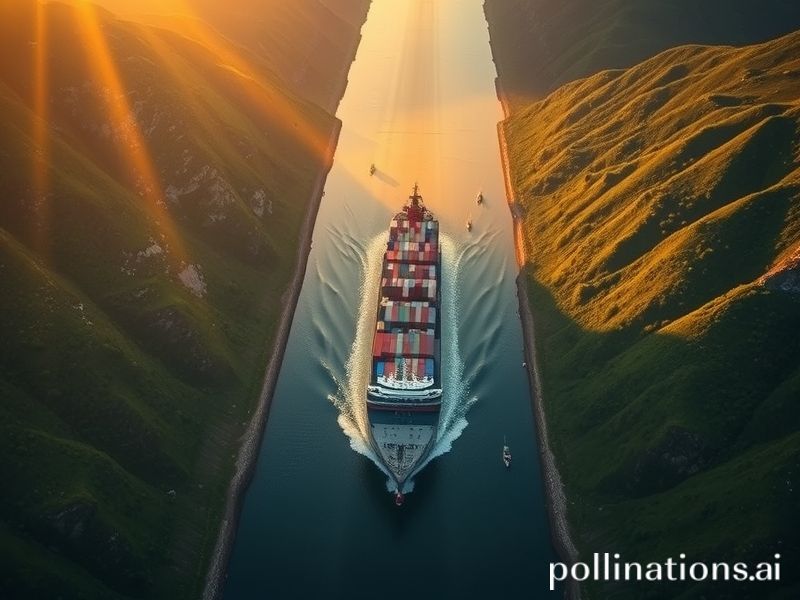
Panama’s canal, that 50-mile surgical scar across the isthmus, is still the country’s most honest business. Every day it swallows 40-odd cargo ships—some hauling your Christmas tchotchkes, others stacked with sanctioned oil that has mysteriously forgotten its birthplace. The tolls are public, the tonnage dutifully logged, and the waterway remains one of the few places on Earth where global supply chains can’t pretend to be Delaware shell companies. Ironically, the canal’s transparency makes it an outlier in a nation that has otherwise turned opacity into a sovereign export.
Of course, the world didn’t suddenly discover Panama’s charms last week. The 2016 Panama Papers leak was supposed to be the scandal that ended all scandals—11.5 million documents, 214,000 offshore entities, and enough shell corporations to restock the Galápagos. Instead, it functioned like a Yelp review for wealth management: four stars, would hide assets here again. Iceland’s prime minister resigned, Pakistan’s did too, and then everyone else discovered that outrage has a half-life roughly equivalent to TikTok dances. Today, Panama’s finance sector is bigger, sleeker, and—if you believe the marketing—so compliant it practically files its own suspicious-activity reports out of sheer boredom.
Geopolitically, Panama is the Switzerland nobody wants to admit is Switzerland. The United States, which originally carved the country out of Colombia in 1903 because Teddy Roosevelt needed a shorter boat ride, now watches nervously as Chinese state firms muscle into port concessions on both ends of the canal. Beijing insists it’s just modernizing logistics; Washington hears the distant clang of a second Suez Crisis. Meanwhile, European pension funds park cash in Panamanian real-estate projects with names like “Ocean Two” and “The Bond”—because nothing says retirement security like a 43rd-floor condo that is simultaneously occupied, vacant, and owned by three different Cayman trusts.
Environmentalists, bless their hemp socks, warn that the canal’s expansion has become a water-guzzling monster. Each transit consumes 52 million gallons from Gatún Lake, enough to hydrate a small nation or, more realistically, keep a dozen Dubai golf courses fluorescent green. Climate change is now scheduling droughts like pop-up ads—last year’s low water levels forced the canal authority to auction transit slots like Coachella tickets. Shipping executives responded with the same stoic grace they apply to piracy: by rerouting around Cape Horn and quietly adding a “Panama surcharge” that somehow never disappears when the rains return.
Then there is the human ledger: tens of thousands of Venezuelan migrants crossing the Darién Gap, that Jurassic-Park-lite jungle where passports go to die. They arrive in Panama not for numbered accounts but for bus tickets to the next border, proving that while capital enjoys red-carpet immigration, actual people still get the rope-line queue. Panamanian officials, ever pragmatic, have proposed charging an “ecological fee” for jungle passage—turning suffering into a line item, a move so cynically efficient it might qualify for an IMF grant.
As COP delegates argue over carbon credits elsewhere, Panama has begun selling “high-quality” offsets tied to its rainforests. The pitch: pay us not to cut down what we weren’t planning to cut down, and we’ll throw in a blockchain certificate you can wave at Greta Thunberg. Investors nod appreciatively, because in 2024 the only thing greener than a rainforest is the money pretending to save it.
So what is Panama? A chokepoint, a hidey-hole, a climate bellwether, and a mirror in which the world sees its own double-entry bookkeeping. It is the place where your Amazon packages and your democracy’s darkest secrets pass within meters of each other, separated by nothing more than a flag of convenience and the polite fiction that someone, somewhere, is still in control. And if that thought makes you queasy, relax: there’s probably a Panamanian pharmacy selling offshore seasickness meds at a discreet markup.