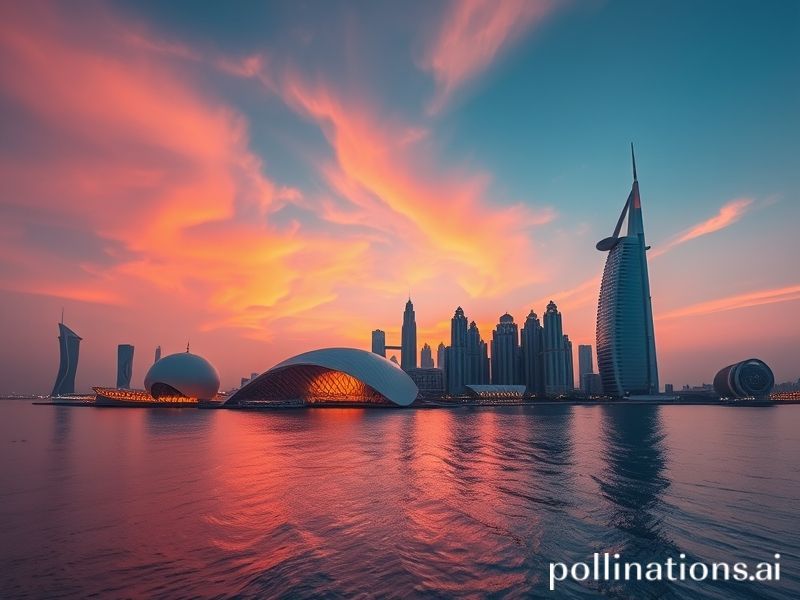
Doha, Qatar – a city where air-conditioned stadiums sit like chilled mausoleums in the desert, monuments to the idea that money can, in fact, buy you shade. From the vantage point of anyone who’s ever queued for a visa or waited for a delayed budget flight, Qatar is less a country and more a well-financed thought experiment: what happens when 300,000 citizens discover they are sitting on one-third of the planet’s liquefied natural gas and decide to play SimCity with real sand?
The experiment has been instructive. In the decade since the emirate won the right to host the World Cup—after a bidding process so transparent it could moonlight as a tinted limousine—Qatar has become the Rorschach test of global hypocrisy. Western democracies that spent years lecturing the Gulf on human rights suddenly found themselves booking charter flights for fans and journalists, their moral outrage conveniently shrink-wrapped in FIFA-approved souvenir packaging. Meanwhile, emerging economies from Accra to Jakarta watched the tiny peninsula build seven new stadiums, 100 new hotels, and an entire subway system faster than most municipalities fix a pothole. The takeaway: if you can’t beat them, liquefy them.
Yet Qatar’s story is bigger than football and its migrant-labor scaffolding. It is the microcosm of a planet that can’t decide whether it wants to transition to clean energy or simply rebrand it. While Europe drafts ever more ambitious carbon-neutral pledges, it simultaneously signed twenty-year LNG contracts with Doha, like a chain-smoker buying nicotine patches from the same guy who sells him cigarettes. Germany’s economy minister flew in last winter wearing the expression of a man asking his dealer for one last hit before rehab. The Qatari hosts, ever gracious, offered him coffee, condolences, and a 15-year indexed price clause.
Of course, no profile of Qatar is complete without mentioning the blockade that wasn’t. In 2017 Saudi Arabia, the UAE, Bahrain, and Egypt formed the geopolitical equivalent of a group chat called “Everyone Hates Doha.” Borders closed, airspace closed, shipping routes closed—yet Al Jazeera kept broadcasting, the World Cup kept planning, and Qatar simply rerouted its supply chains through Oman and Iran, proving that even collective punishment has a workaround if you’re rich enough. By 2021 the embargo was lifted with the same solemnity as a toddler putting down a toy he never really wanted, and everyone pretended the last three years had been a spirited misunderstanding, like forgetting to Venmo a friend.
The broader significance? Qatar is the canary in the coal mine that turned out to be a phoenix. It shows petrostates how to diversify without really diversifying: buy a global airline (tick), purchase landmark real estate in London and Paris (tick), host a tennis tournament that no one can quite place geographically (tick), and bankroll a news channel that alternates between hard-hitting exposés and flattering documentaries about the emir’s falconry skills. Call it soft power with talons.
For the rest of us, Qatar is the mirror we glance into while adjusting our collective tie before the climate summit photo-op. We demand a greener future yet shiver through winters courtesy of Qatari LNG. We praise labor reforms while ordering same-day delivery assembled by workers whose passports still live in company safes. We tweet outrage over LGBTQ rights from stadiums whose rainbow-colored seats were installed, then quietly repainted, because “cultural context” is the polite term for selective amnesia.
And so the peninsula shrugs, counts its royalties, and prepares to host the Asian Cup next, because once you’ve built a city-sized air-conditioner, you might as well keep the doors open. Somewhere in Doha’s Museum of Islamic Art—designed by I.M. Pei, who reportedly accepted the commission only after a secret scouting trip involving a private jet and a crate of Château d’Yquem—there is a 14th-century astrolabe reminding visitors that the stars once guided sailors across these waters. Today the stars are LED, the sailors are on expat visas, and the only navigation required is finding the VIP entrance.
Conclusion: In the grand tragicomedy of globalization, Qatar plays both the magician and the rabbit—pulling prosperity out of a hydrocarbon hat while the audience applauds and asks for an encore, preferably with chilled towels and zero carbon footprint. The show will run as long as the gas does, which, at current rates, is longer than most democracies last. Curtain call optional.