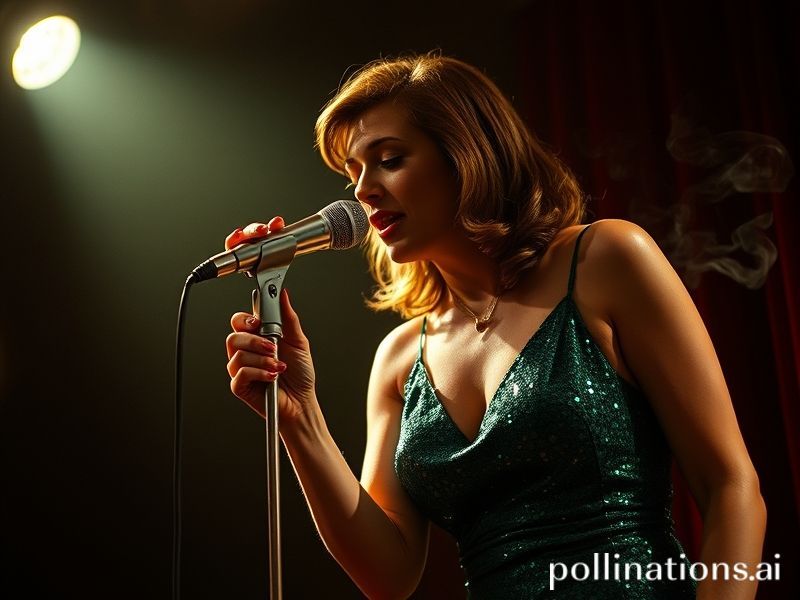
Renee Rapp, the North-Carolina-born soprano with a voice sharp enough to slice NATO red tape, has become an unlikely export commodity—one that even the most protectionist regimes haven’t bothered to tariff. From Berlin basement clubs to Seoul karaoke booths, her vocal runs are now traded like cultural cryptocurrency, a soft-power asset whose market cap rises every time someone on TikTok misuses the phrase “global phenomenon.”
The world first noticed Rapp when she inherited Regina George’s burn-book on Broadway, a job that required her to weaponize a high-school insult in six-part harmony. Americans, ever the connoisseurs of reheated nostalgia, applauded. Overseas, the reaction was more anthropological: Japanese talk-show hosts marveled at the spectacle of teenage cruelty set to major chords, while French critics filed it under “pre-emptive American diplomacy—if only Mean Girls had been deployed in 2003.” The implication was clear: if Washington ever wants to rehabilitate its image, it might consider sending a North Shore High choir rather than another aircraft carrier.
Rapp’s pivot from stage to streaming—via the HBO Max reboot of the same cinematic property—coincided with the planet’s collective decision to treat pop culture as a coping mechanism for geopolitical nausea. Lockdowns turned living rooms into United Nations of fandom: Brazilians learning the choreography in socks, Italians debating whether Regina’s politics lean neoliberal or outright anarchist. Somewhere in Lagos, an influencer posted a 15-second lip-sync captioned “colonialism, but make it fetch,” racking up two million likes and a polite cease-and-desist from Universal’s pan-African legal desk.
Meanwhile, Spotify algorithms—those unblinking sentinels of late-capitalist taste—shoved her debut EP, “Everything to Everyone,” into Discover Weekly playlists from Reykjavík to Riyadh. The title itself functions as a cruel joke on the modern condition: imagine promising universality in an era when even the Wi-Fi can’t stay neutral. Still, the streams climbed, buoyed by listeners who found solace in a 23-year-old belting about the futility of perfection while the planet’s temperature graph resembled a SpaceX launch trajectory.
Critics, especially the British ones who subsist on Schadenfreude and lukewarm tea, have tried to frame Rapp as the latest Yankee ingenue mass-producing vulnerability for clicks. They miss the point: her appeal lies precisely in packaging existential dread as three-minute ear candy. Last month, a Moscow DJ mashed her single “Too Well” over footage of a melting Siberian permafrost pit; the Kremlin’s media watchdog briefly considered banning it for “promoting climate awareness,” then realized that admitting the permafrost was melting would be even worse PR. The clip now circulates on Telegram channels alongside sanctions evasion tips—a serenade for the end times, Auto-Tuned for maximum irony.
Financial analysts, ever on the lookout for the next intangible to securitize, note that Rapp’s touring revenue is denominated in a currency more stable than most emerging-market bonds. When she announced a 2024 arena run, the peso-poor Argentine pre-sale crashed Ticketek faster than the IMF can say “structural adjustment.” Scalpers in Istanbul now accept both lira and bitcoin, proving that hyperinflation and blockchain utopias share at least one soundtrack.
And yet, for all the border-hopping metrics, Rapp remains an emissary of a very American paradox: exporting vulnerability at scale while the homeland legislates against the very identities she dramatizes. Go ahead, belt your heart out about bisexual confusion to a stadium full of Singaporean teenagers—just don’t expect your own state legislature to grasp the nuance. The contradiction is so on-brand for 2024 that the European Union briefly considered adding it to their strategic reserves of tragic irony.
So what does Renee Rapp’s planetary conquest ultimately signify? Only that in an age when traditional alliances crumble like week-old croissants, we still permit ourselves one shared delusion: that a well-executed key change can postpone the apocalypse by roughly three minutes and forty-two seconds. Whether she’s a genuine lifeline or merely the hold music for societal collapse is, naturally, above my pay grade. But if the missiles ever do fly, I’d like to think somewhere a bunker loudspeaker will queue up “Snow Angel,” just to remind us what we were pretending to feel before impact.