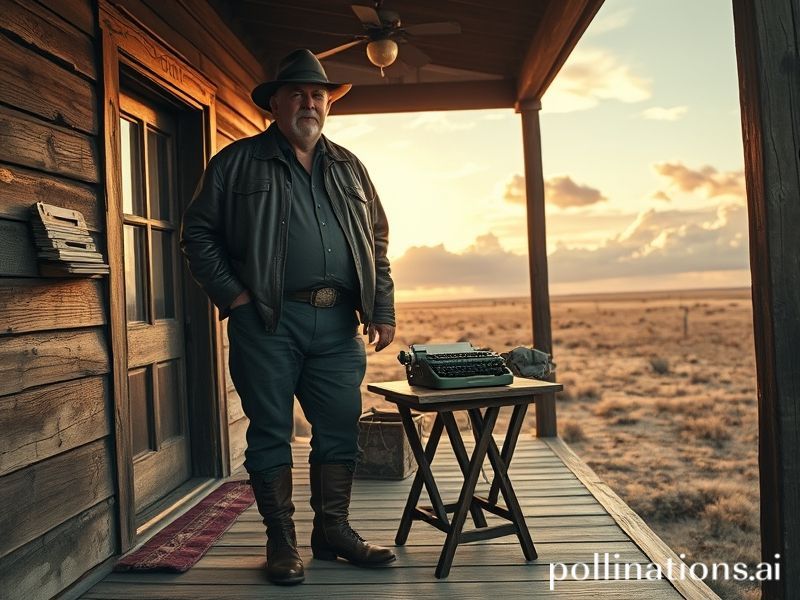
The Curious Afterlife of Robert Howard on a Planet That Keeps Reinventing Barbarism
By Our Special Correspondent in the Global Cynics’ Lounge
Let us begin with a confession: typing “Robert Howard” into any search engine is like tossing a flaming skull into a barrel of cultural gasoline. Half the planet thinks you mean the Texan pulp scribe who taught Conan the Cimmerian how to split heads like overripe melons; the other half promptly asks which hedge fund, indie filmmaker, or anonymous crypto-arbitrageur you’re really after. In the end it hardly matters—the name has become a multiversal passport stamped by every border post of modern anxiety.
From Lagos to Lima, the phrase “Robert Howard” now triggers three reflexive associations: sword-wielding nostalgia, intellectual-property litigation, and that peculiar 21st-century sport of monetising nostalgia while pretending to deconstruct it. The late Mr. Howard—who shot himself in 1936, reportedly distressed by the prospect of his mother’s impending death and the equally impending Great Depression—would doubtless appreciate the cosmic joke: his ghost now earns more per annum than he ever did alive, while entire economies tremble at the thought of a barbarian in sandals outperforming the S&P 500.
Consider the Chinese streaming platform that dropped a CGI-heavy Conan series last autumn. It drew 200 million views in a weekend, crashed iQiyi’s servers, and provoked a minor diplomatic incident when Thai censors objected to the on-screen decapitations (apparently only state officials are allowed those). Meanwhile, in Stockholm, a boutique gaming studio raised €42 million in seed funding for “Howardian,” a survival MMO where players can purchase procedurally generated pre-Iron Age trauma. Early-access users complained the game lacked “emotional realism,” so version 1.2 added seasonal affective disorder and lactose intolerance—progress, of a sort.
Across the Atlantic, the United States Copyright Office has been kept solvent by the descendants of Robert E. Howard, who discovered that if you squint hard enough, every muscular man with a sword and a grudge resembles intellectual property. Their lawsuits stretch from Hollywood to Hyderabad, generating enough billable hours to fund a small lunar colony. One Delhi-based startup now offers AI-generated “Howard-compliant” barbarian scripts for $9.99 a pop, complete with automatic trigger warnings for colonial undertones and optional feminist sidekick.
Europe, ever the continent that likes its violence historic and its remorse artisanal, has responded with subsidised museum exhibits. In Madrid, a retrospective titled “Barbarism, Ltd.” pairs original Weird Tales covers with migrant-crisis photography, inviting patrons to ponder whether Hyboria looked worse than Lesbos on a bad Tuesday. Visitor numbers are up 300 percent, gift-shop sales of plastic broadswords have reached pre-Russian-sanction highs, and the EU Commission is quietly drafting a directive to classify nostalgia as a controlled substance.
Down in Australia—Howard’s ancestral home of cyclones, crocodiles, and cheerful nihilism—academics have rebranded the author as an eco-prophet. Their peer-reviewed argument: Conan’s world is simply ours minus three degrees Celsius and functioning supply chains. The paper’s reception was warm enough to secure a government grant, promptly spent on a carbon-offset program that plants eucalyptus trees in the shape of a giant middle finger visible from orbit.
And yet the broader significance, if one insists on such things, is that Robert Howard has become a Rorschach blot for whatever the globe currently fears most. Inflation? Conan’s purse is endlessly replenished by loot that mysteriously converts to stablecoin. Authoritarian creep? Behold the muscular leader who solves every problem with decisive violence and zero paperwork. Climate dread? Observe the doomed civilizations that litter Hyboria like failed crypto projects. The name itself no longer denotes a man but a mood ring dipped in blood and marketing gloss.
So when you next overhear someone invoking Robert Howard—in a Berlin co-working space, a Dubai boardroom, or a Manila jeepney—do not assume they speak of the writer who once described happiness as “a bellyful of wine and the body of a woman who doesn’t talk too much.” They are more likely referencing an algorithm, a franchise, or a hedge position. The barbarian, as ever, is just the logo on the gate while the real pillaging happens quietly, in subscription increments of $12.99 a month.
In short: the grave keeps shrinking, but the merchandise expands to fill every available void. And somewhere in Texas, a skull grins—whether in approval or despair depends entirely on your quarterly targets.