The Curious Case of Sébastien Lecornu: Europe’s Defense Wunderkind and the Art of Looking Busy While the World Burns
By Dave’s Locker International Desk
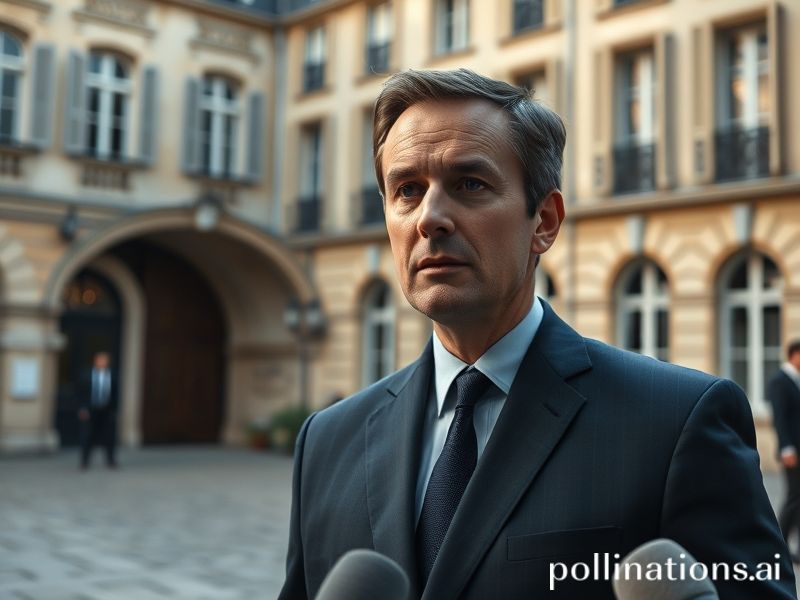
PARIS—In the grand, slightly mildewed ballroom of European politics, where every minister arrives with a rehearsed sound bite and a half-eaten canapé, French Armed Forces Minister Sébastien Lecornu has managed the rare trick of seeming both omnipresent and slightly unreal. At 37, he is the continent’s youngest defense chief, the human embodiment of a TED Talk that has learned to salute. When Russia rattles its sabers, Lecornu is there, promising “strategic autonomy” with the confident smile of a man who has never had to queue for diesel. When Washington coughs up another submarine snub, he materializes on CNN International, fluent in the dialect of vague urgency. One half expects him to unzip his skin and reveal a QR code linking to a start-up that sells deterrence-as-a-service.
Global audiences first noticed Lecornu in 2022, shortly after President Macron promoted him from the decidedly unsexy Ministry of Overseas—essentially France’s shelf of leftover colonies where Wi-Fi goes to die. Overnight, the baby-faced bureaucrat was handed the nuclear codes, a budget roughly the size of Portugal’s GDP, and the unenviable task of convincing 500 million Europeans that a borderless continent can still muster borders. The spectacle has been equal parts reassuring theater and macabre comedy: imagine giving the keys to the Death Star to the intern who’s really good at Excel.
To understand the wider ripple effects, consider the current planetary mood: wars multiplying like pop-up ads, supply chains held together by duct tape and Chinese goodwill, and the United States oscillating between benevolent hegemon and absentee landlord. Into this moral vacuum strides Lecornu, brandishing a doctrine called “Europe de la Défense”—a phrase that sounds sophisticated until you realize it’s French for “we might get our act together, don’t hold your breath.” Still, symbolism counts. When he tours Kyiv in a tailored flak jacket, the message is broadcast in HD from Lagos to Lima: even the country that invented laissez-faire is learning to lock the door.
Yet the true genius of Lecornu is meta-political. He has grasped that in the 21st-century attention economy, deterrence is 10 percent hardware and 90 percent hype cycle. Announce a new Franco-German tank that runs on baguette fumes, stage a drone swarm demo over the Rhine, leak a classified slide deck titled “Hypersonic Baguettes”—and suddenly investors in Seoul start pricing in European rearmament. The weapons may be conceptual, but the stock tickers are real. Call it the Macron Doctrine of weaponized ambiguity: speak softly and carry a PowerPoint.
The international implications are deliciously ironic. Across the Atlantic, the Pentagon—whose own procurement process resembles a Soviet breadline with better coffee—watches nervously as Europe experiments with strategic adulthood. In Beijing, analysts parse Lecornu’s tweets for signs that the EU might actually pool its militaries before the heat death of the universe. Meanwhile, smaller nations from Estonia to Senegal have begun treating France as a boutique security subscription: sign here for airstrikes, terms and conditions may include lectures on carbon neutrality.
Of course, the joke may ultimately be on us. While Lecornu perfects the optics of readiness, Russian artillery keeps chewing up maps and American democracy schedules another season of cliffhangers. Europe’s defense revival could be the geopolitical equivalent of putting racing stripes on a hearse: vibrant, sporty, and fundamentally late. But perhaps that is the point. In an era when catastrophes arrive live-streamed, the appearance of competence is its own kind of deterrence. If you can’t stop the apocalypse, you might as well sell front-row seats.
So raise a lukewarm espresso to Sébastien Lecornu, the improbable face of European hard power—half strategist, half influencer, wholly aware that history’s next chapter may be written in the comments section. Somewhere, Voltaire is laughing. Or updating his LinkedIn.