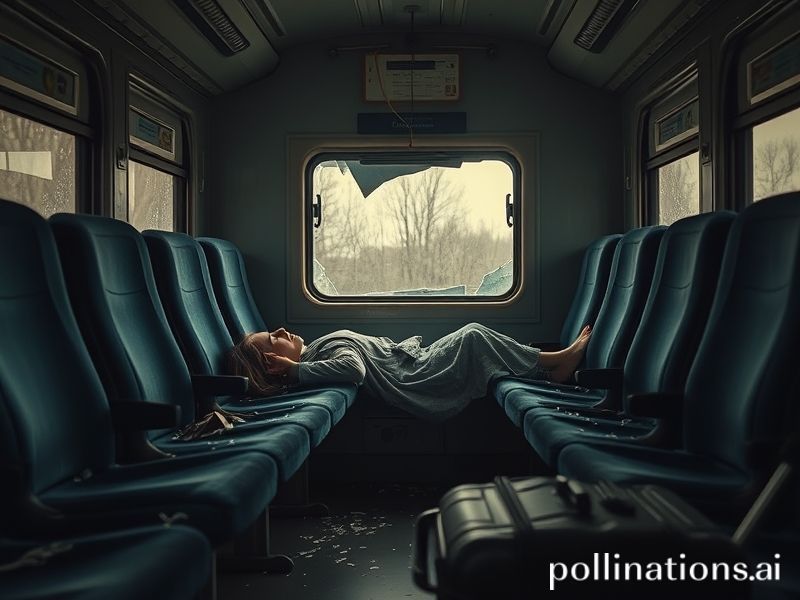
The 18:47 from Kharkiv to Kyiv is many things—overcrowded, chronically late, and lately a mobile refugee hostel—but until last week it had not qualified as a frontline. That changed somewhere east of Poltava when a single bullet, fired through a cracked window, ended the life of 29-year-old Olena Krasnova, a logistics officer turned volunteer turned civilian casualty in the world’s longest-running lesson that geography is destiny. The train kept rolling for another forty-three minutes before anyone noticed she had stopped scrolling. Even war, it turns out, obeys timetables.
International reaction arrived on cue, a synchronized frown from Brussels to Bangkok. The EU issued a statement “strongly condemning the targeting of civilian infrastructure,” apparently forgetting that trains are not usually classed as infrastructure until they explode. The U.S. State Department upgraded its travel advisory from “Level 4: Do Not Travel” to the subtly more urgent “Level 4: Seriously, We Mean It,” which will no doubt deter the same zero Americans who were already planning a rail holiday through Donbas. Meanwhile, the Kremlin blamed a “Ukrainian false-flag operation,” a phrase that now functions as geopolitical background music—audible everywhere, believed nowhere.
Yet the killing ripples outward in ways the press releases prefer not to quantify. Ukraine exports 10% of the world’s wheat and a statistically relevant portion of its hope; every bullet that finds a passenger seat nudges futures markets in Chicago and bread prices in Cairo. The International Maritime Organization has quietly postponed yet another grain-corridor deal, citing “increased risk premiums,” which is suits-and-tiese for “we’re scared a missile might RSVP.” In short, a woman who spent the war rerouting supply convoys around cratered highways now reroutes global food anxiety from beyond the grave—an impressive promotion, if a lousy severance package.
Railway security consultants—yes, that’s a job—have already booked flights to Warsaw, brandishing PowerPoints titled “Hardening Rolling Stock Against Ballistic Threats.” Their slides, seen by Dave’s Locker, propose bullet-resistant glass, overhead drone nets, and something called “passenger threat-sentiment algorithms,” presumably to detect when grandma’s knitting needles take on a menacing aura. The estimated cost per carriage is roughly the GDP of a small Baltic state, but consultants assure us the expense will be amortized over the next century of hypothetical wars. Capitalism, ever the optimist, sees opportunity in a corpse.
Back on the ground, Ukrainian Railways has begun issuing “compensation kits” to traumatized witnesses: instant coffee, a USB copy of the Book of Psalms, and a voucher for 30% off their next ticket—valid only on Tuesdays, blackout dates apply. It’s hard to parody an institution that parodies itself so efficiently. When asked whether the discount could be applied retroactively to Krasnova’s final journey, the customer-service chatbot replied, “We value all feedback,” then offered a survey link that timed out.
The broader significance, if we must be solemn for a paragraph, is that wars no longer bother to declare battlefields. The front line is wherever a passport is scanned, a TikTok is uploaded, or a woman in seat 14B forgets to duck. The old rules—Geneva, Hague, basic human choreography—assumed combatants would meet in a field and wave flags before getting on with the carnage. Now the carnage commutes. The rest of us ride along, pretending our noise-canceling headphones double as flak jackets.
Which brings us, grimly, to the takeaway: in a globalized century, every seat is potentially premium economy in someone else’s war. The price of your bread, the yield of your pension fund, the mood of your next election—all can be rerouted by a single piece of ordnance fired at a moving target most people couldn’t find on a map. Olena Krasnova’s death certificate lists the cause as “penetrating trauma,” which is also a fair description of how the twenty-first century treats anyone naive enough to believe in borders.
The train reaches Kyiv at 22:03, three minutes late. The platform is full of camera crews waiting for the next tragedy to arrive on schedule. Somewhere, a conductor checks his watch and wonders if delay compensation applies to history itself. Spoiler: it doesn’t.