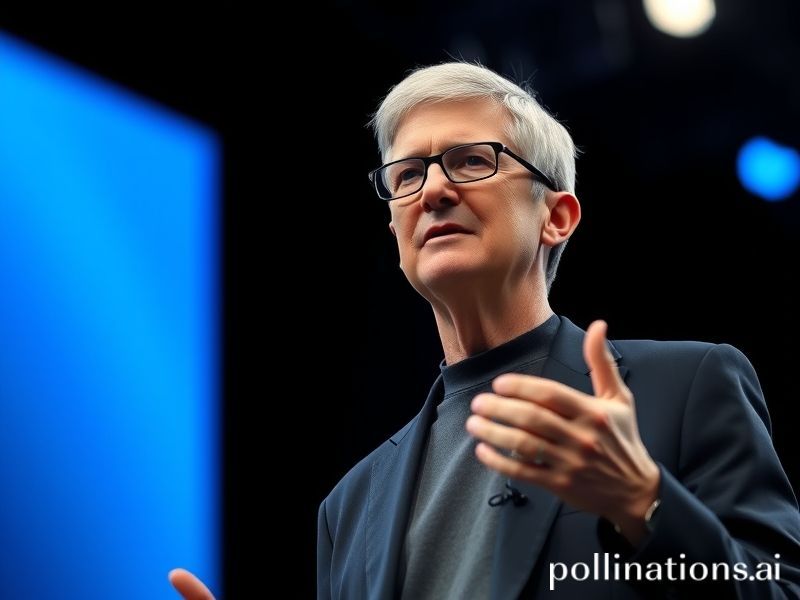
Tim Cook: The World’s Nicest Warden of a Very Expensive Panopticon
By Our Correspondent in Geneva—where surveillance cameras outnumber fondue forks, yet no one seems to notice.
It is a truth universally acknowledged that no one has ever asked, “What does Tim Cook think about the future of humanity?”—yet here we are, hanging on every syllable like shareholders at an earnings call. The Alabama-born, privacy-preaching CEO of Apple Inc. has spent the last decade transforming from supply-chain whisperer to global moral compass, all while selling a billion people the same rectangle in slightly different shades of anxiety.
From Mumbai to Munich, the ritual is identical: queue, swipe, unbox, repeat. The iPhone has become the Esperanto of consumerism, and Cook its soft-spoken pope. Under his watch, Apple’s market cap ballooned past the GDP of Italy, a country that once had dreams beyond being used as a unit of measurement for corporate wealth. When Cook speaks of “human rights,” he does so in the same breath as “services revenue,” a juxtaposition slicker than Foxconn’s assembly-line floors. One wonders if the Universal Declaration of Human Rights would have been shorter had it been ghost-written by Apple Legal—probably just three words: “Subject to change.”
In China, where the Great Firewall is taller than Xi Jinping’s approval ratings, Cook has perfected the diplomatic pirouette: bow low enough to keep the factories humming, yet never so low that the folks back in Cupertino notice the kowtow. The result? Xinjiang-made components wrapped in California-designed virtue. A genocide in the supply chain? There’s an app for that—just don’t look in Settings.
Europe, meanwhile, treats Cook like a polite burglar who keeps returning the silverware. Brussels slaps him with antitrust fines the way Renaissance popes once sold indulgences: painful, but ultimately just the cost of doing salvation. The Digital Markets Act? A mild rash on Apple’s titanium skin. After all, when you’ve convinced the planet that privacy is a premium feature—available for an extra €9.99 a month—you can afford to tithe to the regulators.
Down in Africa, where cobalt miners dream in lithium, Cook’s impact is more abstract. Their labor powers the batteries that power the phones that power the anxieties of teenagers in Jakarta who fear being left on read. It is a poetic circle of life, if your poetry leans heavily toward the abject. Apple’s pledge to be carbon neutral by 2030 is admirable, though cynics note the company can’t even neutralize the carbon footprint of its own hype events.
Yet credit where due: Cook has weaponized niceness with lethal efficiency. Unlike his predecessor, who radiated the warmth of an airport scanner, Cook sends handwritten notes to employees and marches in Pride parades between board meetings. It’s a kinder, gentler authoritarianism—Big Brother wearing rainbow suspenders. When he refused the FBI’s demand to unlock the San Bernardino shooter’s iPhone, privacy advocates hailed it as a stand for civil liberties; the rest of us just updated to iOS 16 and agreed to let Siri listen to our sobbing at 3 a.m.
The broader significance? Cook has proven that late-stage capitalism doesn’t need mustache-twirling villains; it needs affable technocrats who recycle. He is the smiling face on the panopticon gate, reminding us that if we have nothing to hide, we have nothing to fear—except maybe next year’s price hike. In a world where democracy is on life support and the planet is on fire, Tim Cook offers a soothing lullaby: “There’s one more thing… and it comes in purple.”
So here’s to the quiet man from Robertsdale, Alabama, who taught the globe that resistance is futile, but it’s available in five storage tiers. Somewhere in the afterlife, Steve Jobs is grinning at the elegant brutality of it all. And somewhere on Earth, a child is digging for the minerals that will run tomorrow’s empathy filter. Both are, in their own ways, made possible by Tim Cook—international man of mystery, master of the supply chain, and, apparently, our last best hope for a retina-display tomorrow. Sleep tight.