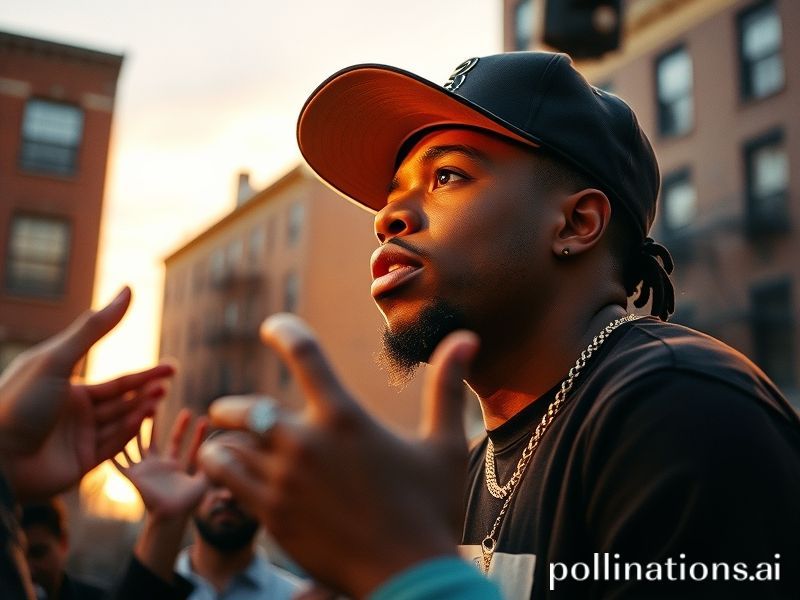
From Lagos to Lisbon, Chance the Rapper has become the polite global ambassador of American angst—an improbable export who somehow convinced the planet that existential dread pairs nicely with gospel choirs and a knit cap. While other U.S. artists hawk gilded despair, Chance peddles it in pastel packaging, a marketing coup that makes even the French shrug with reluctant admiration.
The blueprint emerged in 2013 with Acid Rap, a mixtape that slipped across borders disguised as innocent SoundCloud tourism. Customs agents failed to notice the contraband: Midwestern melancholy laced with enough optimism to be contraband in at least seven authoritarian states. By the time Coloring Book arrived—streamed gratis, because capitalism occasionally enjoys a spot of self-sabotage—Chancelor Bennett had become a case study in post-national stardom. His songs now ring out in Nairobi matatus, Berlin U-Bahn carriages, and Tokyo convenience stores at 2 a.m., uniting commuters in the shared delusion that joy is still refundable.
Internationally, Chance functions as a soft-power vaccine. The State Department can’t officially deploy him—too many references to acid and Jesus in the same sentence—but his presence on foreign stages quietly advances the narrative that America is capable of producing non-lethal cultural products. When he headlined the 2019 Lagos Jazz Festival, Nigerian fans politely ignored the fact that jazz had been on life support in Chicago for decades. Instead, they focused on the spectacle of a black American artist who neither apologized for his heritage nor weaponized it, a rarity in a world where U.S. soft power usually arrives via drone strike or Disney Plus.
Economically, Chance’s global footprint is a masterclass in anti-brand branding. He refuses to sign his name to sneakers, soft drinks, or cryptocurrency schemes—an abstinence that paradoxically inflates his market value. In Seoul, counterfeit Chance merch sells faster than BTS dorm-room pillows, proof that scarcity still works when sincerity is the commodity. Meanwhile, European festival promoters pay premium rates for a performer who might arrive late but will almost certainly hug every member of the catering staff. It’s a transaction that feels almost Nordic in its social-democratic decency, which is probably why Sweden keeps inviting him back despite his habit of turning every backstage rider into an impromptu youth-choir rehearsal.
The darker joke, of course, is that Chance’s international goodwill rests on the same American dysfunction he critiques in verse. His lyrics about violence, debt, and spiritual vertigo translate seamlessly to audiences from São Paulo to Sana’a, because local catastrophes are always looking for foreign validation. When he raps about unpaid taxes next to a gospel refrain, German listeners hear fiscal irresponsibility; Brazilian ones hear divine providence. Everyone leaves convinced their own national crisis has been cosmically acknowledged, a feat of interpretive diplomacy the United Nations has yet to replicate.
And yet, the cynic abroad must concede a grudging respect. In an era when global culture is mostly weaponized memes and trade-war tariffs, Chance the Rapper exports something subversively gentle: the idea that hope is not yet subject to import duties. It won’t balance anyone’s current account, but it might keep a few teenagers from buying into the apocalypse too early—a small mercy in a marketplace that usually charges extra for delayed despair.
As another festival season dawns from Montreux to Montevideo, the man in the “3” cap will board yet another carbon-offset jet, armed with nothing more lethal than a trumpet section and a smile that suggests he knows exactly how this story ends. Spoiler: the world won’t be saved by a mixtape. But if we’re lucky, it might be momentarily distracted—just long enough to forget, for two encore verses and a gospel outro, that the house is still on fire and the fire department has been privatized.