The Curious Case of Harold Fannin Jr., or How a Buckeye Tight End Became the Planet’s Newest Geopolitical Football
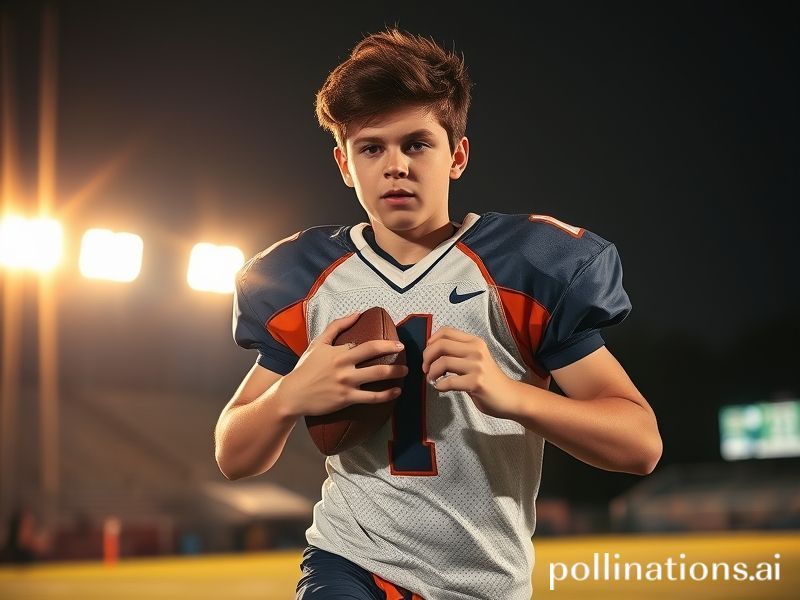
By the time Harold Fannin Jr. caught his third touchdown against Kent State last September, satellites from three continents had already locked onto the 6-foot-4, 242-pound sophomore. Not because the NSA suddenly cares about MACtion, mind you, but because the Chinese Ministry of Sport, the Saudi Pro League’s analytics arm, and a shadowy French investment syndicate all ran the same regression: American tight ends who run 4.5 forties and bench small Fiats eventually export influence faster than TikTok dances.
Welcome to the era when a kid from Toledo can unwittingly jolt global supply chains. Analysts at the Lowy Institute in Sydney now track Fannin’s weekly receiving yards the way they once tracked iron-ore futures—partly as a joke, partly because Australia’s streaming rights for Big Ten football are inexplicably tied to infant-formula exports. Meanwhile, Lagos sports bars have started opening at 3 a.m. to screen Bowling Green reruns, betting that if Fannin declares for the 2026 NFL Draft, Nike’s sweat-shop orders will migrate from Jakarta to somewhere closer to the Great Lakes. The invisible hand has carpal tunnel.
Europe, ever the self-appointed conscience of the world, frets about the carbon footprint of Fannin’s highlight loops going viral. The Greens in Brussels have produced a 42-page white paper titled “Gridiron Gluttony: How American Athletic Exceptionalism Endangers Net-Zero Goals.” It is read by exactly seven people, all of whom secretly have fantasy shares in Fannin dynasty leagues.
Of course, no modern fable is complete without cryptocurrency. A Solana-based token—$FANNIN—peaked at a $38 million market cap during his four-touchdown outburst against Eastern Michigan, then cratered when a bot farm in Moldova realized he once liked a tweet critical of NFTs. El Salvador’s President, never one to miss a meme, briefly floated adopting $FANNIN as legal tender before remembering his country already had a national currency and two are simply gauche.
The Chinese response has been characteristically pragmatic: state broadcaster CCTV now uses Fannin’s seam routes as training footage for the People’s Liberation Army Rocket Force—allegedly to teach “decisive vertical insertion,” though cynics note it’s mostly an excuse to splice in patriotic EDM. In a leaked memo, the Propaganda Department praised Fannin’s “collectivist willingness to block downfield,” which is either a touching misunderstanding of American football or the most savage burn in modern geopolitics.
Back home, the U.S. State Department gamely insists Fannin is “soft power in shoulder pads.” An unnamed senior official confided that they’ve begun inserting clauses into trade agreements stipulating that any country streaming MAC games must also import Florida oranges. Diplomacy is just fantasy football for people with security clearances.
And yet, the most poignant subplot plays out in micro-economies you’ve never heard of. A barber in Accra reports clients requesting the “Fannin Fade.” A Seoul cram-school offers SAT prep packaged with YouTube breakdowns of his route tree. Somewhere in rural Bangladesh, a teenager who has never seen a real football sells bootleg “H-Train” jerseys out of a tarp stall; the polyester, naturally, is woven from recycled fishing nets, because irony is the only sustainable resource we have left.
So what does Harold Fannin Jr. actually signify? Nothing, everything. He’s a 20-year-old who still has to do his own laundry, blissfully unaware that futures traders in Zurich are long on his hamstrings. In a world where supply-chain snarls and algorithmic mood swings send tremors from Toledo to Timbuktu, the kid is both symptom and cure: a reminder that human chaos still trumps the spreadsheet, and also that the spreadsheet now monetizes the chaos in real time.
Catch the next game if you can—preferably on a solar-powered screen, ethically sourced snacks in hand, and a stiff drink for the existential vertigo. The planet is officially on the H-Train, destination unknown, Wi-Fi spotty, seatbelts optional.