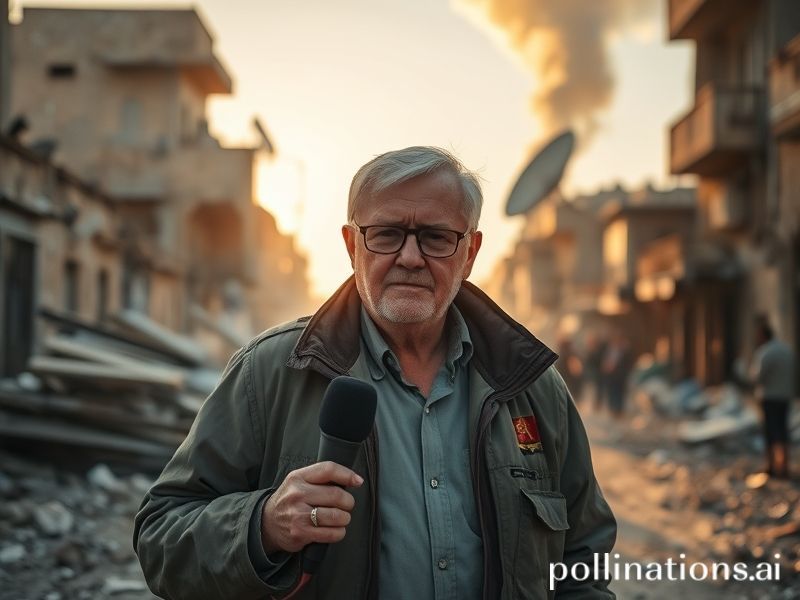
John Simpson and the Uneasy Crown of the World’s Oldest War Correspondent
By our man in the departure lounge, still waiting for the jet bridge to connect
There is a moment, somewhere over the Hindu Kush or the Donbas steppe, when the cabin lights dim and the young reporter next to you begins composing a heartfelt Instagram caption about “bearing witness.” John Simpson—C.B.E., BBC grandee, and the last man alive who can still pronounce “Mujahideen” without sounding like a craft-beer label—looks up from his umpteenth inflight whiskey, smiles the thin smile of a man who has seen too many ceasefires expire before the ink dries, and returns to his crossword. That, in microcosm, is the global significance of Simpson: a living reminder that history’s first draft is usually scrawled on a bar napkin, then laundered into bulletins for breakfast tables from Lagos to Luton.
For four decades Simpson has hopscotched across the planet’s sore spots like a demented travel agent, filing dispatches while mortars rearrange the architecture. Kabul 1989? He was there, interviewing Soviet soldiers who had begun looting their own latrines for souvenirs. Baghdad 2003? Embedded in a tank column that took a wrong turn and ended up live on every television from Tokyo to Tierra del Fuego—an accidental scoop that made him the only correspondent ever to declare a war officially “started” while sitting on the luggage rack of a moving armored vehicle. The man treats geopolitics the way the rest of us treat weather apps: open, grimace, decide whether to pack a flak jacket or just stay in bed.
Yet Simpson’s true international importance lies less in any individual byline than in what he represents: the stubborn, almost preposterous notion that someone ought to keep receipts while nations misplace theirs. As democracies outsource memory to algorithms and autocracies edit Wikipedia in real time, Simpson’s archive—equal parts trench coat and TARDIS—remains one of the last non-rewritable hard drives of the late 20th century. When Myanmar’s generals insist they’ve never shot civilians, or when Russian diplomats claim they never promised not to invade anywhere, it is Simpson’s voice, crackling out of a 1988 U-matic tape, that provides the inconvenient footnote. He is the world’s most polite ghost, haunting press briefings with the question, “Actually, Minister, what about that other time?”
Naturally, the universe has tried to delete him. There was the “friendly fire” incident in Iraq—American shrapnel still rattling somewhere in his left lung like loose change. A Taliban kidnapping in Afghanistan that ended with him convincing his captors to let him finish the stand-up first (“They wanted good lighting; vanity is cross-cultural”). And, most recently, a bout of Covid in Tehran that left him hallucinating Edward R. Murrow doing play-by-play of his own intubation. Each time, Simpson has emerged tweed-scorched but undeterred, proving that the only thing more persistent than war is a BBC expense account.
Meanwhile, the profession he embodies drifts into influencerdom. Today’s correspondent lands in a crisis zone with ring lights and a drone, more worried about the algorithmic half-life of a TikTok than whether the checkpoint ahead accepts press credentials or kidneys. Simpson, who still files on deadline by dictating over a crackling satellite phone while mortar rounds provide percussion, is thus both anachronism and antidote. He is the ghost at the content feast, reminding the banquet that somewhere a village is being shelled back to the Stone Age—no filter required.
What does the planet lose when Simpson finally hangs up his battered Panama? Nothing less, perhaps, than the last adult in the room who still believes facts are not a regional dialect. In an era when strongmen Photoshop themselves into fighter jets and every atrocity is “alleged” until the stock market closes, the absence of someone who can say “I was there” with a straight face feels less like retirement and more like surrender. The rest of us will still scroll, sigh, and swipe to the next outrage, but the archive will be quieter by one sardonic chuckle.
And so the world keeps spinning, explosions and all, while John Simpson—passport fraying, cynicism intact—boards yet another plane, muttering that the duty-free has gone downhill since Kabul ’89. Somewhere over international waters, a new crop of stringers will ask how he copes with the horror. He’ll sip his whiskey, stare out at the wingtip lights blinking like tired Morse code, and give the only answer that ever made sense: “By remembering that the story outlives us all—even when we wish it wouldn’t.”