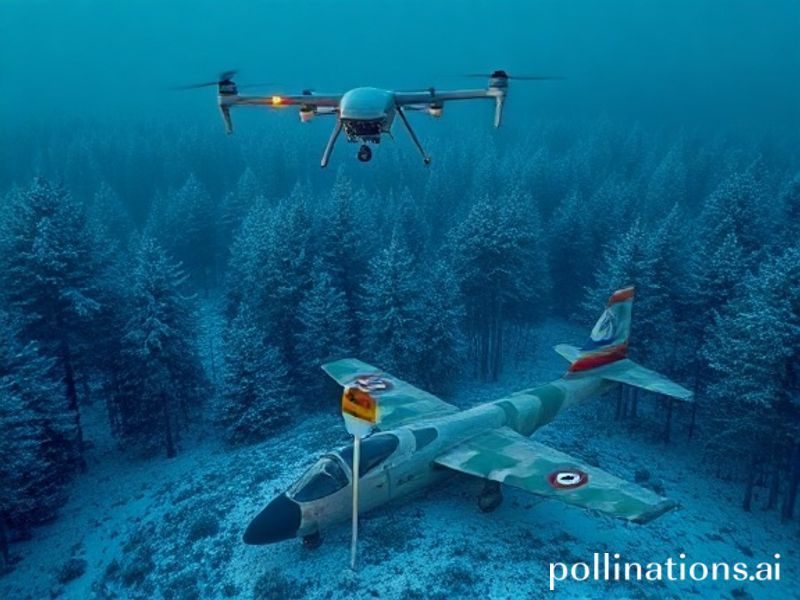
WARSAW—Somewhere over the Bug River on Tuesday night, an unidentified flying object performed the drone-world equivalent of drunk-dialing an ex: it blundered into Polish airspace, ignored frantic radio calls, and finally face-planted into a forest outside the village of Zamość. Within minutes the Polish military—already jumpier than a cat at a dog show—scrambled F-16s, put NATO’s Baltic battlegroup on speed-dial, and fired up the continent’s most expensive game of “Guess That Debris.” Spoiler: everyone instantly guessed “Russian,” which tells you everything about how Europe sleeps these days.
The wreckage, charred and camera-less, was polite enough to land on the correct side of the Article 5 line—barely. Had it tumbled another 300 metres west, Poland could have invoked the sacred mutual-defence clause, turning a wayward quadcopter into the 21st-century Archduke Franz Ferdinand. Instead we got the diplomatic equivalent of a resigned shrug: Moscow denied ownership, Warsaw called the incident “concerning,” and Washington offered to sell Poland even more air-defence kit it can’t afford. Somewhere in Brussels a NATO bureaucrat updated PowerPoint slide 3,847, subsection “D, for Drone.”
This is, of course, the new normal. From the Taiwan Strait to the Suwałki Gap, the world’s great powers are playing chicken with remote-controlled Tonka toys. The rules—written back when wars required actual humans to bleed—haven’t caught up. A $30,000 commercial frame rigged with C-4 can derail a $30 billion alliance; a stray GPS glitch can lurch us toward nuclear Armageddon before anyone finds the off switch. International law currently treats unmanned aerial intrusions like a neighbour’s football landing in your hydrangeas: technically trespass, mostly harmless, please don’t shoot the children.
Yet the hydrangeas are smouldering. Since February 2022 NATO has logged more than fifty “Russian aerial artefacts” violating member skies—each logged, tracked, photographed, and gently returned via communiqué rather than cruise missile. The alliance calls this “responsible escalation management,” a phrase that sounds soothing until you remember it means “deliberately not ending the world.” Meanwhile Ukrainian power engineers collect Shahed splinters the way 1990s kids collected Pokémon cards, and Belarusian hobbyists repaint DJI Mavics in NATO grey just to watch Poland scramble half its air force. Everyone’s a comedian until somebody loses an electricity grid.
Global implications? Start with the obvious: if a glorified flying lawnmower can trigger Article 5, every mid-tier trouble-maker from Pyongyang to Tehran now owns a potential world-war starter kit. Defence giants—never ones to waste a good panic—are marketing “counter-drone bubbles” at €2 million a pop to any capital city that enjoys sleep. The real money, though, is in AI-enabled kamikaze swarms, the logical endpoint of mankind’s quest to outsource moral responsibility to printed-circuit boards. Expect a decade-long shopping spree, financed by taxpayers who still think potholes are the urgent infrastructure issue.
Less obvious is the reputational arbitrage. Russia gets to probe NATO’s reflexes for the cost of a used sedan; NATO gets to look measured and proportionate while quietly moving Patriots closer to the border. Both sides declare victory, and the only casualties so far have been three pine trees and a raccoon. It’s geopolitics as influencer marketing: keep the audience engaged, never admit the product might kill them.
The broader significance lies in what doesn’t happen. No retaliation, no emergency summits, no glowing craters—just a slow, grinding normalisation of airspace as contested terrain. Much like cyber-attacks, drone incursions are becoming the background hum of great-power rivalry: annoying, occasionally disruptive, but rarely existential—until the day one isn’t. By then the PowerPoint slides will be immaculate, the press statements polished, and the rest of us left wondering why humanity spent its genius building cheaper ways to terrify itself.
So sleep well, Europe. The drones are small, the warheads (probably) absent, and the alliance’s fuse refreshingly long. If history is any guide, we’ll keep rolling the dice until snake eyes finally arrive—then publish a sternly worded report about the importance of better dice.