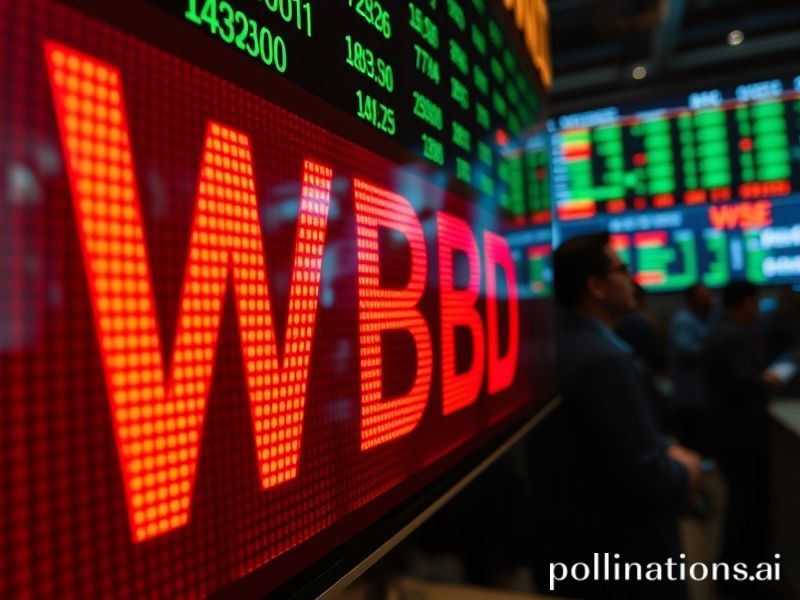
PARIS, 06:07 a.m. CEST—While polite Europeans were still arguing over whose turn it was to buy the croissants, shares of Warner Bros. Discovery (WBD) were already sliding in New York like a tourist who’s just discovered the metro ticket machines don’t take cash. The stock, which once promised to fuse Hollywood glamour with Discovery’s unembarrassed love of reality-TV nudity, is now trading a few dollars above the price of a monthly Max subscription—ironic, since most investors would rather pay for the streaming service than own the company that runs it.
On paper, the 2022 merger stitched together Batman, the Property Brothers, CNN, and 90-Day Fiancé into one glorious transatlantic content goulash. In practice, it has produced a balance sheet that looks like the aftermath of a Targaryen wedding: everyone bleeding, nobody sure who’s next in line. Global markets noticed. Tokyo’s Nikkei yawned. London’s FTSE politely pretended to be looking at its phone. Only the American pre-market shuddered, the way one does when the hotel bill arrives in a foreign currency and you suddenly remember mini-bar whiskey is priced like liquid plutonium.
The international significance? Simple: WBD’s debt—roughly $45 billion, give or take a few CGI dragons—makes Greek sovereign obligations look practically Swiss. That weight is now everybody’s problem. European banks that underwrote the original AT&T spinoff bonds are quietly updating their risk models, the sort of bureaucratic exercise that precedes either a bailout or a long lunch. In Seoul, analysts who once salivated over K-drama licensing deals now fret that WBD might start clawing back global rights faster than you can say “Squid Game Season 3.” Down in Mumbai, Zee executives are praying the Indian Premier League doesn’t end up as collateral in a fire sale—though if it does, at least the cricket will still be loud enough to drown out the creditors.
Meanwhile, the streaming wars have entered the trench-foot phase. Netflix is raising prices again, Disney+ is stuffing ads into Star Wars like product placements in a Bond film, and Amazon Prime is rumored to be preparing a “Lord of the Rings” spin-off about municipal zoning in Minas Tirith. WBD’s Max, caught in the middle, has resorted to the corporate equivalent of moving back in with its parents: licensing big chunks of its library to… well, Netflix. Nothing says “strategic vision” quite like paying your biggest competitor to distribute the crown jewels you just spent billions acquiring.
Currency markets, ever the drama critics, have weighed in. The dollar’s strength means every euro or yen of overseas revenue converts into fewer greenbacks, turning international growth into a slow leak. Analysts in Frankfurt, sipping ristrettos that cost less than a share of WBD, call this “earnings headwinds.” Translation: the company is running uphill while someone keeps adding more hill.
Then there’s the talent exodus. Hollywood writers and actors—remember them?—are still bargaining for residuals that might actually buy groceries. European crews, watching from the safety of strong unions and actual healthcare, are starting to refuse transatlantic gigs unless paid in advance and in euros. Even Australia’s Hemsworth brothers are reportedly hoarding Vegemite as a hedge against currency collapse, which tells you everything about global confidence.
Yet amid the gloom, there remains the eternal optimism of capital markets. Somewhere in Dubai, a sovereign-wealth-fund intern has been told to “look at distressed media assets” between espressos and falconry lessons. In Singapore, algorithmic traders have programmed bots to buy any dip below eight dollars on the hunch that Americans will always, eventually, pay to watch superheroes punch other superheroes while eating nachos. Hope, like cholesterol, is a global constant.
Conclusion: WBD’s saga is less a corporate earnings story than a morality play about what happens when you promise the world a cinematic universe but deliver a multiverse of debt. From Seoul to São Paulo, investors are learning that content may be king, but leverage is the inbred cousin who shows up drunk to the coronation. Whether the stock recovers or becomes a cautionary exhibit in business-school syllabi, one thing is certain: the popcorn will remain wildly overpriced, and we’ll all keep buying it—because at this point, the show is the only thing still running on time.