The Postcode Lottery Isn’t Just a Game—It’s the World’s Quietest Form of Aristocracy
by Dave’s Locker International Desk
Picture this: you’re born in 90210, postcode of swimming pools and televised existential dread. Your cousin, meanwhile, enters the world in 48201—Detroit—where the only pools are potholes deep enough to drown a midsize sedan. Same passport, same flag-draped mythology, but one of you has a statistically higher chance of dying before 40 than the other has of making it past the velvet rope at a West Hollywood juice bar. That, dear reader, is the global postcode lottery in action: a raffle rigged before the tickets are printed, with odds set by GPS coordinates.
From the barrios of Bogotá to the banlieues of Paris, the concept travels under aliases—zip codes, PIN codes, kode pos—but the principle is universal. Geography decides whether your tap water is artisanal or arsenic, whether your ambulance arrives in four minutes or four hours, whether your school teaches Python or plain old serfdom. Finland hands out baby boxes; South Sudan hands out malaria. Same species, different loading screens.
The house, naturally, always wins. International NGOs can wax lyrical about “randomized controlled trials,” but no peer-reviewed study has yet located a control group for being born on the wrong grid reference. Meanwhile, Silicon Valley visionaries promise to “democratize opportunity” via satellite internet—provided you can afford the dish and the sky above you isn’t owned by a warlord with a grudge and a repurposed weather rocket.
Take COVID-19, the great equalizer that turned out to be more of a great clarifier. In New Zealand, Jacinda Ardern’s “team of five million” got wage subsidies and an early bedtime. In India, migrant workers walked a thousand kilometers home because their postcodes suddenly rendered them surplus to spreadsheet. The virus didn’t discriminate; borders, supply chains, and credit ratings did the dirty work on its behalf.
Money, of course, tries to launder luck. Global elites now purchase second (and third) postcodes the way previous generations collected cufflinks. A Maltese passport, a Dubai apartment, a discreet Wyoming LLC—each a golden ticket out of whatever local chapter of purgatory they were accidentally assigned at birth. The merely middle-class settle for VPNs and offshore accounts, cosplaying freedom while still tethered to the same mortifying IP address.
Even climate change plays favorites. If your postcode sits on a Swiss alp, congratulations: enjoy the glacier view while it lasts. If it’s on a Bangladeshi delta, condolences: enjoy the fish swimming through your living room. The UN calls this “climate injustice,” a phrase that sounds like a grievance aired on daytime television rather than the slow-motion re-sorting of humanity by elevation above sea level.
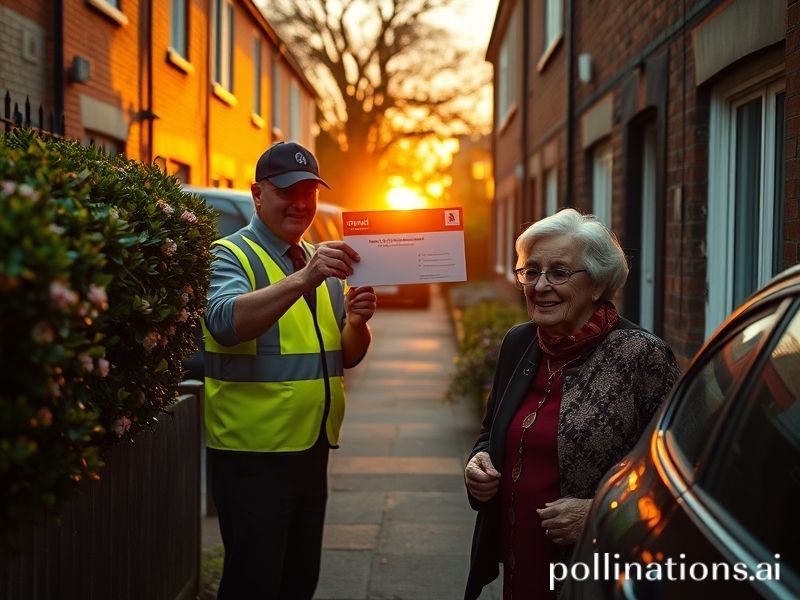
And yet, people keep buying scratch cards. Not the literal ones hawked by Britain’s People’s Postcode Lottery (tagline: “You’ve got to be in it to win it,” which doubles as a neat summary of neoliberal citizenship). No, the real gamble is staying put, hoping the neighborhood improves faster than it gentrifies, praying the algorithm that decides who gets a loan or a lung transplant glances kindly on your coordinates today. It’s a lottery played in silence, with stakes measured in life expectancy.
The punchline? The game is expanding. Tech giants are busy redrawing borders into “cloud regions” and “digital postcodes,” where latency matters more than nationality. Amazon Web Services decides whether your start-up lives or dies; Tencent decides whether your social credit lets you board the bullet train. Same arbitrary cartography, shinier interface.
So next time you fill in your address, pause at the postcode box. Those six alphanumeric characters are more than mail-routing metadata—they’re a résumé, a medical record, a credit score wearing a trench coat. And somewhere, in a server farm cooled by Scandinavian hydropower, an algorithm tallies the odds on whether you’ll read this sentence and shrug, or read it and riot.
Conclusion: The postcode lottery isn’t new, but its jackpot keeps shrinking while the ticket price—in carbon, in data, in dignity—keeps rising. Until the draw is rigged for fairness instead of profit, the wisest bet remains the oldest: cross your fingers, clutch your passport, and hope your coordinates don’t become tomorrow’s cautionary headline. After all, luck may be blind, but the house has GPS.