pastor frederick haynes
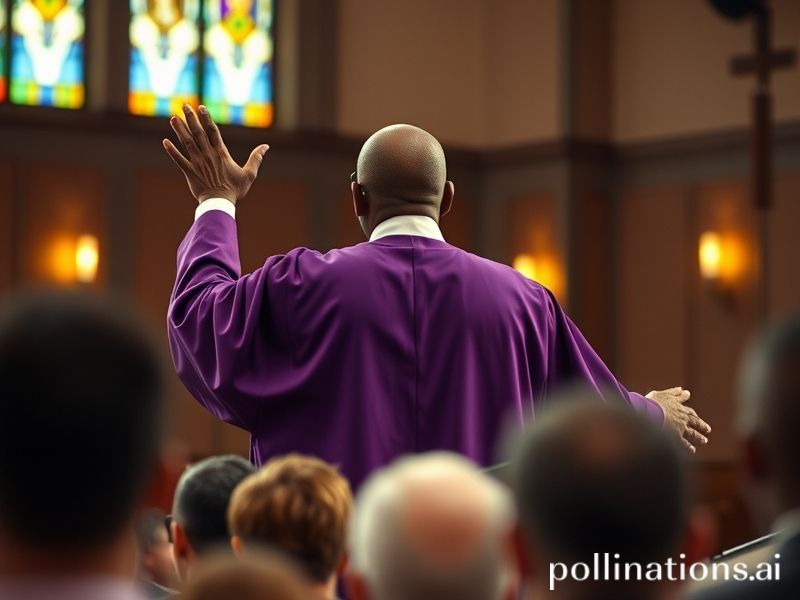
Pastor Frederick Haynes III has spent three decades turning Dallas’s Friendship-West Baptist Church into a pulpit that moonlights as a geopolitical weather station. From there he tracks storms that most American preachers prefer to ignore: Gaza rubble, Haitian debt, South African shack settlements, and the curious habit of U.S. tax dollars to fertilize foreign dictatorships while domestic food banks run on volunteer prayers. In the global marketplace of salvation, where many evangelical franchises export prosperity gospels like supersized value meals, Haynes is the snarling disclaimer at the bottom of the screen: “Product may cause side effects such as conscience.”
To understand why a Texas sermon makes diplomats clear their throats in Brussels, recall that the United States still ships two commodities no tariff can touch: weapons and worldview. Haynes has decided to weaponize the second one, aiming it at the first. When he called Israel’s occupation of Palestinian territories “a moral blight subsidized by Sunday offerings,” the backlash arrived faster than an Amazon delivery: donors fled, death threats poured in, and the church’s insurance company politely inquired whether “plague of boils” was covered under current policy. Meanwhile, in Ramallah, a human-rights NGO translated his sermon into Arabic and circulated it like samizdat; in Tel Aviv, an op-ed page compared him to “Netanyahu’s migraine.” Somewhere in the afterlife, prophets are exchanging knowing shrugs: criticize empires, get crucified—film at eleven.
The international resonance is not accidental. Haynes pastors in a city that styles itself the “Silicon Prairie,” where corporate campuses bloom like steel tulips and the poverty line performs limbo under every overpass. That juxtaposition is not uniquely Texan; it’s the planetary norm wearing cowboy boots. Lagos has Victoria Island’s glass towers casting shadows on Makoko’s floating slums; Mumbai offers billion-dollar penthouses that enjoy sea views and ambient slum fragrance. Haynes’s insistence that scripture should inconvenience the comfortable therefore travels well—like reggaeton, only with more locusts and less auto-tune.
Europeans, who long ago traded cathedrals for museums, watch Haynes with the anthropological curiosity they usually reserve for American gun culture. “You allow clergy to influence foreign policy?” they ask, sipping fair-trade coffee harvested by farmers who can’t afford the airfare to Geneva. It’s a fair question from a continent where church attendance hovers somewhere below “owning a pet snake.” Yet even the secular Nordics recognize a familiar chord: the prophetic tradition that once made kings itch beneath their crowns. Haynes simply updated the firmware.
The global South, meanwhile, hears something else: a rare acknowledgment from the U.S. pulpit that their suffering is not a programming error in the divine algorithm but a feature of someone else’s prosperity. When Haynes links payday lenders in Dallas to structural-adjustment lenders in Lima, he is practicing the kind of comparative theology Wall Street would rather file under “heretical, do not distribute.” And when he invites Palestinian Christian activists to speak to his congregation—via glitchy Zoom calls that freeze on tears—he is exporting the one American product that hasn’t been weaponized yet: listening. Customs officials haven’t figured out how to tax it, though they’re working on an algorithm.
Naturally, there are critics who argue that a pastor’s job is saving souls, not signing them up for frequent-flyer revolution. They prefer their clergy domesticated, like gluten-free communion wafers: tasteless but unlikely to provoke allergic reactions among donors. Haynes’s response is to quote Amos and order bigger offering plates—presumably to catch all the coins clinking back down from heaven, or at least from congregants who haven’t stormed out yet.
What happens next is uncertain. Institutional religion worldwide is hemorrhaging adherents faster than a Twitter exodus, and prophetic voices have a terrible business model: high overhead, low quarterly returns, long-term investment in kingdoms not of this world. Still, every so often a sermon leaks across borders, lands in a WhatsApp group, and sprouts into a protest sign in Johannesburg or a hashtag in Jakarta. In that sense, Pastor Frederick Haynes may be less a shepherd than a pollen grain—annoying to allergy sufferers, but essential to cross-pollinating the moral ecosystem. If nothing else, he reminds us that in an age when outrage is monetized by the click, someone still gives it away for free from a Texas rooftop, trusting the wind to do the invoicing.