The last time Afghanistan and Sri Lanka met on a cricket pitch, the Taliban had just finished rearranging Kabul’s interior décor, Sri Lanka’s president was busy discovering that swimming pools make poor escape routes, and the global economy was debating whether inflation was merely transitory or the new cardio. All of which is to say: both nations have, in their own endearingly catastrophic ways, become case studies in how to survive headlines that read like Mad Libs for geopolitical disaster.
So when the two sides clashed again—this time in the T20 World Cup’s group stage in humid, flood-lit Florida—the match felt less like sport and more like a UN subcommittee meeting wearing spikes. Afghanistan arrived fresh from a moral-victory tour of Australia, having convinced even cynics that banning music doesn’t automatically neuter yorker practice. Sri Lanka, meanwhile, limped in with nine players suspended for laughing at bookkeeping, a captaincy carousel that would make Liz Truss blush, and an economy whose chief export is now IMF conditionality.
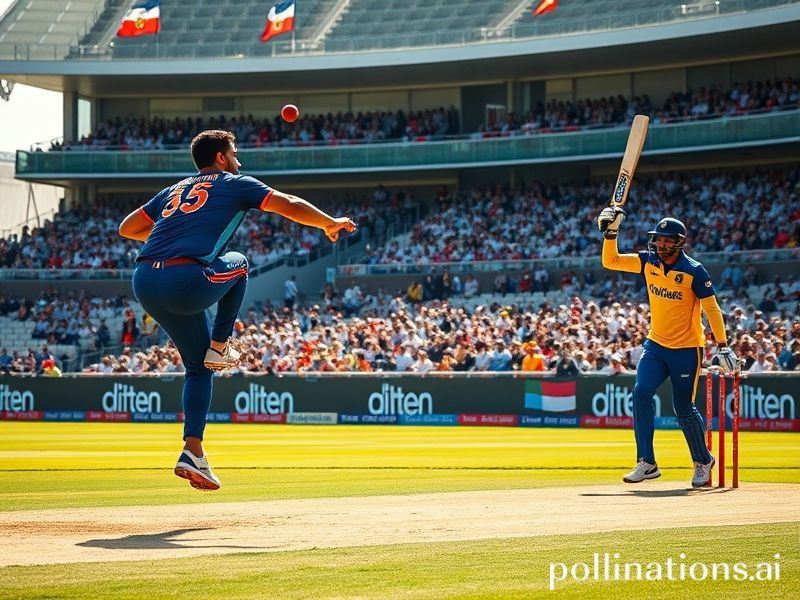
To the naked eye, it was 22 men chasing leather. To the diplomatic corps watching on cracked iPads in assorted embassies, it was a referendum on which brand of chaos travels better. Afghanistan’s openers swung like they were clearing airspace for drones; Sri Lanka’s batters defended like they were protecting the last gallon of diesel on the island. Every dot ball felt like a minor act of sedition, every boundary a hedge against sovereign default.
Naturally, the wider world projected itself onto the scoreboard. New Delhi’s television anchors treated an Afghan win as proof that talent can bloom even under medieval management—useful talking point when justifying strategic partnerships. Beijing’s state media hailed Sri Lanka’s spinners as evidence that Belt and Road debt traps come with optional googlies. Meanwhile, Washington think-tankers scribbled notes comparing Afghan fast bowling to asymmetric warfare, presumably so they could bill it to the Pentagon at $400 an hour.
The match ended, as most things do these days, in a super over—a bureaucratic overtime invented to make sure no one leaves the stadium until every last drop of advertising revenue has been wrung out. Afghanistan prevailed, triggering celebrations in Khost, Kerala, and that one kebab shop in Hamburg that streams matches via a VPN named after a warlord. Sri Lanka’s players applauded politely, already calculating how many more defeats equal another tranche from the IMF.
But the real winner was the meta-narrative: proof that even when your central bank is on fire and your moral compass is under house arrest, you can still field a decent leg-spinner. The planet’s commentariat quickly pivoted to deeper meanings—resilience, soft power, the unifying force of sport—while quietly ignoring ticket prices that rival monthly per-capita incomes. Because nothing says universal brotherhood quite like a $19 stadium beer.
So what does Afghanistan vs Sri Lanka signify in the grand ledger of human folly? Simply this: both countries have learned to weaponize hope the same way hedge funds weaponize derivatives. One does it with teenage pacers who learned reverse swing using duct-taped tennis balls, the other with wrist-spinners who practice between power cuts. Their encounter was less a contest than a joint press release reminding the world that bankruptcy and theocracy are merely surface conditions; underneath, the urge to hit something very hard with a piece of wood remains gloriously intact.
And somewhere in the VIP boxes, men in tailored suits who couldn’t find Kabul or Colombo on a map clinked glasses over broadcast rights, secure in the knowledge that tomorrow’s disaster will still need a highlights package. Until then, we keep score not just in runs and wickets, but in how convincingly we can pretend the game is still the only thing that matters.