barcelona fc
Barcelona FC: The Last Empire That Still Pretends It Isn’t Falling
By Our Correspondent Somewhere Between Duty-Free and Existential Dread
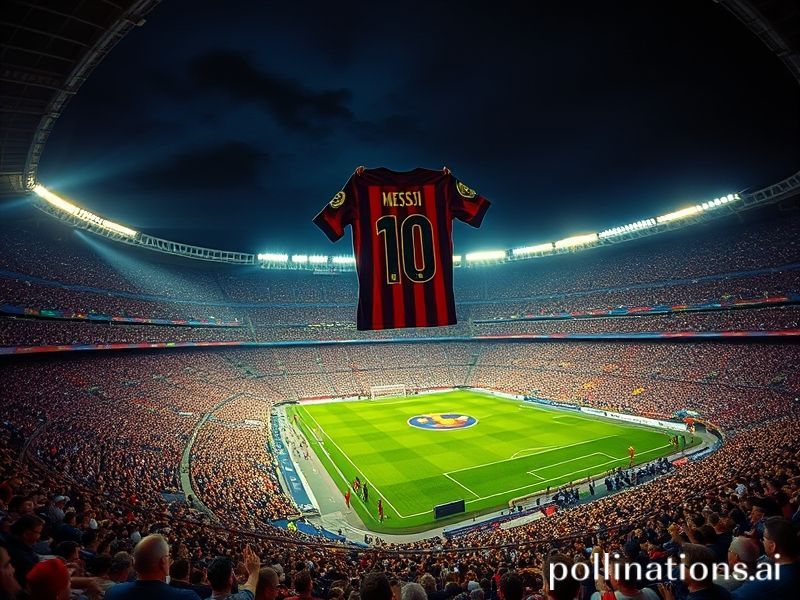
Global capitalism has many temples: the glass cube of an Apple store in Dubai, the tax-domiciled mailbox in Delaware, the neon-lit Nike outlet on Shanghai’s Nanjing Road. Yet none do quite the same brisk trade in collective delusion as Camp Nou on a Champions-League night. There, 100,000 pilgrims still chant “Més que un club” as if the slogan were a binding clause in the Treaty of Versailles rather than a marketing jingle older than TikTok. Barcelona FC, once the chic shorthand for Catalan resistance and lefty cosmopolitanism, now finds itself the most expensive museum of contradictions money can buy.
From Lagos to Lima, the Blaugrana shirt outsells every national flag except the one on your profile pic. The club’s Instagram following (160 million and rising faster than global sea levels) is a soft-power asset envied by mid-tier European states. When Pedri threads a pass, teenagers in Jakarta pause their doom-scroll; when Lewandowski misses a sitter, crypto bros in Miami lose money they didn’t know they had. The football, in other words, is just the loss-leader in a diversified portfolio of sentiment. Barcelona sells hope in extra-small, medium, and Qatar Airways editions.
The balance sheet, however, tells a less photogenic story. The club currently owes roughly €1.3 billion, a figure that would qualify it for an IMF bailout if only it had a seat at the UN. La Liga’s salary cap has turned the team sheet into a Sudoku puzzle: register one star, deregister your conscience. To plug the holes, the board famously sold 25 percent of its domestic TV rights for the next quarter-century—an inspired move that swaps tomorrow’s lunch for today’s Instagram brunch. Analysts at Goldman Sachs (who else?) call it “innovative monetization.” Historians closer to the ground call it what it is: pawning the family silver and telling the kids it’s an heirloom upgrade.
Naturally, the fans are furious—furious enough to tweet in all caps between mouthfuls of official club-branded paella. Some wave white handkerchiefs; others simply photoshop them in. Meanwhile, the socios—the 140,000 voting members who still pretend this is a cooperative—resemble passengers on the Titanic arguing over the playlist as the iceberg files its quarterly report. The cruel irony: the more the club globalizes, the less local control remains. A sheikh in Abu Dhabi now owns a slice of future match-day revenue, and if that sounds like the plot of a dystopian sitcom, congratulations—you’ve understood the assignment.
Yet Barcelona’s predicament mirrors a wider geopolitical farce. Like the European Union, the club expanded too fast, promised too much, and woke up shackled to creditors who speak better English than the players. Like the United States, it prints moral narratives at scale while outsourcing the dirty work. And like China, it tries to censor bad news until the bad news censors back. When Spotify’s logo replaced UNICEF’s on the shirt, nobody bothered to feign surprise; we’d already accepted that every revolution ends in a naming rights deal.
On the pitch, the kids still try. Gavi clatters into tackles like a man who hasn’t read the actuarial tables. Xavi prowls the touchline impersonating a younger, thinner version of himself, the footballing Dorian Gray. Each win is hailed as rebirth; each loss triggers a 24-hour news cycle about whether modern football is dead (it is, but the corpse has excellent engagement metrics).
So what does Barcelona FC mean to the wider world? Nothing less—and nothing more—than a glittering case study in how nostalgia can be leveraged as collateral. The club is simultaneously a city’s identity, a multinational’s cash register, and a generation’s vanishing point. If it finally defaults, the collapse will be narrated as tragedy; really, it will be the most honest thing the institution has done since Cruyff laced up his boots. Until then, the empire will keep singing in Catalan, subtitled in five languages and sponsored by a Japanese tire company. The song ends when the creditors change the lyrics.