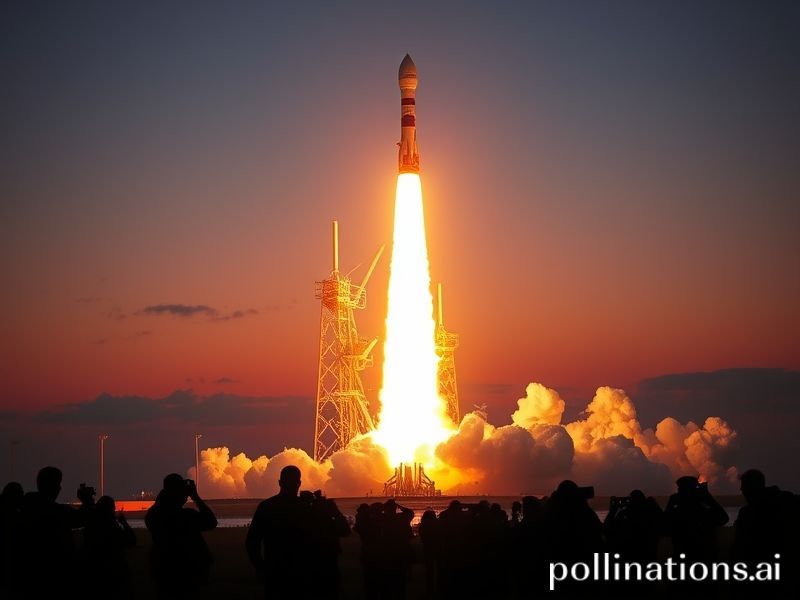
Another Tuesday, another column of fire clawing at the sky like humanity’s collective middle finger to gravity. Today’s rocket—let’s call it the SS Bureaucratic Optimism—blasted off from Cape Canaveral at 09:47 GMT carrying a payload of 64 Starlink clones, two weather satellites nobody asked for, and, allegedly, a freeze-dried pizza for the ISS crew who’ve been surviving on rehydrated moral compromise since March. The launch was streamed live to 3.7 million viewers, most of whom muted the audio halfway through to doom-scroll about the war that may or may not start before dessert.
From Lagos to Lima, the spectacle played on flatscreens in airport lounges where stranded travelers pretended not to notice the gate change that would strand them longer. In Singapore, brokers watched the ascent while algorithmically shorting a rival launch company’s stock; somewhere in rural Moldova, a teenager pirated the feed and clipped it into a TikTok soundtracked by a slowed-down sea shanty about late-stage capitalism. Multitasking is our true global lingua franca.
The geopolitical subtext was thicker than the rocket’s exhaust plume. The United States—fresh off announcing a $2 billion “space sustainability initiative” (translation: we’ll clean up our orbital debris unless someone else pays us not to)—insisted this launch was purely commercial. Meanwhile, Beijing’s state media ran a 900-word editorial reminding everyone that China’s Long March program is greener, cheaper, and comes with Confucian wisdom laminated to the fairing. Russia, still sore that nobody wants to ride its 1980s taxis anymore, countered by leaking grainy footage of a secret nuclear tugboat named Zeus, which sounds like a Bond villain but moves like a pensioner with gout. Europe applauded politely and commissioned another feasibility study.
Economically, the launch nudged aluminum futures up 1.2 %, wiped $400 million off legacy telecom stocks, and inspired 47 start-ups to promise “Uber for satellites” before lunchtime. Analysts in London toasted with flat prosecco, noting that low-Earth orbit is now more congested than the Northern Line at 8:05 a.m., only with fewer apologies. The UN Office for Outer Space Affairs issued a gentle cough of concern about space junk, then retreated to its customary role as a decorative appendix to history.
Environmentalists weighed in, too, armed with spreadsheets proving each launch melts precisely 0.7 polar bears’ worth of ice. Climate activists chained themselves to a Falcon 9 replica outside COP 29’s venue—a venue cooled to a crisp 18 °C, naturally—demanding that billionaires stop joyriding beyond the Kármán line and instead invest in seaweed farms. Their petition was signed by 120,000 people, none of whom were in the room where the billionaires were laughing.
Humanity’s split-screen reaction was predictably performative. On one feed: engineers high-fiving in mission control, their joy mathematically pure. On another: Twitter pundits rebranding the event as imperial cosplay. Somewhere in between, a Belarusian coder updated the open-source debris-tracking software that will probably save all our necks someday, unpaid and unnoticed except by the one PhD student who footnotes him in a thesis no one will read.
As the upper stage slipped into its parking orbit, the onboard camera caught a sliver of Earth—blue, bruised, and still singular. For a moment the comment sections went quiet, the way they do when even cynicism runs out of snark. Then someone posted a meme comparing the planet to a neglected Tamagotchi, and the scroll resumed.
Conclusion? We keep firing titanium phalluses into the black because it’s easier than fixing the mess down here. Yet each launch also threads another strand in the accidental web keeping us from nuclear midnight: shared bandwidth, shared weather data, shared selfies beamed from orbit that remind us the borders are imaginary and the air is getting thin. The rocket arcs, the stock tickers twitch, the ice cracks, and we all keep watching—half horrified, half hypnotized—because looking away feels even more fatal than looking up.