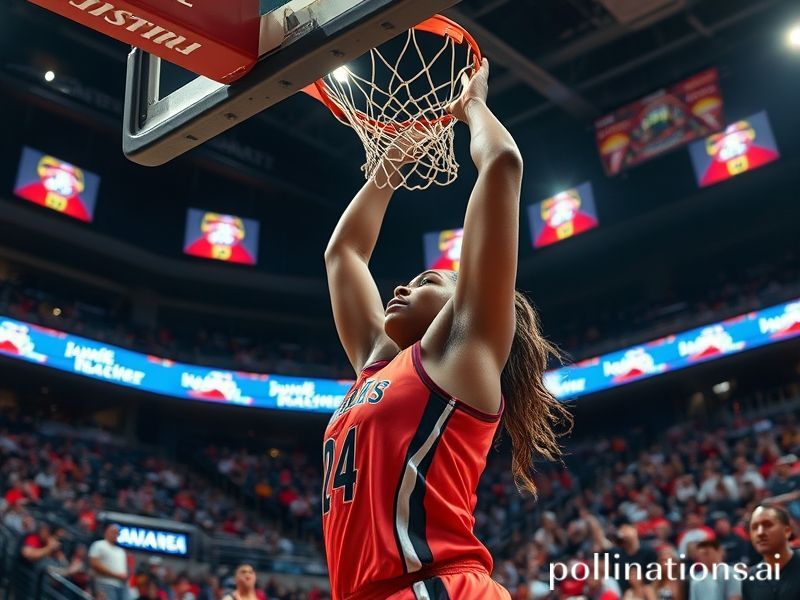
PARIS—While diplomats in Brussels were busy arguing over the precise shade of green that denotes “sustainable” natural gas, 9,317 spectators inside the Accor Arena were witnessing something genuinely renewable: a fourth-quarter Diana Taurasi tantrum so volcanic it could have been classified under the EU’s Emissions Trading Scheme. The Mercury’s 84-78 loss to the Storm was, on paper, merely another WNBA regular-season game. In the grander scheme—if one still believes in such things—it was a tidy parable about American soft power trying to rebrand itself in a world that has already scrolled to the next crisis.
Let’s be honest: outside the United States, women’s professional basketball is usually filed somewhere between “Finnish cricket scores” and “Bolivian chess updates” in the global attention economy. Yet the league’s aggressive marketing push into France, Canada, Australia, and even Brexit-bruised Britain is less about selling Brittney Griner bobbleheads than about selling the idea that the empire still knows how to stage a progressive spectacle. Nothing says “we’ve learned our lessons on human rights” like streaming subsidized athletics into regions where the local pastime is debating which American tech giant to fine next.
The geopolitical subplot is delicious. The WNBA’s marquee games are now broadcast in 24 time zones, allowing insomniacs in Jakarta to watch New York Liberty rookies argue about zoning defenses at 3 a.m. local. The league’s official stance is “growing the women’s game globally”; the unofficial stance is “please ignore our domestic attendance figures and notice how many Chinese manufacturers bid on jersey patches.” When the Chicago Sky recently unveiled a Mandarin-language social-media campaign, it was hailed as outreach. Cynics—okay, this correspondent—saw a desperate hedge against a future in which American cable subscribers finally realize they’re paying for 17 different flavors of CSI: Reno rather than live sports.
Still, one has to admire the audacity. The WNBA is essentially asking the planet to care about a tournament that pays its stars so poorly they spend winters in Siberian leagues where the paychecks come in dollars, euros, or, if the oligarch is feeling nostalgic, frozen herring. Compare that to the NBA, whose worst benchwarmer earns more per Instagram post than most Moldovan villages see in a fiscal year. The gap is so cartoonish that even FIFA executives—professionals who usually can’t smell inequality without invoicing it—have started muttering about “equitable resource distribution.” When Sepp Blatter’s successors lecture you on ethics, it’s time to check whether your moral compass is actually a fridge magnet.
Overseas audiences, bless their algorithmically curated hearts, seem oddly receptive. League-pass subscriptions are up 43 % in Germany, a nation that historically treats any contest without penalty shoot-outs as performance art. In Nigeria—Africa’s largest basketball market—viewing parties now outnumber power outages, a statistic no one saw coming except perhaps the Minister of Irony. Even Moscow, starved of Western entertainment since the invasion sanctions, streams games via VPNs named after Disney princesses, proving that nothing reconciles great-power animosity like watching Angel Reese complain about a referee who once taught high-school civics in Tucson.
What does it all mean? Possibly that in an era when trust in institutions evaporates faster than Argentine pesos, a mid-season tilt between the Indiana Fever and the Atlanta Dream offers the last reliable narrative arc: underpaid labor, corporate greed, heroic individual effort, and a final buzzer that still manages to feel honest—even if the replay center in Secaucus is technically sponsored by a crypto exchange currently under federal indictment. International viewers recognize the plot; they live it daily, minus the endorsement deals.
So the WNBA exports its product, the world imports a dab of optimism, and everybody pretends the business model is sustainable rather than a loss-leading vanity project for conglomerates that also sell you broadband, shaving razors, and warplanes. If that sounds bleak, remember: the alternative is another panel discussion on “rules-based order.” Given the choice, I’ll take the tantrum, the herring, and the faint hope that somewhere a 12-year-old in Lagos is practicing free throws instead of doomsday scrolling. Sometimes the most honest diplomacy is a jump ball.