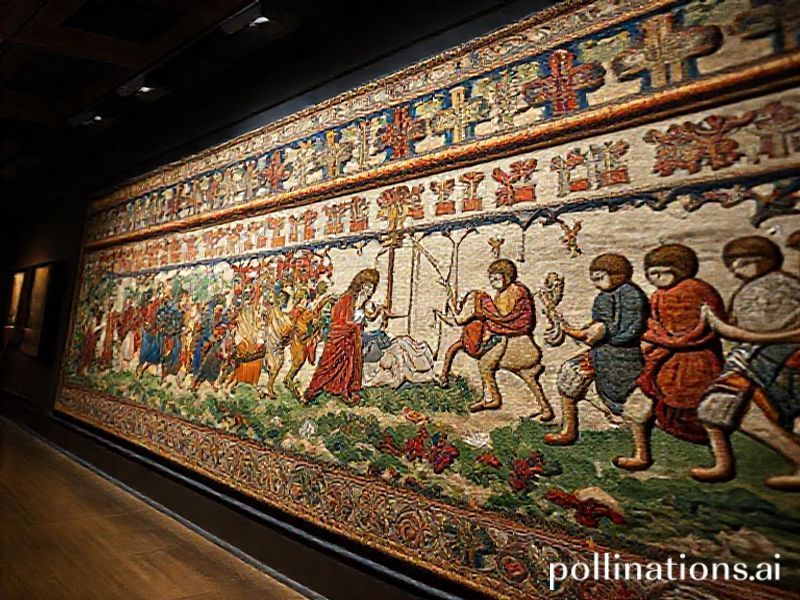
Bayeux Tapestry: The Medieval Meme That’s Still Dropping Truth Bombs
**The Bayeux Tapestry: A Medieval Meme That’s Still Dropping Truth Bombs**
Alright, listen up, internet denizens! There’s a new (well, old) kid on the block that’s been making waves across the globe. We’re talking about the Bayeux Tapestry, a 70-meter-long embroidered narrative that’s been sitting pretty in France for about 950 years. But why, you ask, is this ancient artifact suddenly trending like a viral TikTok dance? Let’s dive in, shall we?
**A Quick History Lesson (Don’t Worry, It’s Not Boring)**
First things first, the Bayeux Tapestry isn’t actually a tapestry. It’s an embroidered cloth, but “Bayeux Embroidery” doesn’t have the same ring to it, does it? This bad boy dates back to the 11th century and tells the story of the Norman Conquest of England, culminating in the Battle of Hastings in 1066. Think of it as the medieval equivalent of a Twitter thread or a Wikipedia page—just with way more drama and fewer typos.
**Why Is It Trending Now?**
So, why is this ancient artifact suddenly blowing up on the internet? Well, a few reasons:
1. **The Pandemic Effect**: With museums closed and people stuck at home, the Bayeux Tapestry’s digital presence has gone through the roof. High-resolution images and virtual tours have allowed people to explore it from the comfort of their couches.
2. **Pop Culture References**: The Tapestry has been popping up in various forms of media, from video games to TV shows. It’s like the medieval equivalent of a crossover event.
3. **Social Media Challenges**: Yep, you read that right. People have been recreating scenes from the Tapestry in their own homes, using household items to mimic the embroidered images. It’s like a medieval version of the “Put a Finger on the Screen” challenge.
**Cultural Context and Social Impact**
The Bayeux Tapestry is more than just a historical artifact; it’s a piece of cultural heritage that has influenced art, literature, and even modern politics. Its detailed depictions of 11th-century life offer a glimpse into the past, making it a valuable resource for historians and enthusiasts alike.
Moreover, the Tapestry’s recent surge in popularity has sparked conversations about the importance of preserving and digitizing cultural heritage. It’s a reminder that even ancient artifacts can have a significant impact on modern society.
**What Makes It Significant?**
So, what makes the Bayeux Tapestry so special? For starters, it’s one of the most significant surviving examples of Romanesque art. Its detailed illustrations provide invaluable insights into medieval life, from fashion and architecture to warfare and politics.
But perhaps the most significant aspect of the Bayeux Tapestry is its narrative power. It tells a story—a dramatic, action-packed tale of conquest and betrayal—that has captivated audiences for centuries. In a world where storytelling is more important than ever, the Tapestry serves as a reminder of the enduring power of a well-told tale.
**Conclusion**
The Bayeux Tapestry might be old, but it’s far from outdated. Its recent surge in popularity is a testament to its enduring relevance and cultural significance. So, whether you’re a history buff, an art enthusiast, or just someone looking for your next social media challenge, the Bayeux Tapestry is definitely worth a look. After all, who knows? You might just find yourself drawn into its dramatic narrative, becoming part of its rich, ongoing story.