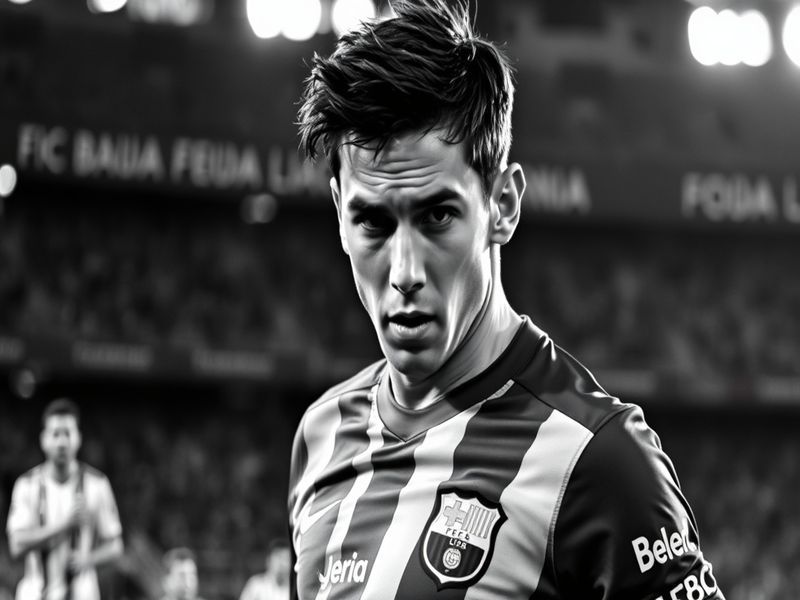
Eric García’s rise in European football has been marked by steady progress, tactical intelligence, and a quiet confidence that belies his young age. At just 23 years old, the Spanish international has already established himself as a key figure at FC Barcelona, where his composure at the back and ability to play out from defense have become invaluable under Xavi Hernández’s system.
Early Career and Development at Manchester City
Born on January 9, 2001, in Barcelona, García’s footballing journey began in the youth ranks of FC Barcelona before he moved to Manchester City at the age of 17. His time at City was pivotal in shaping his defensive awareness and technical abilities. Under the guidance of Pep Guardiola, García learned the nuances of playing as a modern center-back—positioning, pressing triggers, and distribution under pressure.
García made his senior debut for Manchester City in September 2019, appearing in the EFL Cup. His Champions League debut followed shortly after, though his path to regular playing time was often obstructed by the presence of established stars like Aymeric Laporte and John Stones. Despite limited minutes, his performances in training and reserves demonstrated his readiness for top-level football.
Return to Barcelona: A Homecoming with Purpose
In June 2021, García returned to Barcelona, reuniting with his boyhood club. The move was both sentimental and strategic. Barcelona needed young, technically sound defenders to rebuild their squad under financial constraints, and García brought exactly that profile. His first season back saw him play a rotational role, but by the 2022–23 campaign, he became a trusted starter alongside Ronald Araújo and Andreas Christensen in Xavi’s back three.
His ability to play as a single pivot in a back three allowed Barcelona to dominate possession while maintaining defensive solidity. García’s passing accuracy—often exceeding 90% in league matches—made him a cornerstone of the team’s buildup play. This season also saw him score his first competitive goal for Barcelona, a crucial header in a 1–0 win over Real Madrid in the Supercopa de España, a moment that underscored his growing influence.
Tactical Role and Playing Style
García is not a physically imposing defender, nor does he rely on aggressive challenges. Instead, his game is built on intelligence, anticipation, and technical precision. He excels in positional play, often stepping into midfield to receive the ball under pressure and then playing forward passes that bypass the opposition press. His comfort on the ball underpins Barcelona’s strategy of playing out from the back.
Defensively, García relies on reading the game rather than sheer athleticism. His timing in interceptions and his ability to stay composed in one-on-one situations make him reliable despite his lack of height (he stands at 1.82m). This profile makes him particularly effective in systems that demand high pressing and quick transitions, such as Xavi’s preferred 3-4-3 or 3-2-4-1 formations.
His strengths align perfectly with modern football’s demands, where defenders are expected to be comfortable with the ball at their feet and capable of initiating attacks. García’s development reflects a broader trend among young European defenders who prioritize technique and vision over traditional physical attributes.
International Success with Spain
García’s progress has also been evident on the international stage. He made his senior debut for Spain in September 2020, becoming one of the youngest players to represent the national team in recent years. His inclusion in Luis Enrique’s squads for Euro 2020 and the 2022 FIFA World Cup highlighted his standing as one of Spain’s most promising defenders.
At Euro 2020, García played a supporting role as Spain reached the semi-finals, showcasing his ability to adapt to high-pressure environments. His performances in the Nations League, where Spain finished runners-up in 2021, further cemented his reputation as a player with the mental resilience required for international football.
With Spain’s golden generation of midfielders aging, the next cycle of talent—including García—will likely form the backbone of the national team. His partnership with the likes of Pedri and Gavi in midfield could define Spain’s future style of play, blending possession-based football with defensive solidity.
Challenges and Areas for Growth
Despite his progress, García faces challenges that could shape the next phase of his career. One concern is his consistency in high-stakes matches. While he has shown composure in domestic competitions, his performances in elite European fixtures have occasionally been scrutinized, particularly when facing direct, physical forwards.
Another area for development is his aerial ability. Though he has improved in this aspect, he is not naturally dominant in the air, which can be exploited by teams that target crosses into the box. Strengthening this part of his game could elevate him from a promising defender to a complete one.
Additionally, García’s future at Barcelona may depend on the club’s financial situation and transfer strategy. With young defenders like Pau Cubarsí emerging, competition for starting spots could intensify. However, García’s understanding of the club’s philosophy and his leadership qualities give him an edge in retaining his place in the squad.
Comparisons and Place Among Europe’s Elite Defenders
García is often compared to other young Spanish defenders, such as Pau Torres and Jesús Vallejo, though his playing style sets him apart. Unlike Torres, who is more physically robust, García’s game is defined by his technical ability and positional sense. His profile is closer to that of former Barcelona defender Gerard Piqué, who also excelled in playing out from defense and dictating play from the back.
In terms of current European defenders, García’s closest comparables might be players like William Saliba of Arsenal or Antonio Silva of Benfica—defenders who prioritize ball-playing ability and tactical awareness over physicality. However, García’s Spanish heritage and his connection to Barcelona’s DNA give him a unique position in the landscape of European football.
As he continues to mature, García has the potential to join the ranks of Europe’s elite defenders, provided he can overcome the challenges that come with playing at the highest level. His trajectory suggests he is on the right path, but the coming seasons will be critical in determining whether he can sustain his progress and become a defining figure in modern football.
The Road Ahead: What’s Next for Eric García?
Looking ahead, García’s immediate focus will be on helping Barcelona reclaim their position among Europe’s elite teams. The club’s ambitions in the Champions League and La Liga will demand peak performances from its defensive unit, with García expected to play a central role.
On the international stage, Spain’s Euro 2024 campaign presents an opportunity for García to solidify his place in the starting lineup. With a new generation of talent emerging, the tournament could serve as a platform for him to showcase his leadership and technical prowess on a global stage.
Off the pitch, García’s professionalism and humility have endeared him to Barcelona fans, many of whom view him as a symbol of the club’s commitment to developing young talent. His journey from La Masia to the Camp Nou and back reflects the values of identity and continuity that Barcelona seeks to uphold.
As for his long-term future, speculation about a potential move to a club like Real Madrid or a top European giant has already begun. However, García’s loyalty to Barcelona and his desire to win trophies with the club may keep him in Catalonia for the foreseeable future. If he continues on his current trajectory, he could become one of the defining defenders of his generation.
For now, Eric García remains a player who lets his performances speak for themselves. In a sport often dominated by flashy personalities, his quiet confidence and technical excellence offer a refreshing contrast. As he continues to grow, he may well become a name synonymous with the future of Spanish and European football.
For more analysis on Barcelona’s defensive developments, visit our Sports section. To explore profiles of other rising talents in European football, check out our Analysis category.