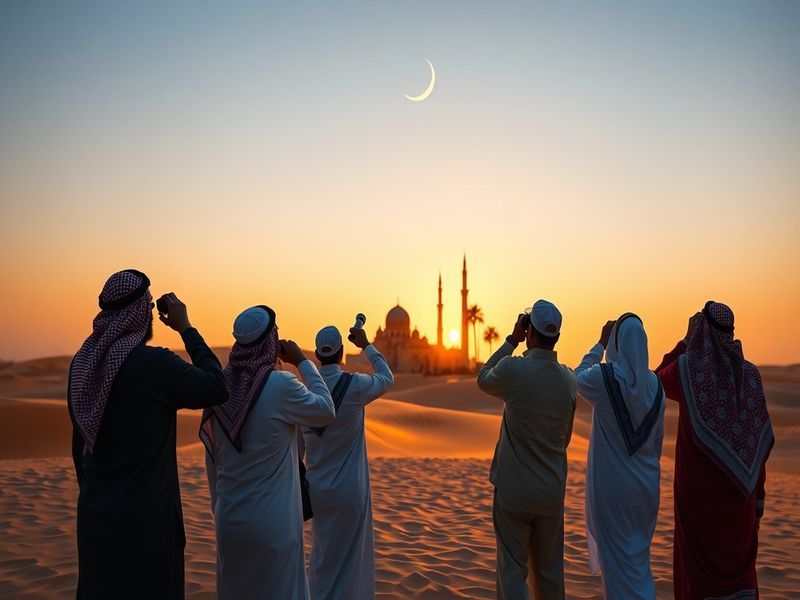
The announcement of Eid al-Fitr in Saudi Arabia begins with a celestial observation that blends ancient tradition with rigorous scientific verification. Each year, the kingdom’s judiciary relies on moon sightings to determine the start of the Islamic holiday, a practice rooted in religious texts and cultural heritage. This year’s process reflects both continuity and change, as authorities balance religious observance with modern astronomical data to ensure accuracy.
The High Judicial Council of Saudi Arabia plays a central role in this tradition. After sunset on the 29th day of Ramadan, committees across the country scan the horizon for the first crescent moon. These teams include religious scholars, legal experts, and technical observers who follow established protocols. Their findings directly impact millions of Muslims worldwide, as Saudi Arabia’s declaration often sets the precedent for global Eid celebrations.
The Religious and Legal Framework
Islamic jurisprudence governs the moon sighting process in Saudi Arabia, particularly through the Maliki and Hanbali schools of thought, which dominate the kingdom’s legal traditions. The Quran and Hadith emphasize the importance of visual confirmation, stating, “Fast when you see the crescent and break the fast when you see it.” This directive has shaped Saudi Arabia’s approach to Eid determination for centuries.
The legal framework is further reinforced by the Basic Law of Governance, which enshrines Islamic principles as the foundation of the state. The Council of Senior Scholars, Saudi Arabia’s highest religious authority, oversees the moon sighting committees to ensure compliance with Sharia law. Their rulings are binding for the kingdom’s judicial system and widely respected across the Muslim world.
However, the process is not without debate. Some scholars argue for the adoption of astronomical calculations as a supplementary tool, citing their precision in narrowing down potential sighting dates. Others insist on strict adherence to visual confirmation, citing religious and cultural significance. This tension between tradition and modernity continues to shape discussions in Saudi religious circles.
Key Institutions Involved
- High Judicial Council: Issues the official Eid announcement based on moon sighting reports.
- Council of Senior Scholars: Provides religious oversight and ensures alignment with Islamic law.
- Ministry of Islamic Affairs: Organizes local observation committees and disseminates results.
- Saudi Space Agency: Provides astronomical data to assist in verification (though not used for official declarations).
The Observation Process: From Tradition to Technology
Moon sighting in Saudi Arabia is a highly coordinated effort. The process begins with the formation of specialized committees in each region, equipped with telescopes and high-resolution cameras. Observers are positioned at elevated locations, such as the outskirts of Riyadh or the mountainous regions of Asir, where atmospheric clarity is optimal.
Once the crescent moon is sighted, the committee submits its report to the High Judicial Council. The council then cross-references these reports with other regions to confirm consistency. In cases of conflicting sightings, the council may request additional observations or rely on historical patterns to make a final determination.
Technology plays an increasingly supportive role in this process. While Saudi Arabia does not officially recognize astronomical calculations for Eid declarations, the Saudi Space Agency provides real-time data on moon visibility. This information helps observers narrow down their search areas and improves the efficiency of the sighting process. Tools like the Moon Phase Tracker on Dave’s Locker offer enthusiasts and scholars a way to cross-verify potential sighting dates.
Global Implications and Regional Variations
Saudi Arabia’s Eid moon sighting carries significant weight beyond its borders. As home to Islam’s two holiest sites, Mecca and Medina, the kingdom’s declaration often influences Eid dates worldwide. Countries with large Muslim populations, such as Indonesia, Malaysia, and the United Arab Emirates, frequently align their celebrations with Saudi Arabia’s announcement to maintain unity.
However, this influence is not absolute. Some nations, particularly in South Asia and Africa, rely on their own moon sighting committees. For example, Pakistan’s Ruet-e-Hilal Committee operates independently, sometimes resulting in Eid being celebrated on different days. This divergence highlights the diversity within the global Muslim community and the varying interpretations of religious texts.
The differences in moon sighting practices have led to calls for standardization. The Organization of Islamic Cooperation (OIC) has explored the possibility of adopting a unified lunar calendar, but religious and political divisions have hindered progress. For now, the tradition of local moon sightings remains a defining feature of Eid celebrations.
Challenges and Controversies
Despite its cultural significance, the moon sighting process in Saudi Arabia is not immune to challenges. Weather conditions, such as cloud cover or haze, can obscure the moon, delaying sightings and creating uncertainty. In 2022, adverse weather in parts of the kingdom led to conflicting reports, prompting the High Judicial Council to extend the observation period before issuing a declaration.
Another point of contention is the role of technology in religious practices. While some scholars advocate for the use of astronomical calculations to supplement visual sightings, others argue that such methods undermine the spiritual essence of the tradition. This debate reflects broader tensions between modernity and tradition in Saudi society.
Public reaction to moon sighting announcements can also be polarizing. In 2021, the late announcement of Eid al-Fitr sparked frustration among some Muslims, particularly those preparing for travel or work schedules. Social media amplifies these reactions, with users sharing their observations or criticizing the council’s decisions. The kingdom’s leadership has emphasized patience and faith, urging citizens to accept the outcome as part of divine wisdom.
Looking Ahead: The Future of Moon Sighting
The future of Eid moon sighting in Saudi Arabia may lie in a hybrid approach, combining traditional observation with scientific verification. While the kingdom has not formally adopted astronomical calculations, the increasing availability of precise data suggests a gradual shift. This evolution could reduce uncertainties and foster greater consensus among Muslim communities worldwide.
Education also plays a key role in preserving the tradition. The Ministry of Islamic Affairs conducts workshops for observers, training them in both religious protocols and modern observation techniques. These efforts ensure that the process remains robust and adaptable to changing conditions.
For Saudi citizens, the moon sighting announcement is a moment of collective anticipation. Families gather to await the news, which signals the end of Ramadan’s fasting and the beginning of Eid’s celebrations. The tradition fosters a sense of unity and shared purpose, transcending regional and cultural differences.
As Saudi Arabia continues to modernize, the moon sighting process remains a testament to the kingdom’s ability to honor its heritage while embracing progress. Whether through the naked eye or the lens of a telescope, the search for the crescent moon connects generations in a timeless ritual.