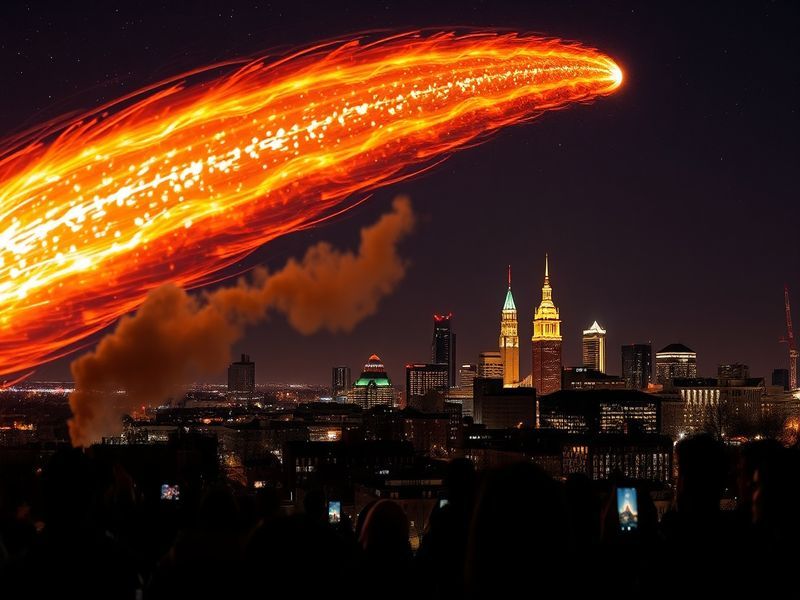
The night sky over Cleveland, Ohio, transformed from ordinary to extraordinary on the evening of October 12, 2023. A bright fireball streaked across the horizon, followed by a loud sonic boom that rattled windows and startled residents. What appeared to be a typical autumn evening suddenly became a moment of cosmic significance as a meteor entered Earth’s atmosphere and fragmented over the region.
Witnesses described the event as both terrifying and awe-inspiring. Local news outlets were flooded with calls from people who reported seeing a “greenish-blue light” and hearing what sounded like distant thunder or an explosion. Security cameras and dashcams captured the fireball, providing clear evidence of the meteor’s dramatic entry.
The Science Behind the Meteor Strike
Meteors are space rocks—often remnants of comets or asteroids—that enter Earth’s atmosphere at high speeds. Most burn up completely before reaching the ground, but some fragments, called meteorites, survive the journey and land on the surface. The Cleveland meteor was estimated to be about the size of a small car before it broke apart, releasing energy equivalent to several tons of TNT.
NASA’s Meteor Watch program later confirmed the event, classifying it as a bolide—a particularly bright meteor that explodes in the atmosphere. Bolides are rare but not unheard of. According to the International Meteor Organization, only a handful of significant bolide events occur worldwide each year. The Cleveland strike was one of the most well-documented in recent U.S. history, thanks to the abundance of security cameras in urban areas.
The meteor’s trajectory was tracked by astronomers, who noted that it entered the atmosphere at a shallow angle, which contributed to its spectacular display. Had it entered at a steeper angle, the outcome could have been far more destructive.
Where Did the Meteor Land?
Initial reports suggested the meteor might have landed in Lake Erie, but further analysis indicated that fragments could have reached the shore. Search teams, including volunteers and scientists from local universities, organized searches along the lakefront and surrounding areas. While no large meteorites were immediately recovered, small fragments were found in residential neighborhoods.
The search continues as meteorite hunters scour the region. So far, the largest confirmed fragment weighs just over 100 grams, but experts believe larger pieces may still be hidden in wooded areas or buried under leaves. The rarity of the event has drawn both scientific interest and public fascination.
Cleveland’s Place in the History of Cosmic Events
Cleveland has witnessed its share of unusual events, but a meteor strike ranks among the most extraordinary. The last significant meteor event in Ohio occurred in 1999 near Lake Erie, though it was far less dramatic. Globally, meteor strikes are more common than many realize. In 2013, the Chelyabinsk meteor in Russia injured over 1,000 people and caused widespread damage. However, most meteors strike uninhabited areas or fall harmlessly into the ocean.
Cleveland’s event serves as a reminder of humanity’s place in the universe. While the odds of a catastrophic meteor impact are low, the psychological impact of witnessing such a phenomenon is undeniable. For a brief moment, the routine of daily life was interrupted by the vastness of space.
Cultural Reactions and Public Fascination
Social media erupted with videos, photos, and theories about the meteor. Memes circulated, jokes were made, and conspiracy theories briefly flourished before being debunked. The event also sparked conversations about space exploration and planetary defense. NASA and other agencies monitor near-Earth objects (NEOs) to assess potential threats, but predicting meteor strikes remains an inexact science.
The Cleveland meteor quickly became a local legend. Schools incorporated the event into science lessons, and local businesses capitalized on the attention with “Meteor Shake” milkshakes and “Space Rock” merchandise. Even the Cleveland sports teams got in on the action, with the Cavaliers jokingly offering “interstellar assistance” to any alien visitors.
For many, the meteor strike was a moment of unity—a shared experience that transcended everyday divisions. In a world often divided by politics and culture, the cosmos reminded everyone of their shared existence on a small, fragile planet.
What’s Next for Meteor Research in Ohio?
The Cleveland meteor has reignited interest in meteorite hunting and amateur astronomy in the region. Local universities are planning expeditions to search for more fragments, and citizen scientists are encouraged to report any unusual rocks they find. The event has also highlighted the importance of tracking near-Earth objects, a task that requires both advanced technology and public awareness.
For now, the meteor remains a topic of conversation in Cleveland. Whether it’s a footnote in history or the catalyst for future discoveries, its impact is undeniable. As one local resident put it, “It’s not every day you get a reminder that we’re just a speck in the universe—but when you do, it changes how you see everything.”
The search for meteorites continues, and with each new fragment found, the story of that October night becomes a little clearer. For now, Cleveland holds its place in the annals of cosmic history—one bright streak across the sky.