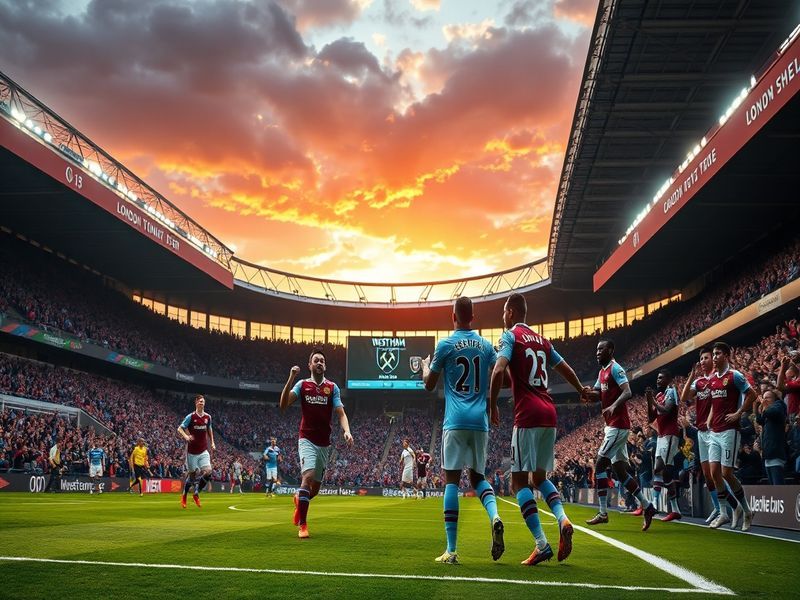
When West Ham United hosted Manchester United at the London Stadium on a crisp October evening, the fixture promised more than just three points. For the Hammers, it was a chance to prove their Premier League credentials against one of England’s traditional heavyweights. For Manchester United, already under pressure from their own fanbase, a poor result would only amplify the growing discontent.
The match unfolded in front of a roaring crowd, with West Ham’s faithful creating an intimidating atmosphere from the first whistle. Manchester United, meanwhile, struggled to impose their usual rhythm, their midfield lacking the creativity that has so often defined their play this season. The game became a study in contrasts: West Ham’s disciplined pressing against United’s disjointed build-up.
First Half: West Ham’s Pressing Pays Dividends
West Ham manager David Moyes set his team up in a 4-3-3 formation, with Declan Rice and Tomáš Souček forming a formidable double pivot in midfield. Their instructions were clear: press Manchester United high up the pitch, force errors, and exploit the spaces behind their full-backs.
It worked almost immediately. West Ham’s front three of Jarrod Bowen, Michail Antonio, and Said Benrahma harried United’s center-backs, particularly Harry Maguire, who looked uncomfortable under pressure. United’s midfield, often reliant on Bruno Fernandes for creativity, found themselves outnumbered in key areas, struggling to transition from defense to attack.
The opening goal arrived in the 28th minute, a moment that encapsulated West Ham’s performance. A quick throw-in by Aaron Cresswell found Bowen on the right flank, and his cross was met by Antonio, who powered a header past David de Gea. The London Stadium erupted, while Old Trafford fans watching on TV could only watch in stunned silence.
Manchester United’s Struggles in Possession
United’s issues were not just tactical but technical. Their midfield pairing of Fred and Scott McTominay looked overwhelmed by West Ham’s intensity, with Fernandes often isolated. The Portuguese midfielder attempted to dictate play, but his passes were frequently intercepted, and his teammates failed to offer meaningful support.
United’s full-backs, Luke Shaw and Diogo Dalot, were repeatedly exposed by West Ham’s wingers. Bowen and Benrahma consistently outpaced them, forcing United into long balls that rarely troubled West Ham’s backline. Even when United managed to string together a few passes, their final ball was rarely accurate enough to trouble Łukasz Fabiański in goal.
Second Half: United’s Late Response Falls Short
Manchester United made two substitutions at halftime, bringing on Antony and Christian Eriksen in an attempt to inject some creativity. The changes had a marginal impact, with Eriksen’s set-piece deliveries causing West Ham problems, but United still lacked a coherent attacking plan.
The best chance of the second half fell to Marcus Rashford in the 67th minute. A poor clearance from West Ham’s defense fell to the English forward, but his shot was brilliantly saved by Fabiański, diving low to his left. It was a crucial moment—one that could have changed the game, but it wasn’t to be.
West Ham, meanwhile, remained disciplined. Moyes had instructed his team to drop deeper once United regained possession, frustrating their opponents and limiting their opportunities. The final 20 minutes saw United throw everything forward, but their lack of a genuine striker—Rashford and Anthony Martial were often isolated—meant they struggled to create clear chances.
The match ended 1-0, a result that flattered United more than it reflected their performance. West Ham had been the better side, and their victory was fully deserved.
Key Takeaways from the Match
This result highlighted several issues for Manchester United. Their midfield, once the backbone of their success under José Mourinho, now looks unbalanced. Fred’s limitations in possession are becoming increasingly apparent, while McTominay’s physicality doesn’t compensate for his lack of technical quality. Fernandes remains their most creative outlet, but he cannot carry the team alone.
For West Ham, the performance reinforced their status as a team capable of competing with the Premier League’s elite. Their pressing was relentless, their shape compact, and their execution clinical. The win moved them into the top half of the table, a position they will be eager to maintain.
Tactically, this match was a microcosm of the wider Premier League. West Ham’s pragmatic approach contrasts with United’s more traditional, possession-based style—yet in this game, pragmatism triumphed. It’s a lesson that other mid-table teams might take note of as the season progresses.
What’s Next for Both Teams?
For West Ham, the challenge now is to build on this performance. Their next fixtures include a trip to Arsenal and a home game against Tottenham, both of which will test their mettle. Consistency will be key if they are to secure European football for the first time in over two decades.
Manchester United, on the other hand, face a growing crisis. Their fans are restless, their results inconsistent, and their manager’s future uncertain. The next few weeks will be critical—do they regroup and mount a challenge, or will the cracks begin to show?
One thing is clear: this was more than just a football match. It was a statement. West Ham showed they belong among the Premier League’s best, while Manchester United’s flaws were laid bare for all to see.
For fans of the beautiful game, it was another reminder that in football, anything is possible—no matter the size of the club.
To stay updated on Premier League action, check out our News and Sports sections for the latest analysis and insights.