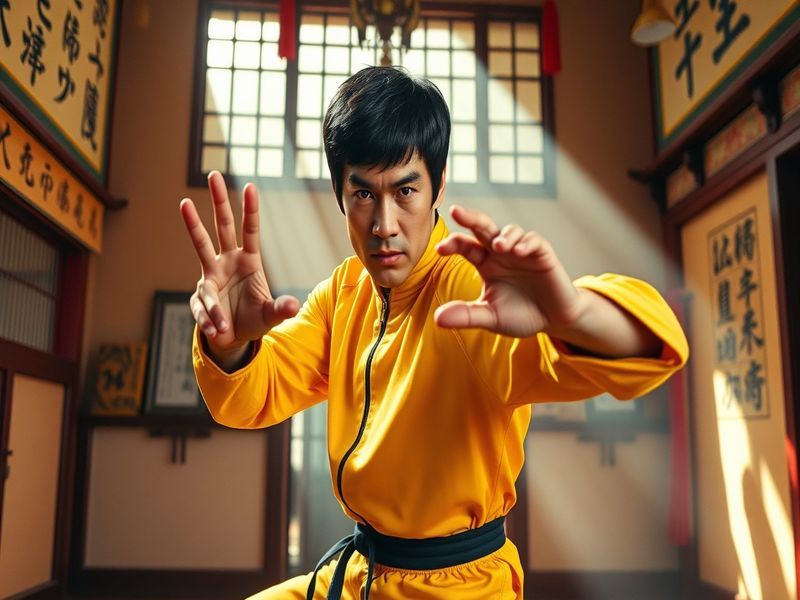
Few figures in modern history have left as indelible a mark on global culture as Bruce Lee. Born in San Francisco in 1940 but raised in Hong Kong, Lee transcended his early life as a child actor to become a martial arts legend, a philosophical thinker, and a cinematic pioneer. His influence extends far beyond the silver screen, shaping the way martial arts are practiced worldwide and inspiring generations of athletes, performers, and creators.
Lee’s journey was not one of overnight success but rather a relentless pursuit of mastery. From his early training in Wing Chun under Ip Man to his development of his own martial art, Jeet Kune Do, he challenged conventions at every turn. His philosophy—rooted in adaptability, efficiency, and personal expression—challenged traditional martial arts dogma and resonated deeply with audiences. By the time of his untimely death in 1973 at age 32, Lee had already cemented his legacy as one of the most transformative figures of the 20th century.
The Making of a Martial Arts Revolutionary
Bruce Lee’s early years were marked by both privilege and struggle. The son of an opera singer and martial artist, he was introduced to the stage as a child actor in Hong Kong films. His exposure to the cinematic world provided an early glimpse into the power of performance, though his path to greatness was far from predetermined. At 13, he began training in Wing Chun under Ip Man, a master of the art, who instilled in him the principles of close-quarters combat and centerline theory.
However, Lee’s training was not without challenges. Due to his mixed heritage—his father was half-German and half-Chinese, while his mother was of Chinese descent—he faced discrimination in Hong Kong. This adversity fueled his determination to prove himself, both as a martial artist and as a student of life. His move to the United States in the 1960s marked a turning point. Enrolling at the University of Washington, he began teaching Wing Chun while developing his own martial philosophy, which he later named Jeet Kune Do, or “The Way of the Intercepting Fist.”
Jeet Kune Do was not just a martial art; it was a philosophy of combat and life. Lee rejected rigid forms and traditional techniques, instead advocating for adaptability and directness. He famously stated, “Absorb what is useful, discard what is useless, and add what is specifically your own.” This mindset reflected his broader approach to self-improvement, emphasizing personal growth over dogmatic adherence to rules. His teachings attracted students from all walks of life, including Hollywood actors and military personnel, who sought to learn from his approach to discipline and efficiency.
Cinema and the Birth of a Global Icon
Bruce Lee’s entry into Hollywood was not immediate. Despite his martial arts prowess, he struggled to secure leading roles in the U.S. due to racial stereotypes and typecasting. His breakthrough came in 1971 with the Hong Kong film Fists of Fury, which showcased his martial arts skills and charisma. The film’s success led to The Way of the Dragon (1972), where Lee wrote, directed, and starred in the lead role. The movie’s climactic fight scene in the Colosseum remains one of the most iconic in cinema history.
However, it was Enter the Dragon, released posthumously in 1973, that cemented Lee’s status as a global icon. Produced by Warner Bros., the film was the first major Hollywood production to feature an Asian lead. Its success shattered box office records and introduced martial arts cinema to mainstream audiences worldwide. Lee’s performance as Lee Siao Lung was more than just action; it was a masterclass in physicality, intensity, and emotional depth. His ability to convey vulnerability alongside his martial arts prowess made him a relatable yet extraordinary figure.
Lee’s impact on cinema extended beyond his roles. He pioneered the use of practical stunts and choreography, setting a new standard for action sequences. His fight scenes were not just displays of skill but narratives in themselves, with each movement advancing the story. This approach influenced generations of filmmakers, from Jackie Chan to Quentin Tarantino, who have cited Lee as a major inspiration. Even today, his films remain benchmarks for martial arts cinema, studied for their technical precision and artistic vision.
Philosophy and Legacy: Beyond the Martial Arts
Bruce Lee’s influence was not confined to martial arts or film. He was also a profound thinker whose writings and interviews continue to inspire millions. His philosophy, rooted in Taoism and Zen Buddhism, emphasized self-awareness, adaptability, and the pursuit of excellence. In his posthumously published Tao of Jeet Kune Do, he explored the intersection of martial arts and life, arguing that true mastery comes from within.
One of Lee’s most enduring lessons was the importance of self-expression. He believed that martial arts should be a vehicle for personal growth, not just a system of combat. His famous quote, “Be water, my friend,” encapsulates this idea—urging individuals to embrace change, remain fluid, and adapt to circumstances. This philosophy resonated far beyond the dojo, influencing artists, entrepreneurs, and educators who sought to break free from constraints and innovate.
Lee’s legacy is also evident in the countless tributes and homages that continue to emerge decades after his death. From statues in Hong Kong to documentaries and biopics, his life and work remain a subject of fascination. His son, Brandon Lee, carried on his legacy, though his tragic death in 1993 added another layer of complexity to the family’s story. Today, Bruce Lee’s teachings are studied in universities, martial arts schools, and corporate training programs, proving that his ideas are as relevant today as they were in his time.
The Enduring Impact on Modern Culture
Bruce Lee’s influence can be seen across multiple facets of modern culture. In martial arts, his emphasis on practicality and efficiency has shaped disciplines like MMA, where fighters blend techniques from various styles to create their own approach. Organizations like the UFC often highlight Lee’s philosophy as a guiding principle for modern combat sports. His impact is also evident in fitness trends, with Jeet Kune Do-inspired workouts gaining popularity in gyms worldwide.
In cinema, Lee’s legacy lives on through the films of directors like Ang Lee, whose Crouching Tiger, Hidden Dragon paid homage to classic martial arts cinema. Even in Western films, his influence is palpable. Directors such as the Wachowskis and Paul Thomas Anderson have cited Lee as an inspiration for their approach to action and storytelling. His iconic status has also made him a symbol of Asian representation in Hollywood, paving the way for actors like Jet Li, Donnie Yen, and Simu Liu.
Beyond entertainment, Lee’s philosophy has found a home in self-improvement circles. His teachings on discipline, adaptability, and self-expression are frequently cited in books and seminars on personal development. Entrepreneurs and leaders, including figures like Tony Robbins, have referenced Lee’s ideas as a blueprint for achieving success while maintaining authenticity. His ability to transcend cultural and linguistic barriers speaks to the universal appeal of his message.
To fully appreciate Bruce Lee’s legacy, one must look beyond the myths and legends. He was not just a martial artist or an actor but a thinker who challenged the status quo and inspired others to do the same. His life was a testament to the power of perseverance, the importance of self-belief, and the pursuit of excellence. Whether through his films, his writings, or his teachings, Lee’s impact endures, reminding us that true mastery is not about perfection but about growth and self-discovery.
For those looking to explore more about martial arts and their cultural significance, visit our Culture section. Additionally, for a deeper dive into action cinema and its evolution, check out our Entertainment category, where we cover the latest trends and timeless classics.