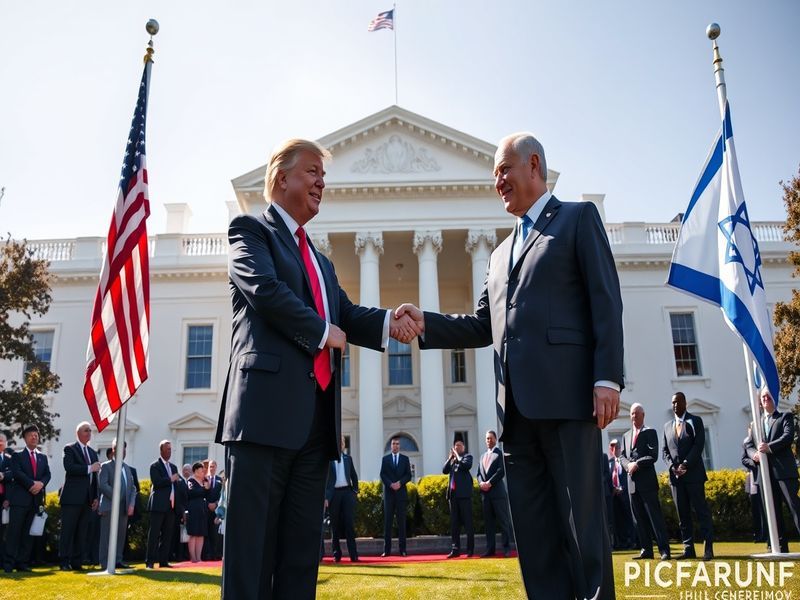
How Donald Trump Reshaped U.S.-Israel Relations and Global Diplomacy
The relationship between the United States and Israel has long been a cornerstone of American foreign policy in the Middle East. Under the administration of Donald Trump, this alliance reached new heights, marked by bold diplomatic moves and unapologetic support for Israeli policies. The Trump era reshaped the dynamics of Middle Eastern geopolitics, leaving a legacy that continues to influence global diplomacy today.
Trump’s approach to Israel differed sharply from his predecessors. While previous administrations had sought to balance support for Israel with efforts to broker peace between Israelis and Palestinians, Trump’s policies prioritized Israel’s strategic and ideological interests. This shift reflected his broader foreign policy philosophy, which emphasized transactional relationships and a willingness to challenge long-standing international norms.
The Recognition of Jerusalem as Israel’s Capital
One of the most consequential decisions of Trump’s presidency was the recognition of Jerusalem as the capital of Israel. In December 2017, the Trump administration announced that the U.S. would move its embassy from Tel Aviv to Jerusalem, a move that had long been promised by pro-Israel politicians but was widely seen as a departure from international consensus.
The decision was met with a mix of praise and condemnation. Supporters argued that it was a long-overdue correction to a historical injustice, while critics warned that it would destabilize the region and undermine the prospects for a two-state solution. The move was celebrated by many Israelis, particularly those on the right, who viewed Jerusalem as the undivided capital of their state. Internationally, however, the announcement sparked protests and drew sharp rebukes from Arab leaders and European allies.
The embassy relocation was completed in May 2018, coinciding with the 70th anniversary of Israel’s founding. The ceremony was attended by high-ranking U.S. officials, including Ivanka Trump and Jared Kushner, who played key roles in shaping the administration’s Middle East policy. The event underscored the Trump administration’s commitment to aligning U.S. policy with Israeli priorities, even at the expense of diplomatic tradition.
The Abraham Accords and Regional Diplomacy
Beyond the Jerusalem decision, Trump’s most enduring legacy in the Middle East may be the Abraham Accords, a series of normalization agreements between Israel and several Arab states. Signed in 2020, the accords marked the first time in decades that Arab countries formally recognized Israel, bypassing the long-standing requirement that Palestinian statehood be achieved first.
The agreements, brokered with significant input from Trump’s son-in-law and senior advisor Jared Kushner, were hailed as a breakthrough in regional diplomacy. The UAE, Bahrain, Sudan, and Morocco all normalized relations with Israel, signaling a shift in the geopolitical landscape of the Middle East. The accords were driven by shared concerns about Iran’s influence in the region, as well as economic and security interests.
While the Abraham Accords were a diplomatic triumph for the Trump administration, they also drew criticism. Palestinians viewed the agreements as a betrayal, arguing that they sidelined their cause. Some analysts questioned whether the accords would lead to lasting peace or merely serve as a temporary alignment of interests. Nonetheless, the agreements represented a significant departure from the traditional Arab-Israeli conflict dynamic and opened new avenues for cooperation.
Key Players in the Abraham Accords
- United Arab Emirates (UAE): The first Gulf state to normalize relations with Israel, the UAE cited mutual threats, particularly from Iran, as a driving force behind the agreement.
- Bahrain: The small island nation followed the UAE’s lead, signaling its alignment with broader Gulf security interests.
- Sudan: After years of isolation, Sudan’s normalization with Israel was tied to economic incentives and the lifting of U.S. sanctions.
- Morocco: The agreement included U.S. recognition of Morocco’s sovereignty over Western Sahara, a controversial move that highlighted the transactional nature of the deal.
Shifting U.S. Policy on Israeli Settlements
Another significant aspect of Trump’s Israel policy was his administration’s stance on Israeli settlements in the West Bank. Unlike previous administrations, which had criticized settlement expansion as an obstacle to peace, Trump’s team took a more hands-off approach. In 2019, Secretary of State Mike Pompeo announced that the U.S. would no longer consider Israeli settlements in the West Bank to be a violation of international law.
This decision was celebrated by Israeli hardliners and criticized by Palestinian leaders and human rights organizations. The move effectively removed one of the key points of contention in the Israeli-Palestinian conflict, signaling that the Trump administration was willing to prioritize Israeli sovereignty over Palestinian aspirations. It also reflected a broader shift in U.S. foreign policy under Trump, which often challenged international legal frameworks and multilateral agreements.
The policy shift had immediate consequences. Israel announced plans for thousands of new housing units in the West Bank, and the Israeli government moved forward with annexation plans for parts of the territory. While annexation was ultimately paused, the Trump administration’s stance emboldened Israeli leaders to pursue policies that had long been deemed illegal under international law.
Global Reactions and Long-Term Implications
Trump’s policies on Israel elicited strong reactions from around the world. In the United States, his approach was divisive. Supporters praised his unwavering support for Israel and his willingness to challenge the status quo, while critics accused him of undermining decades of U.S. foreign policy and exacerbating regional tensions. Internationally, the Trump administration’s moves were seen as a rejection of the international consensus on the Israeli-Palestinian conflict, which had long been based on the two-state solution.
The global reaction to Trump’s Israel policy was complex. While some countries, particularly in the Gulf, welcomed the Abraham Accords, others viewed the Trump administration’s actions as destabilizing. The European Union, for example, reiterated its commitment to a two-state solution and expressed concern over the unilateral nature of U.S. decisions. Meanwhile, countries like Iran and Turkey condemned the Trump administration’s policies, framing them as part of a broader campaign against Muslim interests.
The long-term implications of Trump’s Israel policy remain uncertain. The Abraham Accords have endured, but the broader Middle East peace process remains stalled. The U.S. embassy remains in Jerusalem, and Israeli settlements continue to expand. For many, Trump’s policies represented a necessary correction to a flawed status quo, while for others, they deepened the suffering of the Palestinian people and undermined the prospects for peace.
As the world grapples with the aftermath of Trump’s presidency, his impact on U.S.-Israel relations serves as a case study in how a single administration can reshape global diplomacy. Whether this legacy will endure or be reversed remains to be seen, but its influence on the Middle East and beyond is undeniable.
Conclusion
Donald Trump’s approach to Israel was marked by boldness, unpredictability, and a willingness to challenge conventional wisdom. His policies—from the recognition of Jerusalem as Israel’s capital to the Abraham Accords—reshaped the geopolitical landscape of the Middle East and left a lasting imprint on U.S.-Israel relations. While supporters view these moves as a necessary correction to a flawed status quo, critics argue that they have deepened divisions and sidelined the Palestinian cause.
The global reaction to Trump’s Israel policy highlights the complex and often contradictory nature of Middle Eastern diplomacy. It also underscores the enduring importance of the U.S.-Israel relationship, which continues to shape the region’s future. As the world moves forward, the legacy of Trump’s policies will be debated, but their impact on the Middle East is already clear: a region transformed by shifting alliances, bold diplomacy, and the relentless pursuit of self-interest.