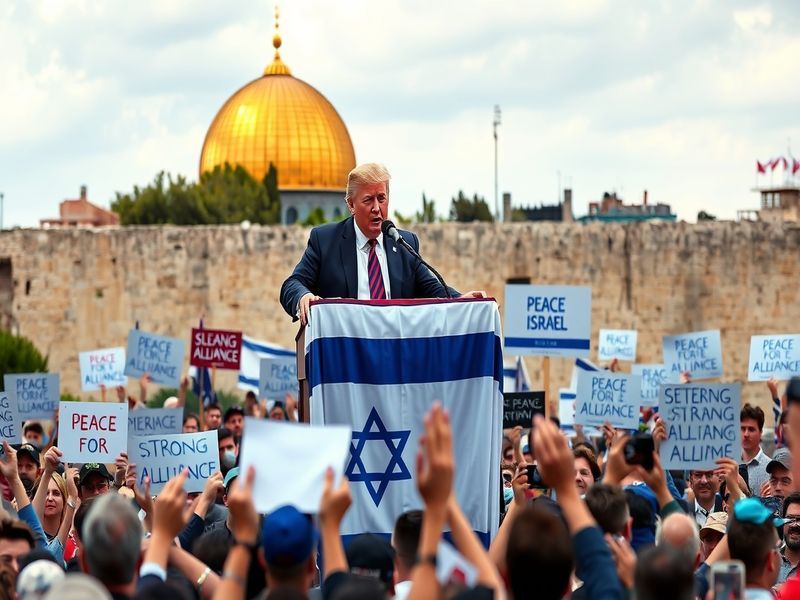
How Trump Changed U.S.-Israel Relations Forever
Few political figures have reshaped U.S.-Israel relations as dramatically as Donald Trump during his presidency and beyond. His administration’s approach to the Middle East, particularly regarding Israel, marked a significant departure from decades of American foreign policy. While supporters praised his bold moves as a necessary correction to outdated paradigms, critics warned of destabilizing consequences. Understanding this complex legacy requires examining key decisions, their broader implications, and the ongoing debates they provoked.
The Jerusalem Embassy Move: Breaking Decades of Diplomatic Protocol
One of Trump’s most consequential actions was recognizing Jerusalem as Israel’s capital in December 2017 and subsequently moving the U.S. embassy from Tel Aviv to Jerusalem in May 2018. This decision reversed seven decades of U.S. policy that deferred to international consensus on Jerusalem’s status pending final negotiations between Israelis and Palestinians.
The move delighted Israel’s government but provoked widespread condemnation from the international community. Palestinian leaders declared it null and void, while European allies expressed concern about undermining peace prospects. The United Nations General Assembly overwhelmingly voted to condemn the decision, demonstrating the depth of opposition among traditional U.S. partners.
Proponents argued that recognizing reality—Jerusalem has been Israel’s functional capital since 1949—was long overdue. They contended that previous administrations’ refusal to acknowledge this fact only prolonged the conflict by incentivizing Palestinian rejectionism. Critics countered that unilateral actions without Palestinian input would poison the atmosphere for future negotiations, making compromise less likely.
The Abraham Accords: Redefining Middle East Diplomacy
Perhaps Trump’s most enduring foreign policy achievement regarding Israel came through the Abraham Accords, a series of normalization agreements between Israel and several Arab states signed in 2020. The accords established diplomatic relations between Israel and the United Arab Emirates, Bahrain, Sudan, and Morocco, representing the most significant shift in Middle East geopolitics in decades.
These agreements demonstrated that Arab-Israeli peace could be achieved through economic and security cooperation rather than through the traditional land-for-peace formula. The UAE’s decision to normalize relations with Israel, in particular, signaled a strategic realignment as Gulf states increasingly viewed Iran—not Israel—as their primary security threat.
While the accords didn’t directly address the Israeli-Palestinian conflict, they created new dynamics that could pressure Palestinian leadership to engage more constructively. The agreements also provided a model for other Arab states to follow, potentially expanding the circle of normalization beyond Trump’s initial breakthroughs.
Defunding UNRWA and Shifting Aid Policies
Trump’s approach to Israel also extended to financial policies, most notably his decision to cut funding to the United Nations Relief and Works Agency (UNRWA) in 2018. UNRWA provides essential services to Palestinian refugees across the Middle East, but critics argued that its operations perpetuated the refugee issue by passing refugee status down through generations rather than resettling them.
The administration also suspended $3.8 billion in aid to the Palestinian Authority, citing its payments to families of Palestinians convicted of terrorism as justification. These financial pressures were designed to force Palestinian leadership to the negotiating table while also demonstrating unconditional support for Israel.
Supporters of these moves argued that previous U.S. administrations had enabled Palestinian rejectionism by providing unconditional assistance without demanding reforms. Critics contended that punishing ordinary Palestinians for their government’s actions would only increase suffering and radicalization, making peace more elusive.
The Broader Implications for U.S. Foreign Policy
Trump’s Israel policies didn’t exist in a vacuum—they reflected a broader reorientation of American foreign policy toward transactional relationships and away from multilateral institutions. This approach prioritized immediate strategic interests over long-term institution-building, a philosophy that had profound implications for the Middle East.
One significant consequence was the erosion of U.S. credibility as an honest broker in the Israeli-Palactic conflict. By openly siding with Israel on controversial issues like settlements and Jerusalem, the U.S. lost much of its perceived impartiality. This shift may have made it easier for Israel to pursue unilateral actions but complicated America’s ability to mediate future negotiations.
The Trump administration’s policies also accelerated the trend of Arab states prioritizing their own national interests over the Palestinian cause. While this didn’t immediately lead to comprehensive peace, it created new opportunities for regional cooperation that could outlast current political tensions.
Domestically, Trump’s Israel policies reinforced divisions within the American Jewish community. While Orthodox and evangelical supporters largely embraced his approach, more liberal Jewish groups expressed alarm at the abandonment of two-state solutions and the potential for annexation policies that could jeopardize Israel’s democratic character.
Key Takeaways from Trump’s Israel Policy
To understand the full scope of Trump’s impact on U.S.-Israel relations, consider these essential points:
- Jerusalem Recognition: Broke from decades of bipartisan policy by recognizing Jerusalem as Israel’s capital and moving the embassy
- Abraham Accords: Facilitated normalization agreements between Israel and several Arab states, reshaping Middle East geopolitics
- Financial Leverage: Cut funding to UNRWA and Palestinian Authority to pressure leadership toward negotiations
- Policy Shift: Prioritized strategic interests over multilateral institutions, fundamentally altering U.S. diplomatic approach
- Domestic Impact: Deepened divisions within the American Jewish community over Israel policy
Trump’s approach to Israel demonstrated that bold, unilateral actions could achieve immediate diplomatic breakthroughs while also carrying substantial long-term risks. The Abraham Accords proved that Arab-Israeli cooperation was possible without resolving the Palestinian issue first, but the ultimate viability of these agreements remains untested.
Perhaps most significantly, Trump’s policies forced a reckoning with the fundamental question of what American leadership in the Middle East should look like. Should the U.S. continue its role as an impartial mediator, or is it more effective as a strategic partner willing to make tough choices that align with its allies’ interests?
The answers to these questions will shape not just U.S.-Israel relations but the broader Middle East for decades to come. While Trump’s tenure may have accelerated certain trends, the ultimate consequences of his policies will depend on how future administrations choose to build upon—or dismantle—the foundation he created.
For those seeking to understand the current state of Middle East diplomacy, examining Trump’s Israel policies provides essential context. These decisions didn’t occur in isolation but rather represented a deliberate attempt to rewrite the rules of American engagement in one of the world’s most complex conflicts.
As the region continues to evolve, the question remains whether Trump’s approach offered a necessary correction to failed policies or merely replaced one set of problems with another. What’s certain is that his presidency fundamentally altered the landscape of U.S.-Israel relations in ways that will be debated for generations.
For further reading on related topics, visit our Politics and International Relations sections for deeper analysis and expert perspectives.